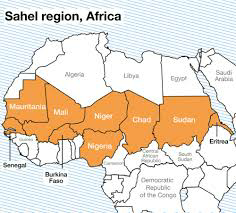
The Sahel Zone is a vast strip of land, with steppe vegetation, south of the Sahara Desert in Africa. In practice, however, the interest of this region of Africa has to do with the political instability that characterizes it, the extreme poverty, the intensity of the experience of climate change, accompanied by changes of power through coups, constantly producing extremist elements that fuel terrorist and guerrilla movements operating in Africa and on other continents.
The Background
The “Sahel Zone” consists of the states of Niger, Chad, Mauritania, Burkina Faso and Mali. The characteristics of these countries are extreme poverty and extremely low average age of their population. More specifically, Mali has an annual per capita income of US $ 859, while Niger has a US $ 565 per capita and a corresponding low average age of 15 years, ranking first in the world for Chad, which is the second largest in the world. 15.8 and for Mali the 16.3 years respectively. Mali, made up of two ethnic groups, the Touareg Berbers in the north and the African tribes in the south, faced an al Qaeda-instigated Islamic insurgency in the north, which disbanded the National and mainly the African army and directly threatened the African South.
France intervened with the Cerval operation to stop the Islamists. The United Nations sent a force of 12000-15000 soldiers (MINUSMA). The situation seemed to stabilize as a peace agreement was signed between the warring parties, with France replacing Operation Serval with a new Berkhane operation. However, political instability in Mali continued with coups and Russian and Turkish involvement in the region, with political problems and terrorist attacks in Chad, Burkina Faso and Niger. The Sahel countries united and formed the G5 Sahel group, led by France.
The G5-Sahel
These countries, aiming to limit the activity and spread of radical Sunni Islam as well as Islamic jihad in West and Central Africa, created in 2014 the formation of the G5-Sahel group, a politico-military organization. The G5-Sahel is led by France, with US support, while the Armed Forces of the “Sahel” countries have so far failed to deal effectively with the large number of extremist organizations operating in the region.
The main rival of the G5-Sahel and France leads, is the Islamic State of Greater Sahara (ISGS), which moves in almost the entire Sahel area, providing shelter to all Islamist-fighters of International Terrorism. This organization has a centrally controlled political and military structure. Most of its fighters have significant combat experience from the events of the Arab Spring in the North African states (Algeria, Libya, Egypt, Tunisia, Morocco, Mauritania). France operates in the Sahel Zone, through selected surgical strikes on bases maintained by ISGS in the region.
In addition, France provides advisory, military and financial assistance to the governments of the Sahel countries. More specifically in Mali, France has created the Takuba Task Force with the participation of EU member states (Belgium, the Netherlands, Germany, the Czech Republic, Denmark, Estonia, Portugal) and with the recent participation of Greece, with the aim of the country’s armed forces to acquire the necessary operational autonomy to better deal with terrorist organizations in the region.
On October 8, 2021, the French force announced that in Burkina Faso, a key member of a terrorist organization, Omaro Mobo Monti, who specializes in the placement of improvised explosive devices, was killed after a clash. Its neutralization was achieved with the cooperation of the Armed Forces of Mali and the United States. Improvised mines are the main weapon used by jihadists operating in the area. The victim was a member of the Ansar al-Islam terrorist organization founded in 2016 in Burkina Faso.
In recent years, the Turkish National Intelligence Service (MIT) has been operating in the Sahel Zone under the cover of Turkish troops based in Mali, acting in support of the UN MINUSMA mission. MIT’s work includes advising and providing financial assistance to specific radical Islamic organizations in the region, maintaining channels of communication with many former jihadist fighters who have acted internationally and taken refuge in the region.
Why these Sahel countries must be supported
The reasons are obvious. The Sahel countries are primitive demographic bombs that, if not stabilized politically and economically to enter a development trajectory, then to hold their populations within their borders, will create millions of refugee flows to Europe and neighboring countries or cling to terrorist Islamist organizations. Stability and security are key preconditions for any development and ultimately the restoration of a standard of living, but above all hope for the people of these countries.