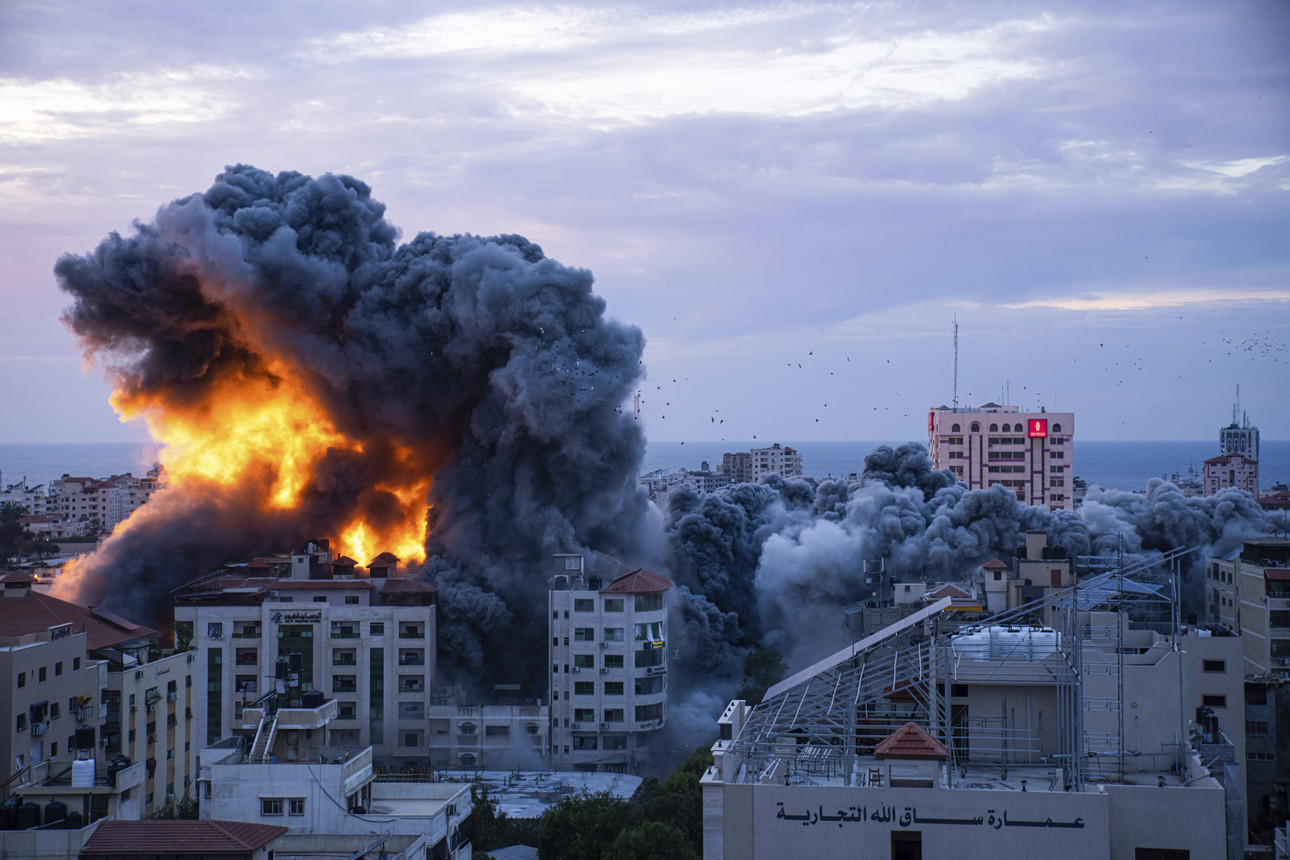
As Israel has made a general mobilization declaring that “we are at war” but also with absolute clarity statements that “this time we will destroy Hamas for good” and that “every member of it is already dead”, commitments basically both to the interior of the country as well as to the international environment. However, the problems and impasses they project for the entire Middle East are too many and we mention them in the form of development scenarios:
Scenario 1: Israel invades Gaza and succeeds in exterminating Hamas
It is the theoretical demand and the promise given today by the Israeli leadership. However, something like this with a large invasion and systematic “hunting” of Hamas and the other terrorist groups in Gaza will have a sea – not a river – of blood. Israeli soldiers (because they will find a lot of resistance), civilians (who will have nowhere to go something that is already happening) and of course terrorists, but also anyone else who will take up arms against Israel. And such an outcome risks igniting seismic reactions among Arab masses throughout the region that will either “overthrow” their regimes or force them to confront Israel. Not necessarily with weapons, but by submerging any process of rapprochement and peace.
Let us recall here that a few years ago in Egypt the Sisi regime was imposed by coups of the “Muslim Brotherhood” in the midst of huge riots and many dead, Jordan remains a country with a significant number of Palestinians, while a third of Lebanon is controlled by Palestinian organizations. All this, because no one knows what reactions there will be in Saudi Arabia with its religious fanaticism, in Iraq, in Iran obviously, in Libya and so on.
So the “ideal” scenario for Israel involves a great fear of returning somewhere in 1967, when it was completely isolated in its region, living invasion after invasion, with the entire Middle East ablaze with fanaticism and its own “Big Idea”.
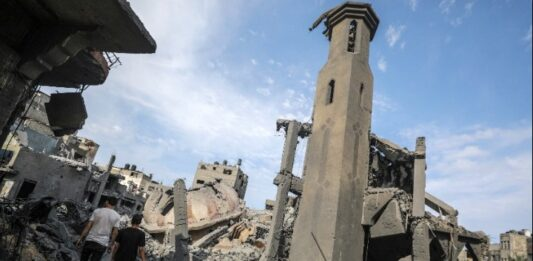
Scenario 2: Israel invades Gaza, destroys significant part of Hamas, leads to ceasefire
It is the most likely scenario historically, a revival of what has been done in previous “Gaza wars”: in 2008 with Operation Cast Lead, in 2012 with Operation Pillar of Defense, in 2014 with Operation Protective Edge ». Where massive bombings, many dead Palestinians, rocket fire by Hamas, casualties by Israel, global discomfort with the way the conflicts were conducted, all resulted in a win for both sides. Since both sides presented it like this, Israel that “we gave them a strong lesson”, and Hamas that “we endured this round as well”.
Here, of course, the severity and brutality of Hamas’ attack and its massacres require a very heavy response, which even if it ends in a truce at some point, may give the terrorist organization the advantage of interpretation. As in her own narrative – which has a very large audience in the Muslim world, especially among young audiences – she will say that “Israel promised our annihilation, it did not succeed, so we were vindicated”. And of course Israel will be waiting for the next round of attack, in a few years from today, amid a rampage of armaments and militarism.
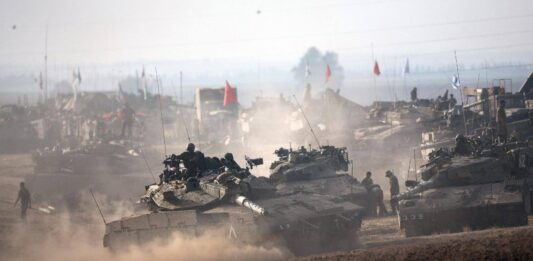
Scenario 3: International intervention that forces peace talks or even a truce
This scenario is also somewhat possible, but it will take time to convincingly organize an international coalition with a competent diplomatic reserve. But the crucial issue here is the absence of Russia. Which will hardly find itself at the same table as the USA to compose, even behind the scenes, a “solution”, even a Mediterranean one. When in fact at this moment the turmoil in the Middle East creates an extra pole of focus for American interventionism and relieves Moscow.
But the US itself no longer has the political weight and such internal solidity to impose a solution on the Middle East. The Biden administration is “open” on many fronts, in the Republican camp the phenomenon of absurdity called Trump is galloping, who also declares that he is ready to “crush Iran”, i.e. to pour more gasoline on the fire in the Middle East. Europe is unfortunately far from its power and is oriented towards the Ukrainian, while China will hardly interfere in such cases, as it will not risk its own political capital. So, even if there is an international diplomatic intervention, it cannot be ruled out that it has “weight”.
Scenario 4: Political upheaval in Israel amid war
Although the Netanyahu government has temporarily rallied Israeli society, already criticism against it is fierce. The formation of an “emergency government” with little opposition participation (by Benny Gantz, head of the National Unity party that had come 4th in the 2022 elections) does not solve any problems. While the leader of the opposition, Yair Laipid, head of the second party in power, the centrist Yesh Atid, refused a place in the emergency government, as he sees the dominance of extremist elements in it.
Also, the revelations that Netanyahu had received messages from the Egyptians that “something big is being prepared”, but he either ignored it, or believed that it concerned the West Bank, that is, where the small parties of the Israeli far-right have their great electoral power. support, it is not a simple thing, nor will it overcome them easily.
Of course, the shock of the Israeli society from the massacre is still great and everyone has been carried away by the war preparations, but the country has a tradition of liberalism and control of state power. The populist Netanyahu – probably the worst in power for Israel since the Sharon era – is already charged with the country’s insufficient preparation for mass terrorist acts (from the right) and his own service to every far-right request, but above all the methodical worsening of relations with Palestinian community inside Israel (from the left here the criticism). So we cannot overlook the possibility of a political crisis in the country, with an unknown outcome.
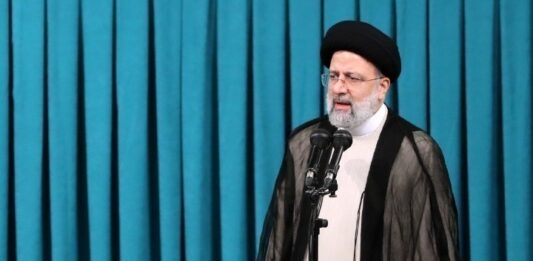
Scenario 5: Involvement with Iran
It’s the worst case scenario right now, in any version. From Israel’s “preemptive” or “retaliatory” strike on Tehran, in an operation that is almost popular reading in the Middle East and has been expected for years, to the US doing something similar, which is “crowded” in the region . Interesting here is the direct communication between the President of Iran and the crown prince of Saudi Arabia, something of great symbolic importance for the Middle East and the Muslim world in general. The two countries, one leader of the Shia crowd, the other of the Sunni (the two main Islamic sects), are making a resurgence of their bilateral relations (for years hostile), already in a “thaw” phase, but something that has “frozen” » Israel and especially Washington.
Thus a strike on Iran, even a preemptive strike, can create a sudden “grand coalition” in the Middle East that no third party wants to see materialize. And with Turkey… eager to lead as a defender of the Palestinian demand, but mainly as a champion of Islamic purity, in Erdoğan’s own description.
The only way out and the hardest choice
If at the moment everyone is talking about “blood”, Israel rightly so after the improbable human attack by Hamas, the Palestinians as they see that another centenary of theirs has already begun, Hamas and the chorus of other terrorist organizations, who are happy because they succeeded “a heavy blow to world Zionism”, the only way out with perspective, is the search for a solution to the Palestinian issue.
It may sound strange, in the face of the beginning of the war, to talk about “peace”, but this new crisis could become a catalyst to repeat the rapprochement process. Once started at Camp David in 1978 (between Israel and Egypt), continued in 1993 in Oslo between Israel and the Palestinians (of the PLO), and buried in 1995, with the assassination of Israeli Prime Minister Yitzhak Rabin by a domestic far-right. We write it, of course, because it needs to be written, even if history has taught us that any reflection on peace requires a blood cycle first, with direct proportionality. That is, the more blood, the more people will be convinced of the need to prevent new bloodshed.
The above endless multiples cannot be charged unilaterally, although distinctly today Hamas took the “monster” step. They are impasses of both Arab nationalism and Israeli chauvinism and religious fanaticism on both sides and the conflict of the mutually negating truth of the great monotheistic religions, but also of the current social despair for the “zero of the future”.
It is dead-end inherited from the great games of the “Great Powers” to divide the robes of the Ottoman Empire, which continue to this day, as they all seek influence, resources, control, subservience. They are impasses of historical memory, where the populations of the region remain “imprisoned” in insatiably intense narratives of sacred texts, traditions and myths, conflicts from millennia ago, heavy historical traumas, geographical self-determination in terms of absolute ownership, identity searches that produce more paradox than explanation. And with immersions in pools of blood that even the most tolerant and forgiving can hardly overcome.