The recent deployment of nuclear units on the global geostrategic chessboard, manifested by the United States deploying nuclear weapons in the United Kingdom and Russia conducting nuclear submarine exercises off the coast of Florida, had marked the culmination of the competition between these major nuclear powers. From the perspective of Aggressive Realism, these actions did not reflect miscalculations or misunderstandings, but strategic clarity: imposition on an anarchic system requires aggressive capability, proximity, and significant coercive power.
This analysis does not reject the liberal view of nuclear weapons as primarily deterrent tools, but at the same time supports their full and binding use in a first strike should a nuclear power face an existential threat. In this case, there is no turning back, and a nuclear response is guaranteed, effectively destroying the planet through food elimination, water poisoning, shelter destruction, radiation sickness, and nuclear winter.
Furthermore, this analysis debunks the myth of “tactical nuclear weapons.” Nuclear weapons are inherently strategic, their effects uncontrolled, transnational, and time-persistent. Should NATO or the United States pose a serious conventional threat to Russia’s territorial integrity or the survival of its regime, Moscow’s response will not be gradual or limited, but full-scale existential. Nuclear war, once started, will not and cannot be compartmentalized. Nor will there be a return to normal life.
1. Aggressive Realism and the Return of Proximity Coercion
Aggressive Realism argues that great powers seek regional hegemony and will act preemptively to deny other states the same privilege (Mearsheimer, 2001). The reintroduction of US nuclear weapons to RAF Lakenheath in the United Kingdom after decades of absence is not a symbolic act but a strategic promotion of proximity coercion.
This redeployment serves a clear purpose: to compress response times, deny Russia a sanctuary within its borders, and reassert US nuclear dominance in the European theater. NATO’s eastward expansion, combined with its integrated missile defense and surveillance systems, promotes a logic of encirclement, aimed not at deterrence but at dominance.
Russia’s response, with nuclear submarines conducting exercises just 66 miles off the coast of Florida, reflects this logic. It is the natural reaction of a major nuclear power signaling its readiness to retaliate in kind, on the adversary’s doorstep. The Atlantic & Pacific Oceans no longer protect the US homeland and Europe accepts the deployment of nuclear weapons, creating a major threat to Russia.
2. There are no tactical nuclear weapons
Much of the Western narrative clings to the idea of “tactical” nuclear weapons, that is, weapons systems of relatively low yield (0.3 with a limit of 50 kilotons) for nuclear data, with precise guidance and with the assumption that they can be used in battlefield conditions. This is a dangerous delusion.
Whether a nuclear device yields 0.3 kt or 50 kt or more, its use immediately introduces uncontrolled strategic-level consequences:
- Direct radiation, dispersion of radioactive contaminants and long-term environmental poisoning (Cesium-137, Strontium-90) spread unpredictably beyond national borders and geographical constraints.
- The psychological and political shock collapses conventional frameworks of command and control, rapidly escalating the logic of retaliation.
- Geophysical effects (atmospheric currents, groundwater contamination) cannot be isolated to battle zones.
- Weapons like the B61-12, although “advertised” for precision and adjustable yield, do not escape this logic. A 0.3 kt hit, like the equivalent radiation from Chernobyl, over a point on the battlefield does not remain “local” when the radiation will enter air currents and panic civilian populations hundreds of kilometers away. Of course, earlier, these civilian populations may not even exist.
There is no such thing as a tactical nuclear warhead, only strategic nuclear warheads with delusional limited-use doctrines.
3. Nuclear weapons are not tools for controlled escalation
A popular belief among some analysts is that nuclear weapons, due to their devastating consequences, will never be used and that modern wars will thus remain conventional. This belief is intellectually appealing, emotionally comforting, and militarily naive.
It is true that no state would use its nuclear weapons frivolously. Their use entails systemic collapse and existential risk. However, if a nuclear-armed state such as Russia were to face:
- A conventional invasion supported by NATO,
- The loss of key military-industrial cities (e.g. Rostov, Belgorod),
- A threat to the survival of the regime and the annihilation of society,
- then the logic of Aggressive Realism holds: limited retaliation will be rejected.
- No state will initiate the use of nuclear weapons with the intention of using just one. A nuclear first strike, even with the lowest yield, signals a transition to all-out war.
If forced into a corner, Russia’s most logical move would be to immediately escalate its nuclear arsenal to full scale, targeting Western Europe and U.S. military infrastructure. There would be no more possibility of a ceasefire, no more conditions for coercion of mutual destruction.
Nuclear war is not a “stepping stone.” It is a precipice. Once crossed, the only logical path is to escalate to full scale to ensure the most favorable or sustainable end result, which is already a very strong oxymoron.
4. The Strategic Geography of Escalation
Russia would be unlikely to strike Kiev with a nuclear warhead of any yield because of the uncontrollable effects of radiation.
This strategic calculation explains President Vladimir Putin’s decision to refrain from using nuclear weapons during the Oreshnik strike on Kiev. This offensive did not even use explosive ordnance, it used only the kinetic energy of the warheads.
A nuclear explosion over Ukrainian territory would have severe radiological consequences far beyond the intended target zone. Given the atmospheric conditions prevailing in Eastern Europe, such an explosion would likely have dispersed a radioactive cloud over Europe, Belarus, southern Russia, and possibly even as far as Moscow, thereby endangering Russian citizens and undermining domestic and regional stability.
Rather than signaling weakness, this limitation underscores the fundamental reality that nuclear weapons, regardless of their yield, cannot be used in a controlled manner. Their effects are inherently geographically uncontrollable in at least four dimensions (air, land, aquifers and reservoirs, duration of contamination). Consequently, the concept of “tactical” nuclear use collapses under the science of nuclear physics.
Once the nuclear threshold is crossed, escalation is not gradual but immediate and total. Nuclear war, therefore, does not occur in discrete phases; it enters as a total catastrophe, which explains why its threshold remains so high.
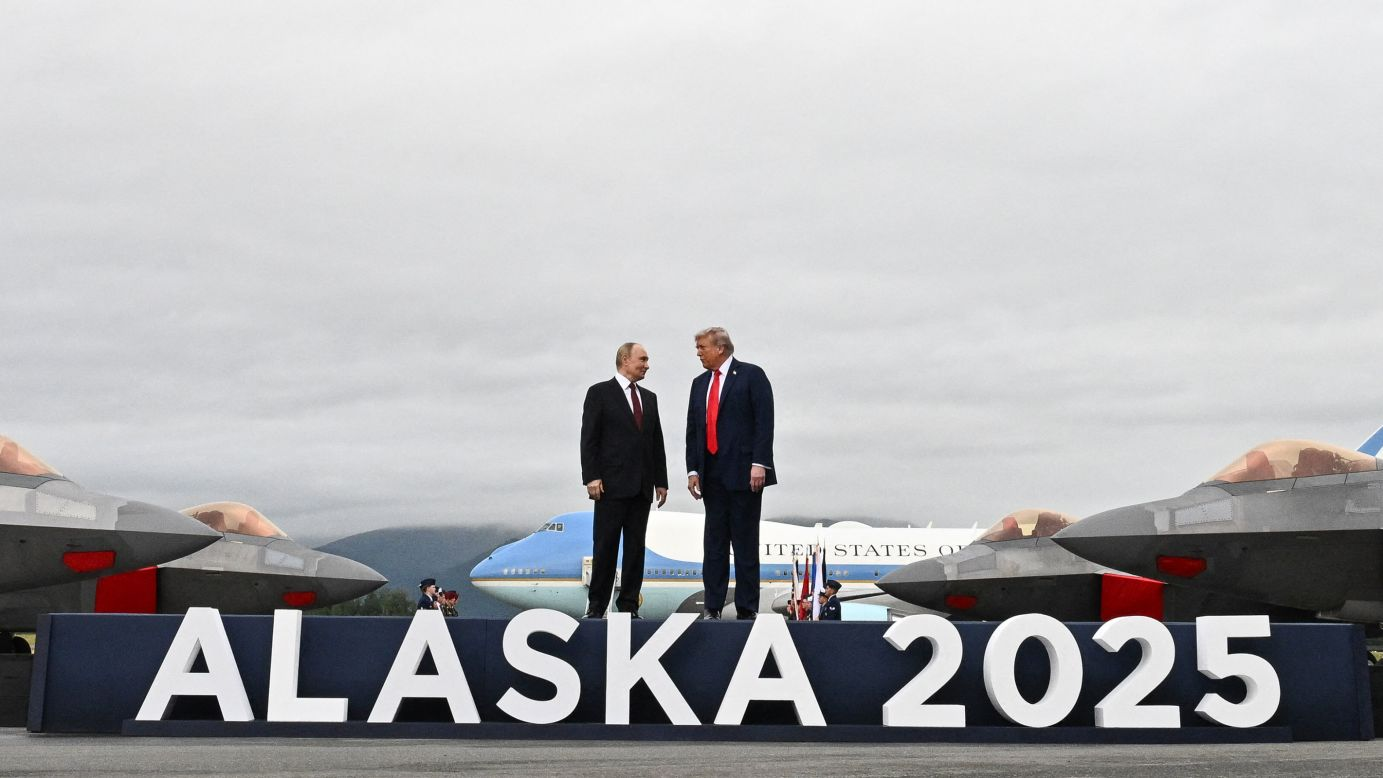
5. Alaska 2025: A Summit Born of Nuclear Threat
The Alaska summit in August 2025 between US President Donald Trump and Russian President Vladimir Putin was not a diplomatic advance in international relations. It was a strategic intervention, a last-ditch, high-stakes effort to halt the momentum toward nuclear war before the logic of Aggressive Realism consumed both nations.
Why personal diplomacy? Because institutions had failed.
- The attack on Russian nuclear-capable aircraft by drones has put a big question mark on every nuclear arms control and limitation treaty, such as New START, which expires in February 2026. In general, even Foreign Affairs analysts do not attach much importance to such treaties.
- The INF Treaty (Intermediate-Range Nuclear Forces) has expired. The United States officially suspended the treaty on February 1, 2019, and Russia did so the next day in response. The United States formally withdrew from the treaty on August 2, 2019. Russia announced that it would no longer abide by the treaty on August 4, 2025.
- The P5 treaty, which refers to the joint statement of the five permanent members of the UN Security Council (P5) on the prevention of nuclear war, is generally seen as a positive step, but its effectiveness is questioned. While the statement, which includes the statement that “a nuclear war cannot be won and must never be fought,” is seen as an affirmation of nonproliferation goals, some argue that it lacks force due to the continued modernization and expansion of the P5’s nuclear arsenals.
Thus, in the absence of institutional mechanisms, ad hoc diplomacy became the only available crisis management tool.
Alaska was not chosen as a symbolic or logistical convenience. It was chosen precisely because it embodies the new strategic reality: the US and Russia have no oceans behind which they could hide in the event of a nuclear war.
6. Conclusions
This analysis has argued that the liberal conception of nuclear weapons as instruments of sustained deterrence is not entirely dangerously flawed. When a great power faces an existential threat, whether through conventional invasion, loss of strategic territory, or direct challenges to regime survival, their use will be necessary.
Under such circumstances, the use of nuclear weapons is not a last resort to be gradually calibrated, but a comprehensive and immediate response. There are no tactical nuclear weapons, only strategic nuclear weapons cloaked in doctrinal illusions. The physical realities of radiation, atmospheric dispersion, and uncontrolled escalation ensure that any nuclear explosion, regardless of yield, is subject to neither physical nor strategic limits.
The myth of controlled escalation must be dispelled. Nuclear war does not unfold as a ladder of measured steps, it is a cliff. Once the first warhead explodes, the momentum toward a full-scale exchange becomes almost unstoppable. Command structures collapse, panic spreads, and the logic of retaliation trumps diplomatic resolution.
In this context, the “Alaska 2025” summit between Presidents Trump and Putin stands out not as a diplomatic triumph but as a desperate, last-ditch intervention in a system where institutional nuclear arms control has collapsed. With the INF Treaty abrogated, New START imminent, and multilateral forums like the P5 and the UN paralyzed by mistrust, individual diplomacy has become the only remaining safety net in an overloaded circuit.
The choice of Alaska, on the geographic border between two nuclear superpowers, symbolizes the central truth of the current era: there are no oceans for the US and Russia to hide behind. Even the Arctic is no longer a frozen frontier.
Strategic depth has evaporated in the age of hypersonic missiles and stealth submarines.
The symbolism is striking. The B-2s and F-22s did not fly over Putin for effect, nor did the meeting happen by chance at Joint Base Elmendorf-Richardson, which houses NORAD in Alaska.
Sources – References
- Mearsheimer, J. J. (2001). The Tragedy of Great Power Politics. W. W. Norton.
- Kristensen, H. M., & Korda, M. (2024). “United States Nuclear Weapons, 2024.” Bulletin of the Atomic Scientists, 80(2), 98–110.
- Freedman, L. (1983). The Evolution of Nuclear Strategy. Palgrave Macmillan.
- Tannenwald, N. (1999). “The Nuclear Taboo: The United States and the Normative Basis of Nuclear Non-Use.” International Organization, 53(3), 433–468.
- Lieber, K. A., & Press, D. G. (2006). “The End of MAD? The Nuclear Dimension of U.S. Primacy.” International Security, 30(4), 7–44.
- https://www.norad.mil/About-NORAD/Alaskan-NORAD-Region/
- https://www.marinecorpstimes.com/news/pentagon-congress/2025/08/15/b-2-fighter-jets-fly-over-as-trump-putin-summit-begins/