



New tension has emerged in relations between Armenia and Azerbaijan, two years after the end of the second major war between the two countries in 2020. A war that ended with thousands of casualties on both sides, with Azerbaijan managing to wrest territories until now held by the Armenians from the previous war and Russia to assume the role of essentially the guarantor of the cease-fire, to the extent that it maintains relations with both sides.
The core of the war and an open wound since the time of the Soviet Union is the existence of two enclaves that do not communicate with the countries to which they refer. This concerns the Armenian enclave of Nagorno-Karabakh which is formally part of the territory of Azerbaijan and the autonomous republic of Nakhchivan, to the east of Armenia which formally belongs to Azerbaijan, although it has no territorial continuity with it. Especially the region of Nagorno-Karabakh was the main dispute of the first major conflict between the two countries that started in 1988 when they were still part of the USSR and continued until 1994 (please also read the analysis titled “The Geopolitical Benefits Turkey expects to reap from the West through the Armenia-Azerbaijan War in the Caucasus“).
The new tension
The ceasefire in 2020 did not mean the end of tensions. The latest source of tension has to do with the virtual exclusion of Nagorno-Karabakh and its approximately 120,000 inhabitants.
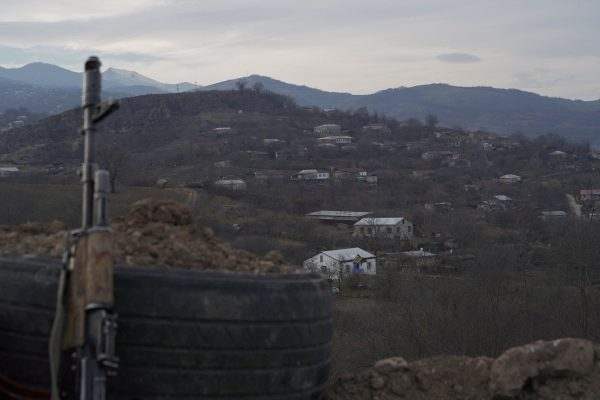
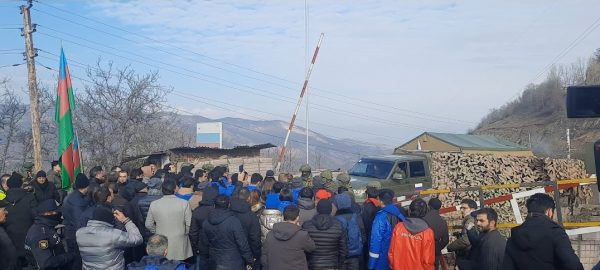
On December 12, “environmental activists” purportedly protesting illegal mining appeared on the road that crosses the so-called Latchin Corridor, which is the road connecting Armenia with Nagorno-Karabakh, and thus cut off Nagorno-Karabakh from access to essential supplies. Officially, the Azerbaijani government denies any involvement in the blockade, arguing that it is a legitimate environmental protest. The result is that Nagorno-Karabakh is facing a humanitarian crisis as critical goods such as medicine, baby milk powder are not arriving, while the power and gas cuts imposed by the Azerbaijani government are making matters worse. In fact, on January 30, the representatives of Armenia argued that this specific blockade essentially paves the way for the ethnic cleansing of Nagorno-Karabakh.
For his part, the leader of Azerbaijan Ilham Aliyev underlined that his country offers guarantees for the rights of those who choose to stay “under the flag of Azerbaijan” and that for anyone who does not want to become a citizen of Azerbaijan, “the road is open”, but , “to leave”.
However, despite the reactions of both the European Union and the United States, the blockade continues.
The geopolitical dimension
A crucial dimension that was captured in the second war between Armenia and Azerbaijan is that the way the two countries were related was also determined by their alliances. Azerbaijan emerged strengthened mainly because it steps on the alliance it has built with Turkey (let’s not forget that in Turkey the Azeris are considered the preeminent “brother nation” among Turkic countries) and Israel. In fact, for Turkey, the upgrading of relations with Azerbaijan is a key aspect of its attempt to acquire characteristics of a “regional power” in a wider region.
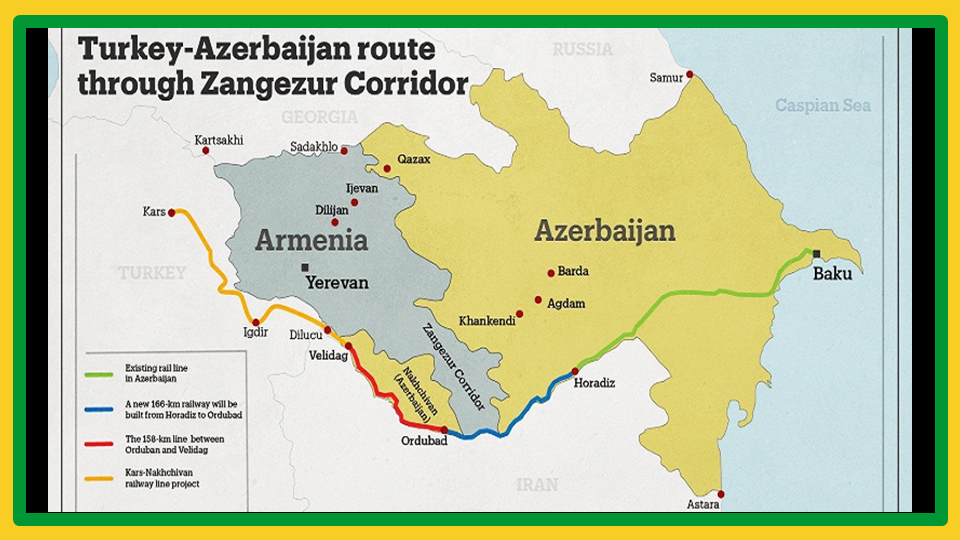
Against this backdrop, Azerbaijan is pushing hard to implement the “Zangezur Corridor” plan, arguing that it is also a commitment to the 2020 ceasefire agreement.
It is about the construction plan of a road and railway axis that, crossing southern Armenia, in the Siunik region, will directly connect Azerbaijan with Nakhchivan. Now a corridor connecting Nakhchivan directly with Azerbaijan would be of particular interest to Turkey, which borders Nakhchivan and could thus gain direct access to Central Asia through Azerbaijan, effectively bypassing Iran. In addition, Iran fears that an Azerbaijani-controlled corridor in the south of Armenia would undermine Iran’s access to Armenia and upset the current balance.
Anyway, relations between Iran and Azerbaijan have worsened lately not only because of moves like the push for the Zangezur Corridor but also because Azerbaijan after many years has returned to a redemptive rhetoric in relation to the significant number of Azeris living inside Iran, which has been of particular concern to Iran.
However, Iran is particularly worried about Azerbaijan’s good relations with Israel. Israel gets its oil from Azerbaijan and at the same time from the main arms suppliers to Azerbaijan. In addition, good relations with Azerbaijan allow Israel to use it as a monitoring station for Iran.
However, Iran has made it clear that it will not tolerate the road connecting it to Armenia being blocked, the Revolutionary Guards have held large-scale demonstrations near the border with Azerbaijan, and recently opened an Iranian Consulate in the southern Armenian city of Kapan. Iran has old ties with areas of Armenia, from the time when they were under Persian rule (note that Azeri culture is also heavily influenced by Persian) and relations between the two countries remain good, and trade between them has grown significantly , including major energy deals (Iran gives natural gas to Armenia and receives electricity). Of course, Armenia, which also invests in good relations with the West, avoids procuring weapons from Iran for fear of sanctions.
The role of Russia
Armenia is a member of the Collective Security Treaty Organization, in which Russia plays a leading role. For its part, Moscow insists on having a more mediating role, maintaining good relations with both sides, while it has also taken on the role of providing peacekeeping forces. At the same time, Russia, which claimed to be the main guarantor of stability in the wider region, is currently mainly focused on the war in Ukraine. This has caused enough resentment on the Armenian side that it would like to see Moscow take a more interventionist role and accuses Russia of not wanting to clash with Azerbaijan and Turkey. For its part, Moscow is trying to maintain balance in a complex conflict, where it must, while waging a very large-scale war, handle a web of contradictions between countries with which it wants to cooperate for different reasons and at different levels.


