



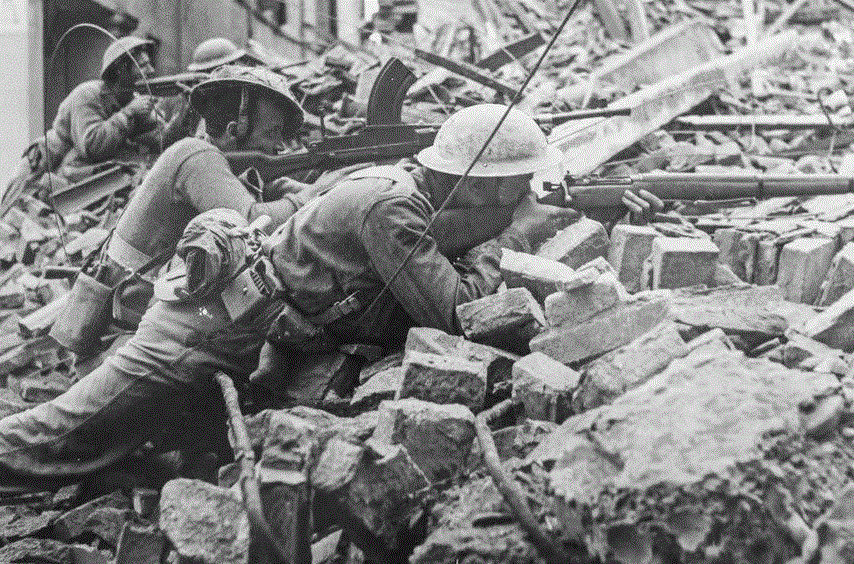
On September 21, 1944, during World War II, another glorious chapter of Greek military history was written on Italian soil when the men of the 3rd Greek Mountain Brigade succeeded in entering the city of Rimini, neutralizing the occupying German forces, and raising the Greek flag there.
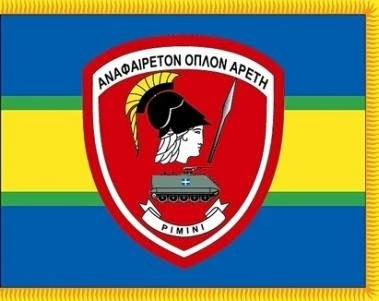
The legacy of the legendary ΙΙΙ Greek Mountain Brigade is carried on today by the 3rd “Rimini” Mechanized Infantry Brigade, based at the “Captain (Infantry) Anastasios Avramidis” camp in Kavyli, Orestiada (it falls under the operational command of the XVI “Didymoteicho” Mechanized Infantry Division).
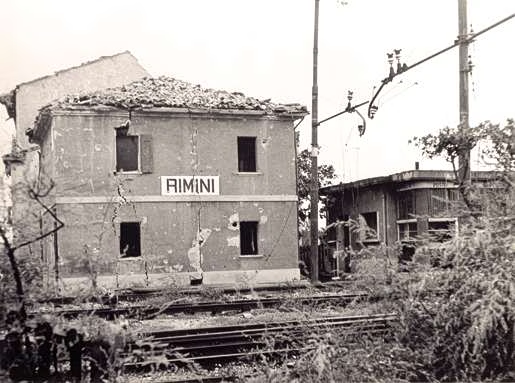
The Formation of the 3rd Greek Mountain Brigade
Following the suppression of the mutiny of April 6, 1944—which involved the disbanding of the implicated units, the disarming of their personnel, and their transfer to various internment camps—the Greek government initiated intensive efforts with the General Headquarters Middle East (GHQ ME) to reorganize the Greek Army in the Middle East and form new units capable of participating in Allied operations on various fronts.
Discussions between the Greek government and GHQ ME resulted in a decision to form a new mountain-configuration brigade. This unit was to be composed of selected officers and enlisted men drawn from the disbanded units or from units that had not participated in the April 6 mutiny, utilizing the 2nd Brigade as a foundation. The relevant GHQ ME directive was issued on May 31, 1944, and the formation of the new unit—designated the III Greek Mountain Brigade (III GMB)—proceeded immediately under the supervision of the British Ninth Army. The Insariye camp in Lebanon was designated as the site for the brigade’s formation, with Infantry Colonel Thrasyvoulos Tsakalotos appointed as its first commander.
The formation and manning of the brigade were completed on June 19. It was then transferred to Tripoli, Lebanon—specifically to the Mountain Warfare Training Center (MWTC)—for brief training in mountain warfare and preparations aimed at participating in Allied operations in Italy. Training and the completion of the brigade’s combat-ready organization were finalized on July 28, 1944.
The Transfer of the 3rd Mountain Brigade to Italy
On July 28, 1944, pursuant to an order from the General Headquarters of the Middle East Forces (GHQ MEF), the transport of the brigade’s equipment to the port of Beirut for loading onto ships began. The transfer of personnel by rail to the port of Haifa commenced on the morning of August 4. The brigade was transported by the Dutch ocean liner Ruys, which sailed from the port of Haifa at 04:45 on the 7th of the month, bound for Taranto, Italy, where it arrived on the morning of August 11, 1944.
It subsequently moved to the Spoleto area and was placed under the tactical command of Major General Weir’s 2nd New Zealand Division. On August 28, having been reinforced by three transport platoons from the division, it received orders to advance to the forward zone.
The Entry of the 3rd Greek Mountain Brigade into Combat
On September 3, the III Greek Mountain Brigade came under new tactical command, being placed under the 5th Canadian Division as a reserve unit, and was ordered to move to the Santa Maria Pietrafitta area, eight kilometers from the front line.
On the afternoon of September 7, the brigade commander was summoned to the headquarters of the 1st Canadian Division to be briefed on the tactical situation and his mission. Under this plan, the brigade was to move during the night of September 8–9 and relieve the 3rd Canadian Brigade, which had established defensive positions northwest of the town of Cattolica. Its mission was to cover the right flank of the 1st Canadian Division during the division’s planned offensive towards Rimini.
The Battle of Rimini (September 14–21, 1944)
On the night of September 13–14, the 1st Canadian Division concentrated in the area south of the Marano River, preparing to launch an attack at 06:30 on September 14. The III Greek Mountain Brigade (III EOT) was ordered to launch a night attack at 02:00 that same day, in conjunction with the III Canadian Brigade, which would operate on its left flank. The movement of the brigade’s units to secure the assembly area began during the final hours of the night of September 13–14.
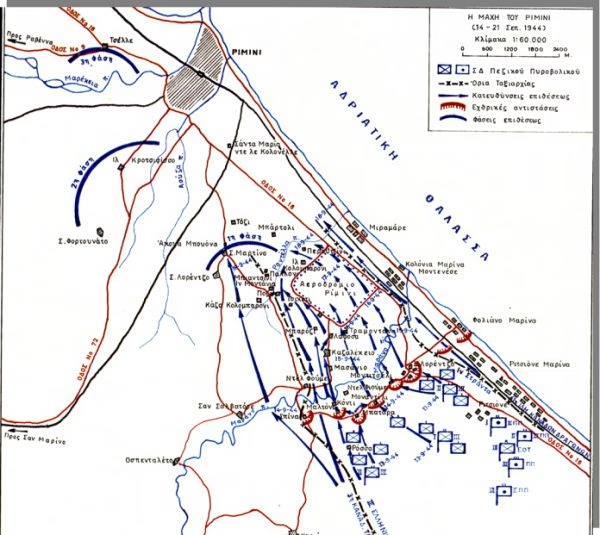
The brigade’s attack began at 16:00 on September 20th with the 1st Battalion, following a ten-minute artillery bombardment. Supported by tanks and after fierce fighting, it captured Santa Maria delle Colonnelle. The attack by the 2nd Battalion followed at 16:30, supported by artillery and tanks. Fighting heroically, the battalion neutralized German resistance in its sector and, by 20:00, had advanced to a position 1,200 meters southeast of Rimini, achieving the day’s first objective.
Rimini finally fell at 09:00 on September 21, 1944. Its capture—achieved only after fierce house-to-house and bunker-to-bunker fighting—was the hard-won prize of the III Greek Mountain Brigade’s struggle against an enemy that possessed strong defensive fortifications and defended its positions with tenacity.
On the afternoon of September 21, a ceremony was held in the town square, attended by delegations from Greek, Canadian, and New Zealand units, to honor the battle flag of the 2nd Battalion—the first unit to enter Rimini. From that time on, the III Greek Mountain Brigade became known as the “Rimini Brigade.”
The commander of the Allied forces, General Alexander, in his report titled “The Allied Armies in Italy from 3 September 1943 to 12 December 1944,” notes the following regarding the actions of the III Greek Mountain Brigade: “On September 20, after a desperate struggle, San Fortunato was cleared, and during the night the Greeks, under the command of the 1st Canadian Division, entered Rimini. I was delighted, because this success had so timely illuminated the destiny of this heroic country—which had been our only fighting ally during dark times—and because a new victory in Italy had been added to the glory won in the mountains of Albania.”
The casualties of the III Greek Mountain Brigade during the aforementioned operations were as follows:
| No. | Rank | Killed | Wounded | Total |
| 1 | Officers | 10 | 23 | 33 |
| 2 | Hoplites | 106 | 293 | 399 |
| Total | 116 | 316 | 432 |
Here is what the distinguished Greek politician and intellectual Panagiotis Kanellopoulos—whose insights are, as always, of particular interest—had to say about Rimini (in the context of the National Resistance of 1940–1944 and, specifically, the events that unfolded in the Middle East):
“Our ΙΙΙ Mountain Brigade—commanded by Colonel Thrasyvoulos Tsakalotos (with Lieutenant Colonel Nikolaos Papadopoulos—the legendary “Grandpa”—as deputy commander, and Lieutenant Colonel Gerasimos Lamaris as chief of staff)—wrote a glorious chapter in our military history by capturing Rimini after a fierce battle against the Germans.
That historic city—where Sigismondo Malatesta (the Lord of Rimini and an admirer of his intellect) reverently deposited the remains of Plethon (the eminent Byzantine philosopher and Neoplatonist scholar Georgios Gemistos) in a magnificent sarcophagus within the Church of San Francesco, having daringly seized them in 1464 from the enslaved Mystras; the city that had seen one of its own—the lovely Cleopa Malatesta—marry the Despot of Mystras, Theodore II (brother to the last two Byzantine emperors)—entrusted its keys and its destiny to Greek hands following the withdrawal of Hitler’s defeated forces.
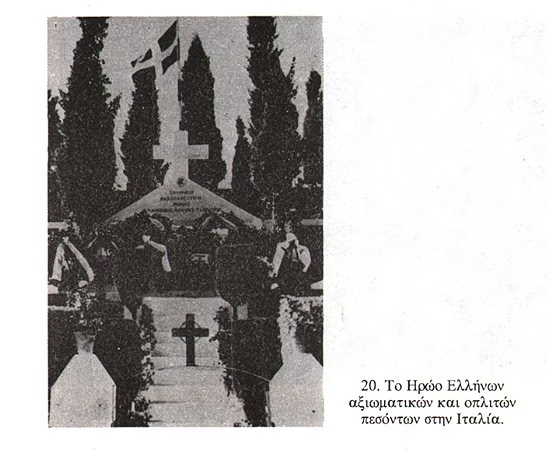
And there, in a Greek cemetery, the heroes of our Brigade who fell on the field of honor rest forever alongside Plethon. History devises things that no poetry could ever invent. And let me not fail to mention that during those same historic hours when our ΙΙΙ Mountain Brigade (comprising three powerful infantry battalions and an artillery regiment of three batteries) was defeating Hitler’s forces at Rimini, the “Sacred Band”—the Greek Army’s first-ever commando unit (and a substantial one at that)—was carrying out daring and difficult missions in the Aegean islands, continuing the glorious service it had begun in the African desert and Tunisia.”


