



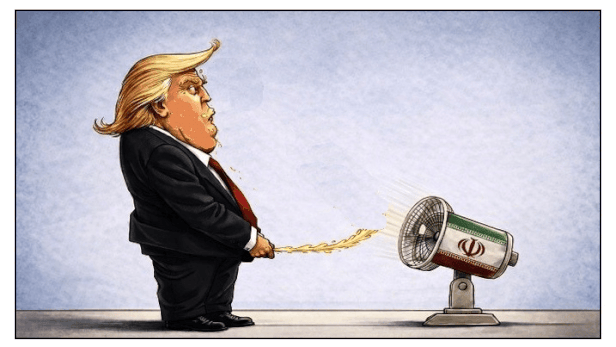
The war against Iran, presented as a demonstration of American power and determination, has turned into a conflict that has revealed the limits of US military supremacy and left behind a landscape of… geopolitical ruins.
In the new landscape that has now emerged in the Middle East, no one is strong enough to impose order, but everyone is strong enough to cause chaos.
Perhaps this is the most certain conclusion that can be drawn: that the Middle East has emerged from this war more unstable, more dangerous, and more unpredictable than ever… to a point where all the great powers are paying a heavy price and no one can impose its own order of things.
Trump’s “Failed” War on Iran
The situation after Donald Trump’s war on Iran is completely different for the US. The United States is in an unquestionably weaker position than it was before it started this conflict, while its key strategic objectives have been damaged (please also read the analysis titled “Why Iran could be the biggest US military and political defeat since Vietnam?“).
Unlike the 1990-91 war to liberate Kuwait from Saddam Hussein, where the destruction of the Iraqi army stunned the world, the technological superiority of American weapons in the war with Iran was overshadowed by the limited reserves and weaknesses of the American war machine.
The image that will remain from this conflict will not be technological superiority, but the bloodstained schoolbags of Iranian schoolgirls killed because of an apparent database error.
At the same time, although American defense systems performed satisfactorily against Iranian missiles and suicide drones, Iran managed to penetrate them in critical situations, raising questions about their effectiveness in a larger or longer war.
At the strategic level, the consequences are even more serious.
The United States achieved a form of “regime change,” but not the one it sought. Rather than turning Tehran into a docile ally, the war strengthened the most hard-line forces, as a result of which the Islamic Revolutionary Guard Corps gained even greater influence.
The American and Israeli strikes, however effective they were in the early days, revealed the limits of purely military solutions.
Iran’s nuclear program has now survived two waves of joint Israeli and US air strikes, and a third attempt is considered unlikely to have a very different outcome.
Washington decided on the conflict expecting a demonstration of overwhelming military dominance. What it received was a brutal lesson in strategic failure. American deterrence has been shattered, its credibility seriously damaged, its aura of invincible military power stripped away in the eyes of the world.
The loss or degradation of military bases throughout the Arabian Gulf is not just a military setback; it is a historical humiliation far greater than that of Vietnam or Afghanistan. Facilities that once symbolized American power have now become monuments to strategic miscalculation. US allies in the Gulf are wondering whether American protection is worth anything. Meanwhile, adversaries have now learned that the US can be challenged and will survive politically and strategically unscathed.
Most humiliating of all, Washington has allowed itself to be dragged into a disastrous confrontation while bearing the overwhelming share of the costs.
A blow to American global leadership
The implications for US global leadership are even deeper. Regional allies, many of whom are said to have opposed the campaign, have borne much of the cost.
More importantly, Iran has realized that its ability to disrupt shipping in the Strait of Hormuz could give it enormous economic influence globally.
Freedom of navigation has been a fundamental US strategic goal for more than two centuries. The potential restriction of free passage through the Strait of Hormuz could signal the transformation of trade routes into a geopolitical weapon, with serious and lasting consequences for global trade.

Defeat for US, Israel
With the announcement of a framework agreement to end the war in Iran, the prevailing view is that the United States and Israel have been defeated.
According to this view, the tactical and operational successes achieved by the American and Israeli armed forces masked a deeper strategic failure, as neither country achieved the political goals it invoked to justify the war.
The Iranian regime survived and emerged from the conflict even more hardened, while gaining a new and powerful bargaining chip: the ability to close the Strait of Hormuz.
The United States has once again found itself embroiled in a costly conflict in the Middle East, which has damaged its credibility with its partners, weakened its deterrent power against its adversaries, and reduced its operational readiness in the Indo-Pacific.
At the same time, Israel’s efforts to promote normalization of its relations with Saudi Arabia and other Gulf Arab states appear to have suffered a new setback, while it has failed to eliminate the Iranian threat to the postwar regional order.
However, focusing solely on U.S. and Israeli losses overlooks the fact that almost everyone involved lost.
The war left every major player further from the strategic goal it sought. It did not produce a clear winner or create a more stable regional order.
Instead, it accelerated fragmentation, increased insecurity, and imposed costs on all major regional and global powers, including Iran, the Gulf Arab states, Russia, and China.
The war demonstrated that no country can navigate the new era of global instability unscathed.
Iran’s Survival at a High Price
Iran may have avoided regime collapse, but it did so in a way that limited its future options. Survival came at the cost of:
- weakening relations with its allies,
- a more unstable deterrence environment,
- economic devastation, and
- fewer possibilities for national recovery.
Neither China nor Russia were willing to protect Iran from American and Israeli attacks, demonstrating that these relationships are more transactional than true alliances.
After the war, Tehran will need to rely even more on its partners, but from a position of greater weakness and reduced bargaining power.
The economic costs could prove existential. The war has accelerated the collapse of the rial, fueled inflation, and damaged key industrial infrastructure, including steel mills, shipyards, and energy facilities.
If estimates of more than a million jobs lost during the conflict are confirmed, it would be one of the most economically destabilizing periods in the Islamic Republic’s history.
At the same time, the regime is not necessarily more secure. The war appears to have strengthened the power of Iran’s military-security elite, strengthening its control over the state in the short term.
However, systems dominated by security apparatuses often struggle in the long term to manage popular discontent, economic reform, and political adjustment.
Thus, Iran may emerge from the war more militarized, but at the same time more fragile.
Russia and China: Short-Term Gains, Long-Term Losses
Russia’s position has proven more complicated than it first appeared. Moscow has benefited from a temporary rise in oil prices and limited sanctions relief.
However, the war has accelerated developments that are undermining Russian influence in the Middle East. Russian anti-aircraft systems in Iran have proven ineffective against American and Israeli attacks.
At the same time, Ukrainian President Volodymyr Zelensky has used the conflict to promote cooperation with key Gulf states and Syria on drone defense, further limiting Russian strategic margins.
Russia’s support for Iran has angered Gulf Arab states, particularly after Moscow vetoed a UN Security Council resolution on April 7 to reopen the Strait of Hormuz.
The war has also exposed the limits of Russian diplomatic influence, as Moscow played no significant role in shaping the final outcome.
The picture is similar for China. Beijing has benefited in the short term by appearing more stable and restrained than the United States.
At the same time, the erosion of American military preparedness in the Indo-Pacific has improved China’s relative position. However, it has also suffered significant losses (please also read the analysis titled “Why is the Persian Gulf War targeting China and not Iran’s nukes?“).
The conflict has jeopardized billions of dollars in investments in Iran under the Belt and Road Initiative. It also soured relations with the Gulf states, as Beijing failed to persuade Tehran to reopen the Strait of Hormuz and joined Russia in vetoing it at the UN.
This exposed the limits of Chinese influence in Iran and caused strong resentment among Arab leaders, who felt that China was either unable or unwilling to protect their economic interests and their own investments.
Confronting History
History is rarely kind to great powers that overestimate themselves. The verdict will be harsh:
- The United States lost prestige, lost deterrence, and lost strategic depth.
- Iran survived, resisted with high Prce and emerged as the geopolitical victor.

