




The BRICS countries (Brazil, Russia, India, China, South Africa) have surpassed the economic power of the G7 in terms of GDP (Market Power Share), with their share reaching 40% of global GDP compared to 29% for the G7. This historic shift is mainly due to the rapid economic growth of China and India, which are the main drivers of the group. According to World Bank data, the GDP of the BRICS increased from 16% of global output in 2000 to 35% by 2022, posing a significant challenge to the dominance of Western economies.
Economic Rebalancing and Geopolitical Tensions
The rise of the BRICS comes at a time of increasing geopolitical tensions, particularly US sanctions against Russia and the US-China trade war. This demonstrates the inability of the US and its economies to properly assess contemporary economic challenges. In 2023, there was a 10% drop in “dollar” trade between the BRICS countries compared to 2019, indicative of “de-dollarization” efforts. Russia and China have intensified the use of national currencies in bilateral transactions, while the BRICS are promoting the use of a common settlement platform, steadily reducing dependence on the dollar.
Historical Context and Demographic Power
Founded in 2006, the BRICS group now represents over 40% of the world’s population, as a relevant UN study points out in 2024. This demographic superiority, combined with control of critical resources (e.g. Russian hydrocarbons, Chinese rare earths), strengthens their position as global players. Furthermore, the recent accession of new members (e.g. Egypt, Iran, UAE) since January 2024 indicates their long-term strategy of expanding their influence.
Challenges and Doubts
Western analysts point to internal inequalities (e.g. unemployment in South Africa, China’s debt, heterogeneity of political systems) thus remaining blind to the new dynamics, as if the West is free from such problems… However, despite the limited perspective of “Western analysts” the common opposition to Western arrogance seems to unite the members, with initiatives such as the BRICS New Development Bank (total loan commitments of 32 billion dollars since 2015) underlining their separatist course.
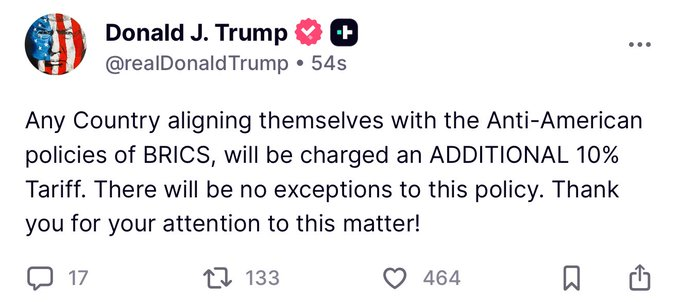
It is not at all a coincidence that the US President made a very recent post in which he threatens the economies of other countries. It is not a coincidence but characteristic of panic and economic arteriosclerosis:
Prospects for a Multipolar Order
The comparative weakness of the G7 in terms of GDP is somewhat symbolic, but it clearly reflects a deeper trend: the multi-polarization of the world economy. With Asia now accounting for 50% of global GDP and the West facing demographic and production challenges, the BRICS may redefine the rules of the global economic game. However, their long-term success depends on their ability to convert economic mass into political and technological hegemony.
The situation highlights the aging and increasingly ineffective economic hegemony of the United States, based on the harsh interventionist political arrogance it acquired after World War II.
Additional Facts:
- Investment in Infrastructure: China has invested over $1 trillion in the “Belt and Road Initiative,” strengthening connectivity with other BRICS countries.
- Technological Competition: India and China now account for 25% of global AI applications (UNCTAD, 2023).
- Energy Transition: BRICS control 60% of global renewable energy reserves (IRENA, 2024), laying the groundwork for a potential “green alliance”.


