



To date, most naval platforms appear quite rigid in the adaptation of their armament and equipment as it is initially installed during shipbuilding. So any change to it, either due to a change in the nature of the missions, or due to technological obsolescence, is only carried out during the modernization of the platform, which is usually quite expensive, while the change is usually permanent for the rest of a ship’s life. This problem occupied the Western shipbuilding industry relatively early on, which, following pressure from the navies, tried to find a solution to the faster adaptation of the equipment according to the needs created by each mission.
International efforts for modularity
1. Germany
An early solution to this issue was provided by the Blohm & Voss family of ships, called MEKO, from “MEhrzweck – KOmbination”, i.e. “Combination of Multiple Uses”. Although the ease of choosing the desired equipment composition at the will of the prospective user was evident, in relation to the competing designs of the time, however in practice no ship of the family had the operational flexibility of immediate equipment change. Any change that was made, was always carried out in the context of Mid-Life Modernization, which is expected for our own MEKOs. Here, of course, it should be emphasized the successful modernization of many ships of the class worldwide with completely different characteristics, something that is also responsible for the right design from the start.
2. Denmark
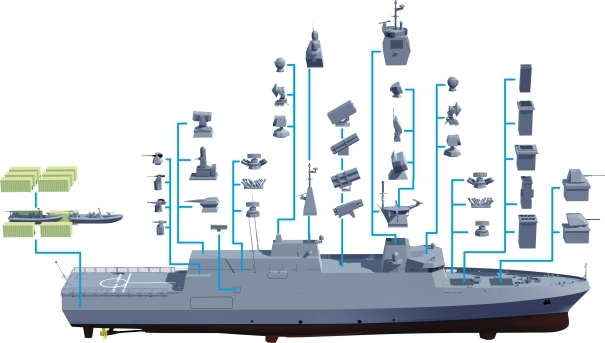
The Danish Navy’s approach with the adoption of the “StanFlex” system is considered clearly more successful. The original idea for a modular ship arose from the inability to replace, due to costs, 22 vessels of the Danish Navy, in the early 80’s. It was therefore proposed to build a ship that could change the composition of its equipment relatively easily, given the times. Common equipment for all roles would be installed on the ship from the start, while mission-required special loads would be integrated into standardized structures, ready to be placed in also standardized slots on the ship when needed. This modular equipment attachment system became known as “Standard Flex”, or “StanFlex” for short, and was likened by the Danish Navy to another product of Danish origin, the familiar Lego toy.
Benefits of the “StanFlex” configuration according to the Danish Navy
- Modules that are not in use can be stored in controlled conditions, thus reducing the need for preventive maintenance.
- Ships do not need to be taken out of service when equipment requires maintenance and vice versa.
- New weapons and systems can be installed by fitting them into a module, instead of upgrading the entire ship.
- When a ship or an entire class is retired from service, the modules can be reused by other ships. Economies of scale are important here, and as an example we will cite a 2006 Danish Navy study in which a proposed 6,000-ton frigate design was projected to cost $254 million per ship, while the same design for other European nations was projected to cost from 413 million to 1 billion dollars.
- Multi-role ships are perhaps less efficient than single-role ships, but their ability to re-equip makes up for this disadvantage.
The StanFlex configuration has since been largely adopted by most ships in the Danish Navy, the best known today being the Absalon-class “hybrid” frigates and the Iver Huitfeldt-class air defense frigates, from which the new Type 31 frigate derives its origins of the British Navy and its export version, the Arrowhead 140.
3. USA
Easily customizing a ship based on the mission it will be called upon to undertake has been a major design goal of the US Navy’s Littoral Combat Ships (LCS). The program resulted in the construction of two parallel classes, “Freedom” and “Independence”, with ambiguous results, as the idea of separate mission modules was never completed, with the original forecast that he wanted three of them, mine warfare, surface combat and anti-submarine warfare. So now the boats undertake specific missions, with some standard differences in equipment-armament and with geographical separation, e.g. the Independences are expected to receive NSM anti-ship missiles for action primarily in the Pacific.
“The Cube”, the new LEGO
Recently, on March 22, the manufacturer proceeded to test it at the Korsor Naval Base of the Danish Navy. The aim was to demonstrate operational flexibility in the management of standardized loads of armaments and equipment.

“The Cube” is a solution to creating a truly modular platform for a variety of maritime businesses. It consists of: a system of interchangeable shipping loads placed in standard containers, an on-board and off-board cargo management system. According to the manufacturing company, almost any ship can accept “The Cube” and thus be transformed into a multi-role platform.
The system is structured in such a way that significant economies of scale are achieved, with one vessel adapting to multiple roles. At the same time, the modules that remain stored on land are not strained by their stay in the marine environment, while they can be maintained much easier and form part of the operational training of the executives.
The “StanFlex” system, although successful as a philosophy, was created to primarily satisfy the needs of the Danish Navy, while “The Cube” is designed to be able to meet the needs of more than one customer.
The equipment can be placed in six different container frames, certified to NATO STANAG 4830/ANEP-99 and covers six general categories of shipments:
- Dealing with maritime and natural disasters, humanitarian crises.
- Anti-submarine warfare.
- Surface warfare.
- Mine warfare and minelaying.
- Anti-aircraft warfare.
- Support operations.

