



The highest form of organization of a people is the state. The history of shaping the state in the first world, Europe, shows us that in order to reach the current form of organization that have the states all over the world, the institution of the state has gone through specific shaping tendencies in order to evolve as all “living” organisms used to evolve.
In this analysis, we will present in many details, based on our opinion, how and when the first state has historically emerged in the form of the organization it currently has, on which principles it was based and how its institutions were formed for serving operationally individual freedom in a free society. The purpose of this study is to highlight the problems and characteristics of European states nowadays which form the basis of a supranational European state in Europe. The European Union (EU).
by Thanos S. chonthrogiannis-https://www.liberalglobe.com
In the first part of this analysis becomes a general description of the emergence needs state in human history. Also, are presented the first forms-types of state that have the characteristics of modern state. Then there is a description of the archetypal forms of modern states in Europe and how they worked.
In the second part of this analysis we will present the role that the Church had with regard to the formation of the state. Reference is made to the reasons for the formation of the archetypal forms of State and the role played by taxation, bureaucracy, the application of the law and the development of the system of courts in the newer state models.
In the third part we will look at what the European model of state was. There is also a detailed presentation of the main and representative models of the state, namely England and France, as they are presented in detail how their main institutions were formed and what was the administrative system that followed these two states.
The fourth part of this analysis presents the reasons that did not allow the sovereign state, during the Middle Ages, to acquire an integrated administrative form. It also presents political struggle and how citizens were organized politically and the various ways they used to procrastinate the implementation of government policy. In addition, reference is made to the main problems faced by states in the Middle Ages.
In the fifth part of our analysis are presented the ways of stabilizing the state (period 1400-1800 A.D.) but also the ways of effective governance, the rivalries between the then administrative services and mechanisms, the political crises, the development of new state services (19th century). It also presents the shortcomings of the EU as a state that does not allow it to function successfully, as well as the solutions that the EU should implement to resolve these malfunctions.
The need to show the state in human history
As we have mentioned at the beginning of our analysis, the state is the highest form of political organization for a people. So, as the highest form of organization of a society, the state has overcome and has virtually wiped out all other forms of social organization.
The emergence of the state in human history is due to the fact that there was an increasing need of the societies themselves to obtain the best possible way of managing and exploiting human and natural resources, which would lead to increasing-improving the standard of living and enabling the talented individuals of a society to fully realize their potential for the benefit of social welfare.
All these goals and social achievements are achieved in a society through the cooperation of the members that make up this society. Essentially, the state as a form of organization provides the best way to make collectively use of the human resources in which this social cooperation is ideally achieved in order to attain the above social objectives. The effectiveness of this organizational form, which in one word is called the state, was so great that every other form of social organization was wiped out.
The other forms of social organization that preceded the emergence of the state as a form of social organization, are the family and the community. In times when the state did not exist as a form of organization it was the family that kept the coherent ties between its members while protecting its members from external risks. The living of many families in a geographic area gave the possibility of cooperation at the community level.
In those times people sacrificed their lives to defend their family and any property. But the organizational power of these communities-societies was incomplete and inadequate in achieving their goals. Many times, these communities failed to create a political organization that would resemble the organizational form of a current state because of external factors.
In order to create a political form of state, it would be necessary for all these families who made up communities to reside permanently in a specific geographical area-a site for generations. If these families-communities were forced to move either for the purpose of finding more food or for reasons of avoiding their destruction by foreign invaders, it was impossible to create original organizational forms of state structure.
The first forms of state that have common characteristics in the modern form of a state
Those families who achieve to work together within the framework of a community and remained in the same geographical area for many generations of people were the first communities of people who forged the first organizational political structures of a state. But these structures at the beginning were intangible and impersonal without structure and related to issues of general interest that employed their community. A main issue of general interest in such a community would be, for example, the organization of defense of their community by external invaders.
1. The City-State
The first organized form of state that made its appearance and fulfilled most if not all the above criteria-needs of the state’s appearance are the city-states in ancient Greece. Given the relationships that existed between the inhabitants of a city-state in ancient Greece, they were created in these city-states, in other more in other less, permanent type institutions that remained unchanged over time independently of the any changes that existed in the leaderships of these city-states.
These institutions increased the effectiveness of any political process followed and strengthen the sense of political identity of the inhabitants of the city-states. The glory and prototype of this city-state cited as an example of modern political state was Athens of 5th Century B.C.
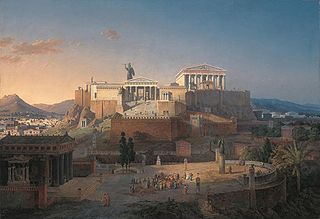
Painting by Artist Leo von Klenze (1784-1864) , licensed public domain
Source/Photographer://Neue Pinakothek, Munich
https://commons.wikimedia.org/wiki/File:Akropolis_by_Leo_von_Klenze.jpg
The convention of the Municipality of Athens, in which all the issues of general interest and organization of the city of state were discussed, the Supreme Court (Arios Pagos) who was made final decisions on disputes between citizens and respected by all citizens, the meetings of eminent men and the justification of the activities of their administration, the electoral system of ancient Athens, as well as the predominance of the institution of equality-isonomy (all citizens are equal to the law) which is the cornerstone of the Democracy, are examples of permanent political institutions of a modern state.
The city-state in Ancient Greece and based on its organizational structure managed to better exploit and manage human resources (residents) and its natural resources. There was full participation of the citizens in the meetings of their city and participated actively in any political process to achieve their social welfare. This brought a strong political identity to the inhabitants of the city-state to the point where they could be described as fanatics for their origin. The moral and mental anchoring that the inhabitants of the city-states had in their state was fully.
Despite the above achievements of the city-states their disadvantages were equally important and for this the form of the city-state could not last in the passage of time. No city-state has been able to integrate its entire population into its political processes while at the same time was unable to annex and incorporate into the existing territories the new territories and populations (territorial and human expansion equally). The result was sooner or later the city-state type of state to occupy by foreign conquerors due to its military weakness which led to the destruction of its state institution.
2. The Empire
The second form of state that existed on the European territory and not only in the period of antiquity was the empire. In the European area we have the peculiar case where a city-state (Rome) instead of being wiped out like the other city-states in ancient Greece, manages to become the nucleus of an empire-the Roman Empire-gradually occupying the entire territory of the Mediterranean Sea Basin, part of central Europe and a large part of the Northwest Europe.
The advantages of the era’s empires were since they were militarily strong and relied on a very small number of people for their political events. Institutions such as the Senate, the Res Public on which the equality of Roman citizens was based (Marcus Tullius Cicero-(106-43) B.C.) constituted the institutions of the political civilization left by Rome.
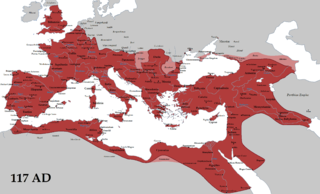
Photo by Author: Tataryn, licensed CC BY-SA 3.0
https://creativecommons.org/licenses/by-sa/3.0/
Source: own work,
But these advantages also created the disadvantages of this type-state. The fact that a small group of people in relation to the total population of the Empire was involved in the political events of the Empire made the other citizens-its subjects remote morally and mentally by the Empire creating indifference to them as to work any attempt to maintain its existence.
Essentially, there was no such coherent bond between the citizens of the Empire to continue to struggle and give their lives for it, as it appears to the inhabitants of the city-state. At the same time, the imperial system managed to make poor management of human resources and natural resources, not by promoting all those talented individuals who could create situations to achieve social well-being in the whole territory.
The first forms of emergence of the modern state in Europe
The type of European countries that appeared on the European stage after 1100 A.D. combined the advantages of the two above types of states, namely the city-state and the empire for this and survived through time. The English and French model of state, for example, exceed the age of nine hundred years. The achievements of this new type of state could be summarized by the following principles:
1. They gain great chances of survival because they are very sizable compared to a city-state and less in size than a vast empire.
2. They achieve to incorporate in the political processes of a large proportion of their population transforming them into real citizens.
3. In view of the achievement that we have presented in number 2, these countries succeed in giving their citizens, apart from a common political identity and a sense of brotherhood among their local communities.
4. The result of the above achievements is the best possible use of the management of human and natural resources in their territory.
5. In addition, citizens started to care about their state and this interest makes them morally and mentally attached to the state within the boundaries of which they live.
This European model state prevailed in Europe during the period (1100-1600) A.D. and around the world as the most effective. But the path to this form was not easy. The newest European model of state emerged through two different types of states. These two types are the English and the French newer model of state respectively.
More specifically, the Anglo-Saxon kingdom of 10ο-11ο Century and the Kingdom of the Franks of 8ο-9ο Century are the archetypes of the youngest European state models. This is because these states have been consolidating for many years in a territorial area and surviving. Their common characteristics are that the King has the role of representative towards God and creates mechanisms of institutions that give solutions to the local issues of his citizens ensuring social peace in his kingdom.
The way in which archetypal forms of state operate in Europe
Within this framework, the King creates the institution of the courts to ensure social peace and cohesion within his kingdom. However, the royal officials in both models of the newer state and the other models of the state that appeared at the time, do not act as representatives of the King and in general the central power that stems from him but act as representatives of their own interests. From there comes the institution of feudalism, where every royal dignitary becomes independent and acts as a local ruler.
In fact, until 1100 A.D., feudalism has undermined the notion of state in Europe except for the Byzantine Empire, which is the only geographic space in Europe that has brought the form of a modern state on the map. Feudalism worked both ways in the creation of the modern state.

This photo by Author: Bukkia (talk_contribs), licensed public domain
Source: Own work based on: Europe.814.jpg
https://commons.wikimedia.org/wiki/File:Europe_814.png
On the one hand feudalism created independent local rulers, breaking the king’s central political power and the notion of state, but on the other hand it gave the opportunity to create exceptional structures of command and organization at local level with aim to achieve local prosperity in local territories because local rulers were more motivated to pursue the well-being of their nationals-subjects and their own counterparts.
This resulted in increased ties between the nationals and the local Lord working together jointly to achieve their local well-being. Given that by that time the King was responsible for creating the system of courts in his kingdom for the performance of justice, the system of courts was the one that constituted the coherent link for maintaining the geographic size of his kingdom.
More specifically, the existence of the local rulers (Dukes, Komites, Thanites, Vassi Dominici etc.) who had been transformed into the rulers of autonomous local communities had every reason to develop the local courts for their benefit. However, when those courts did not work for the benefit of local residents or the local nationals were oppressed by their local lord, that nationals had the choice of going to another higher-level court away from their place and to the point of reached to seek justice from the king himself who was in charge of the system of courts (essentially the upper tier of the court system was the king himself).
That is why the subject was always sworn to the king and expected justice and protection from the king in the most worst-case scenario for him. This single event made every citizen of the realm faithful to the king and defended his land and the geographical territory of the realm sworn in the name of the king.
Essentially, the life of the citizen was settled by the local magistrate, but he knew that the local ruler had always feared that if he ignored the orders of the king’s courts, he would have to face the King’s army. In this case, the great danger to the local magistrate would be to replace him by the king with someone else taking also his property.
In other words the system of courts that appeared in the kingdoms-sizable states in Europe was that system that kept unchanged the territorial integrity of the Kingdom-state from the local rulers-in the event of their secession-but also in nationals gave a common political identity to the whole state irrespective of the size of which they accepted to defend it as a whole.
So, the system of courts within the state has the role that the military has in defending the state from external invaders. The first correct application of the system of courts that began to give these results among the same nationals was the Western state of the Franks and later state of France (Louis XIV). The same was the case with the Anglo-Saxon kingdom, which included different nationalities (Scotland, Wales), which had been conquered by the English by war.
The further proper functioning of the local courts in which the differences of the residents found solutions helped in a partial increase of the local standard of living, the peaceful living in turn gave the possibility of creating storage-warehouse spaces, the application of new ways of growing wealth at local level etc.
Feudalist areas should be considered as the first autonomous political units in the geographical area of Europe that simulate the city-states of antiquity that were much larger than the city-states but were operating under the umbrella a specific geographically enlarged realm. Today we can see the results of the feudalist cultures as a legacy in the European states by the great degree of decentralization that present the modern states of Europe, which essentially give a high degree of autonomy and independence to Local governments (communities, cantons, etc.).
The specific kingdoms that manage to survive in space-time from that time are the new models of the European state. The main remaining kingdoms that managed to survive are the kingdom of the Western Franks (destined to become France), the Kingdom of the Eastern Franks (which later became the core of the German state) and the Kingdom of England. These three Kingdoms in one way or another managed to survive until today.
But what is the first broad coherent link which, as one point broadcast the organization of its institutions in the newly created European states by strengthening them further? We’ll see about that in our next analysis in the second part.
Thanos S. Chonthrogiannis
The law of Intellectual Property is Prohibited in any way unlawful use/appropriation of this article, with heavy civil and criminal penalties for the infringer.

