

An essential capability of modern surface vessels is the CEC: Cooperative Engagement Capability, which few countries have globally, such as the USA, France, India.
What is CEC and how does it work?
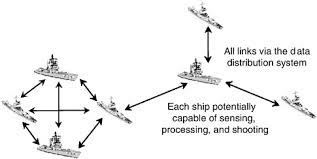
The essence of the CEC is the exchange of data between friendly ships and aircraft, the sharing of the picture of the tactical situation and the cooperation between the friendly naval units. In other words, the CEC system allows the exchange of primary data and information. The friendly ships have not only the data collected by their sensors, but also the data collected by other friendly ships, which may be in an advanced position.
The image of the radar or other sensor of the frigate “X” is available and displayed, in real time, on the screens of the destroyer “Y”. This function achieves the optimal awareness of which situation, in contrast to the enemy, allowing the selection of the appropriate weapon system to use to deal with the opponent. In other words, it optimally determines the “map” of the field in which the conflict will take place (please read the analysis entitled “The Parameter that Determines Each Time the Doctrine & the Strategy on the Battlefield“).
The CEC gives the option where the carrier of the projectile does not need to control the projectile, after its launch. The benefit for the ship or aircraft is that they launch the missile from a safe distance even after their radar is inactive. The central philosophy of the CEC capability is the “all-in-one, direct or intermediate” interface.
The integration of dozens of sensors is, among other things, a defense against electronic attacks as it is unlikely that an electronic attack will destroy all the sensors, which will belong to the carriers-platforms that will be located throughout the map of the collision field. Which attack can be detected, after its occurrence, and neutralized.
Τhe USA
The United States has developed Naval CEC capability through the NIFC-CA (Naval Integrated Fire Control-Counter Air) program. In this context, the US Navy will use the CF / A-18EF Super Hornet and E / A-18G Growler, F-35 Lightning II and E-20 Advanced Hawkeye aircraft, in a promoted / observer role.
The F-35Cs, with the stealth features they incorporate, will fly to the boundaries of the area of interest and with their sensors will perform intelligence gathering, surveillance and reconnaissance missions. Via the E-20 the data will be transmitted to ships and / or F-35C and F / A-18E / F aircraft. Depending on the situation and the targets, ships or aircraft will carry out the attacks, creating an Anti-Access / Area Denial: A2 / AD) achievement on the opponents.
The France
France had developed its own CEC known as VCN: Veille Cooperative Navale. VCN is based on the VHF / VHF RIFAN Step.2 network.