There is a starting point in determining the strategy on the battlefield and which determines the success or not on the battlefields. So this parameter-starting point that determines everything is the Map. More specifically:
• The Map defines the Doctrine.
• The Doctrine determines the Strategy.
• The Strategy determines the weapons to be used.
• Weapons determine the tactics to be applied on the Battlefield.
Several examples show us that the Map is the most basic parameter in the development and implementation of appropriate weapons systems.
Example 1
The USSR had to defend a huge airspace that covered half of the planet’s northern hemisphere. Since US bombers and spy planes could invade en masse from the Arctic Circle, the USSR air defense developed very long-range anti-aircraft systems and large interceptor aircraft to have the necessary transferability and speed. Today this Doctrine is presented with the Russian S-400 and S-500 anti-aircraft / anti-ballistic missile systems as well as in giant twin-engine fighter jets such as the MiG-25, MiG-31 and Su-27.
Example 2
Despite Sweden’s neutrality during the Cold War, in the face of the USSR threat from the Arctic Circle, Sweden developed its own weapons systems and fighter jets. Given the threat of the USSR from the Arctic Circle, Sweden looking at the Map found that it does not have the necessary strategic depth to protect its air bases. For this reason, he developed a Defense Doctrine for the dispersal of fighter aircraft, as a result of which he led to the construction of fighter aircraft with special characteristics. The culmination of this construction is the JAS-39 Gripen, by SAAB, a STOL single engine to perfectly serve the doctrine of the Swedish Air Force. This aircraft could operate not only from air bases but also from narrow roads and motorways of the Swedish National and Provincial Road Network in which there were also mobile support stations.
Example 3
The United States built its Naval Doctrine by looking at the Pacific Charter on which they faced the Japanese Imperial Navy during World War II (1939-1945). The vastness of the Pacific Ocean did not allow air cover of naval fleets from bases on land. As a result, the USA presented its largest supership, the aircraft carrier, which changed the nature of the naval operations until then.
After the end of World War II, US Navy entered the Cold War, demanding that the then US political leadership always be able to project leveling power to any part of the world that is accessible by sea.
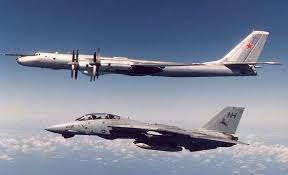
To achieve this, Carrier Groups were created – the various support and protection ships of a Supercarrier. Against the Carrier Groups of the US Doctrine, the USSR deployed its giant bombers with a large nuclear load and a large radius of action, creating its own Doctrine. The US response was the F-14 Tomcat fighter jet with its own equivalent defense doctrine.