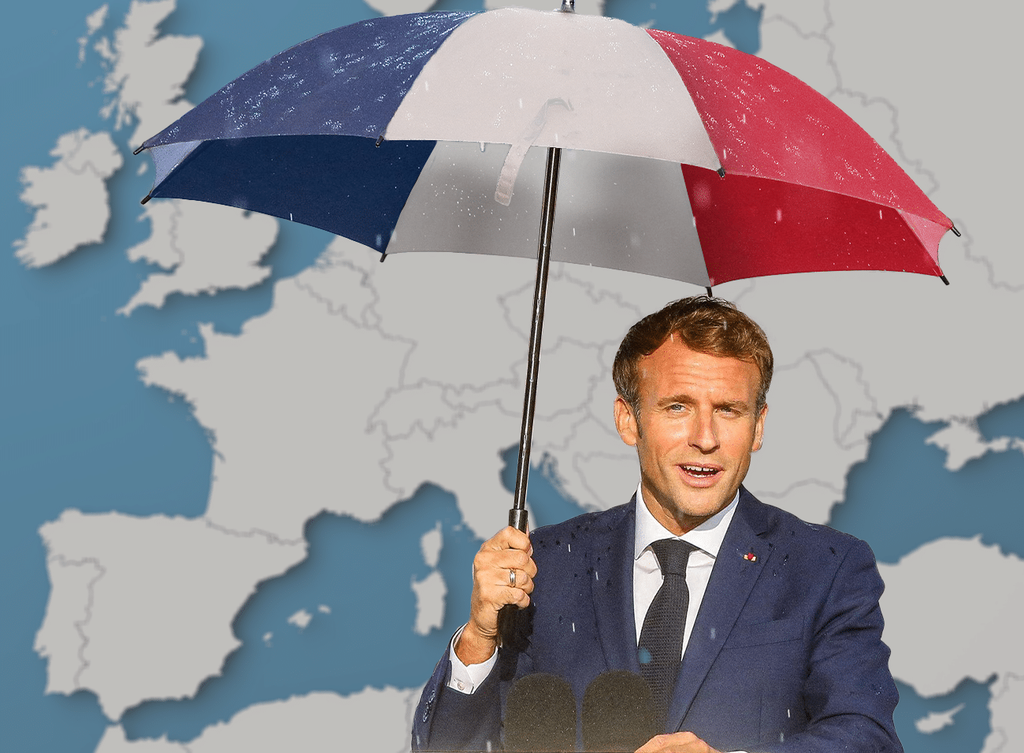
The Agenda of European “Strategic Autonomy” where the EU can formulate and defend its own common interests and not heterogeneously force it (please read the analysis entitled “Joint Communication on the EU’s Relations with Russia” to understand that its security should be moved in two pillars.
The first pillar is to “buy” security from the US which will give it time to strengthen its own autonomous security, while the second pillar is to autonomously deepen its own security within the framework of NATO security.
by Thanos S. Chonthrogiannis
©The law of intellectual property is prohibited in any way unlawful use/appropriation of this article, with heavy civil and criminal penalties for the infringer.

Photo by the website www.russia-now.com
European autonomy is defined by a framework that must be answered in practice by the EU, i.e.,
- Can the EU defend itself autonomously against attacks by other states and poles of military power (e.g., Russia)?
- Can it prevent regional conflicts in North Africa and the Middle East by controlling refugee flows away from its territory?
- Can it in cooperation with the U.S. develop cutting-edge technologies as a counterbalance to China’s technologies?
- Can the EU develop self-sufficiency in vital goods, so that it does not depend on foreign powers?
Having experienced two disastrous wars on its territory, Europe now prefers to negotiate, to discuss its differences with its opponents, preferring this type of problem-solving approach to the choice of hot or cold war.
The strength of the EU is not military, despite France’s efforts. It knows that its power is to impose extra-apart power regulatory rules in conjunction with its enormous economic influence.
Its troubled neighbours in Eurasia (Turkey, Russia) will have to adapt to its strength to access the EU market.
The EU is the largest trading partner of Russia and Turkey. The EU’s largest trading partner is China.
Essentially, the EU is a mercantile global giant that makes its choices based on economic utilitarianism, with an indelible Kantian approach at its core.
The economic grid of dense transnational trade forms structures of mutual interest, which in the long run prevent conflict and war.
European diplomacy (please read the analysis entitled “The EU’s Negative Assessments of Its Future Relations with Russia“)) comes to international talks with financial assistance and trade agreements but also sanctions and not with aircraft carriers and fighter jets.
This “core” of Immanuel Kant has secured Europe 75 years of peace (“The Better Angels of Our Nature: Why Violence Has Declined?” Steven Pinker, proves that these 75 years of peace are the longest-lasting European peace since 1400).
In fact, the EU as the second pillar of the West leaves the US with the task of sending cold war messages to China and Russia, using its influence and soft global power as a complement to US military power to appease both China and Russia, while knowing the dangers of matching Asia’s views (matching China’s and Russia’s views).
U.S. President President Joe Biden acknowledges the fact that as Asia unites and at the same time grows in population and wealth, the democratic world will have to make even greater efforts to protect its economies and values.
That is why in his recent statements at the G7, Joe Biden recognizes the US’s natural partner in the face of the EU, because they are united by the same democratic principles and values.