

Britain appears, in the end, to be returning to the very point from which it sought to move away a decade ago. The historic decision to leave the European Union—presented at the time as the dawn of a new era of national independence—has instead become a persistent source of economic hardship, political conflict, and strategic deadlock.
Today, the government of Andy Burnham is seeking a way forward by re-engaging with Brussels; for its part, the EU appears willing to discuss improving relations—though not without demanding concessions in return.
The administrations that oversaw Brexit failed to translate the departure into a coherent development strategy. Meanwhile, the current leadership attempts to frame this rapprochement with the EU as a solution to problems that, in reality, require far deeper economic and institutional reforms.
The November 20th Summit: Billion-Pound Agreements and Difficult Compromises
The second UK–EU summit, held on November 20th in Brussels, marked a significant milestone in this new trajectory.
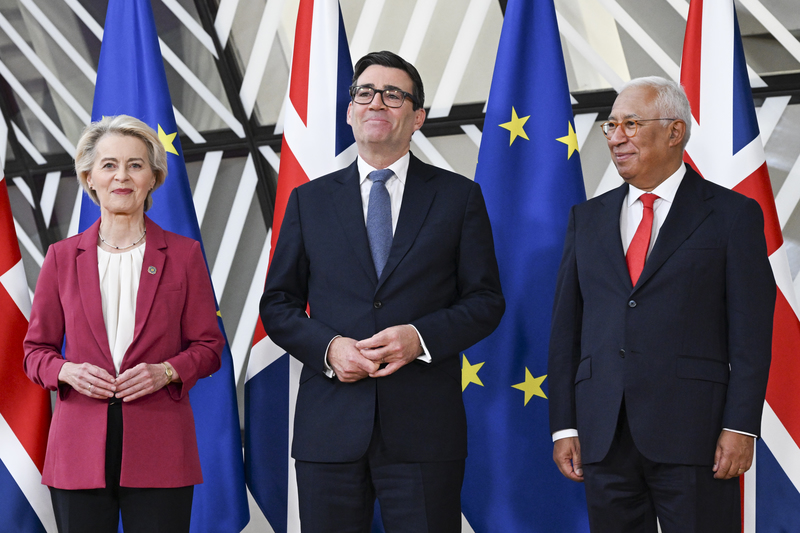
Andy Burnham met with European Commission President Ursula von der Leyen and European Council President António Costa, with both sides announcing three key agreements aimed at reducing trade barriers and strengthening cooperation.
1. The first agreement concerns trade in food and agricultural products.
The British government estimates that the economic benefit could reach £5.1 billion annually by 2040. The very fact that a new intergovernmental agreement is required to limit barriers on everyday consumer goods serves as an indication of just how costly the decoupling of the two economies has proven to be.
2. The second agreement concerns the linking of emissions trading systems.
The objective is to avoid additional burdens on British exports—including steel and aluminum—with a total value of approximately £6.5 billion. Essentially, this is an attempt to restore some of the economic predictability that was lost following the departure.
3. The third agreement concerns the creation of a mobility program for young people aged 18 to 31, allowing for temporary work, study, and residence for up to three years.
Provision is made for up to 100,000 permits annually for each side. However, these new arrangements do not amount to a return to full freedom of movement, nor do they automatically entail reintegration into the European Single Market.
The actual economic impact will depend on the implementation of the agreements and the final regulatory arrangements.
Moreover, the scheduled implementation of the agri-food package starting in March 2028, combined with the later launch of the youth program, indicates that this rapprochement will be a much slower process than triumphant political announcements might suggest.
Brussels hardens its stance: Rapprochement comes at a price
Behind the declarations of cooperation, the European Union appears determined to defend its own economic and institutional interests.
Ursula von der Leyen and António Costa welcome the rapprochement; however, negotiations indicate that the EU has no intention of granting Britain unrestricted access to the benefits of the European market without corresponding obligations.
The dispute over university tuition fees is a case in point. The European side is seeking more favorable terms for students from EU member states studying at British universities, while the British government is concerned about the financial implications of such a change.
The issue proved significant enough to affect the finalization of the overall cooperation package. Both sides have agreed to continue negotiations on this matter for another six months.
Brussels’ stance can be interpreted as an effort to ensure equal treatment for European citizens. At the same time, however, it reveals the highly transactional nature of European policy. The EU appears willing to bring Britain back into its fold, provided that London accepts an increasingly large share of European rules and obligations.
European leadership must also explain why a relationship based on mutual economic benefit should entail such complex bureaucratic and political negotiations.
The fact that it takes years to restore simple trade facilitation measures is not a success for European bureaucracy, but rather a sign of its dysfunctions.
From National Sovereignty to Regulatory Dependence
One of the primary arguments in favor of Brexit was the ability for Britain to make autonomous decisions regarding its laws, economy, and trade policy.
The new agreement reveals the limitations of this notion. In order for British businesses to gain easier access to the European market, London has committed to aligning certain of its rules with the European regulatory framework.
This gives rise to a politically sensitive issue: Britain may end up implementing more European rules without having an equal say in the process by which they are formulated.
The paradox is clear.
A country that left the EU to strengthen its political autonomy may ultimately find itself compelled to follow decisions made by an organization in which it no longer has full institutional representation.
This does not mean that every shared rule constitutes a loss of sovereignty. International trade relations are inevitably built upon mutual commitments.
It does mean, however, that the British political establishment failed to explain the true cost of its choices to the public. Proponents of Brexit underestimated the extent of economic interdependence with the European market. Today’s proponents of rapprochement risk underestimating the significance of the institutional and political concessions that the new relationship entails.
In both cases, society is called upon to accept the consequences of strategic decisions that are often presented through slogans rather than full information.
The recurring errors and the new bill for citizens
Britain joined the European Economic Community in 1973. In June 2016, 51.9% of voters opted to leave, while 48.1% supported remaining. The exit was formally concluded on January 31, 2020, and the transition period ended at the close of that same year.
Nearly a decade later, the country once again faces a fundamental dilemma regarding its European orientation—only this time, the circumstances are different.
Britain is no longer negotiating as a member state seeking specific exemptions; it is negotiating as a third country looking to regain privileges it previously relinquished. This fundamentally shifts the balance of power.
Brussels is aware that the British government requires trade facilitation and economic results. London, for its part, knows that the EU is unlikely to readily accept a reintegration based on the same preferential terms as in the past.
This creates the risk of a protracted process of political horse-trading, leaving both the economy and the public trapped in a state of uncertainty. The major failure does not belong exclusively to the supporters or the opponents of Brexit. It belongs to a political class that, for a decade, treated an exceptionally complex economic and geopolitical issue as a tool for internal political conflict.