

The European Drone Defence Initiative (EDDI) now has an official timeline. The European Union’s defense readiness roadmap envisages initial capability by the end of 2026 and full operational status by the end of 2027. However, behind these Brussels-set milestones lies a trajectory moving in the opposite direction—from small frontline states toward European integration.
A study by the Geneva Centre for Security Policy identifies Estonia and Latvia as the operational pioneers of this entire endeavor. The core concept is simple: when a threat is imminent, the states facing it first do not wait for a joint 27-member process to conclude. Instead, they develop or test a capability, establish a fait accompli on the ground, and subsequently seek funding, standards, and further development from the Union.
The Baltic system that paved the way
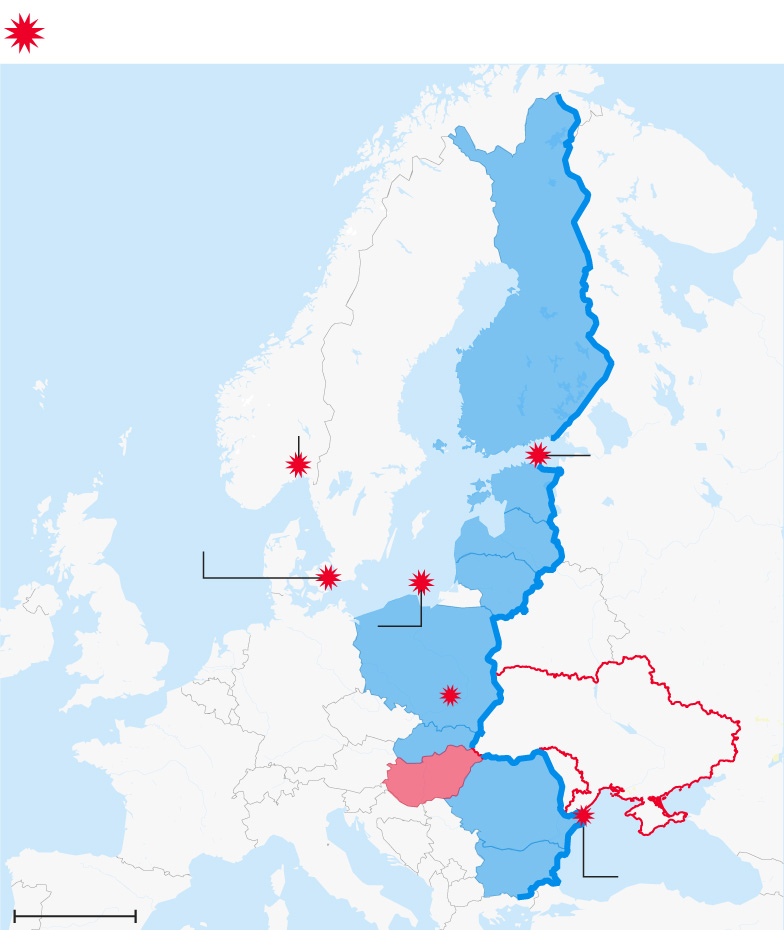
The “Baltic Drone Wall” industrial initiative was unveiled in February 2025 as a collaboration among companies from Estonia, Latvia, Lithuania, Finland, and Poland. The architecture combines sensor networks, mobile units, electronic warfare, central command, and various interception assets.
In September 2025, Estonia’s DefSecIntel Solutions and Latvia’s Origin Robotics signed a memorandum of cooperation. The former contributed the Eirshield platform, featuring radar, electronic countermeasures, and data fusion capabilities. The latter added the Blaze portable interceptor drone, which utilizes visual recognition and operates under human supervision. The significance of this partnership lies in the fact that two small markets integrated a sensor and an interceptor without waiting for a unified European tender. This model allows for testing, failure in specific areas, and rapid improvement—unlike a program that begins by seeking a more comprehensive balance of political and industrial development.
The EU Takes on the Challenge of Standardization
The European Commission has included counter-drone defense among the four flagship projects of “Readiness 2030,” alongside Eastern Flank surveillance, European air defense, and space protection. The official plan calls for multi-domain surveillance, drones and counter-drone systems, electronic warfare, precision strikes, and coordinated responses, all in cooperation with NATO.
A common European mechanism must exchange track data between national networks, distinguish between civil and military air traffic, and operate under shared security rules. It must also determine who assesses the threat, who authorizes jamming or engagement, and who bears responsibility when a target moves from one jurisdiction to another.
Standardization is an operational issue, not a bureaucratic detail. If each country purchases a closed system with a unique data format, the European map will become a patchwork of incompatible coverage islands. Open interfaces, common track classification, jamming resilience testing, and the ability to rapidly integrate new interceptors offer a longer operational lifespan than any current drone.
There is no single target or single weapon
The term “Drone Wall” creates a deceptively simple image. The threat encompasses small quadcopters, reconnaissance UAVs, loitering munitions, low-observable targets, decoys, and saturation attacks. Some rely on radio links and are susceptible to jamming. Others utilize inertial guidance, visual target recognition, or fiber-optic links, requiring different countermeasures. That is why defense requires a layered approach. Passive and active sensors detect and classify threats. Electronic countermeasures disrupt links wherever possible. Guns, guided missiles, interceptor drones, and other weapons engage whatever gets through. Cost per engagement and replenishment speed are just as critical as the probability of a kill. A system that runs out of ammunition after the first wave offers a mere demonstration, not a resilient defense.
The EU must also link funding to actual stockpiles, trained crews, spare parts, and production lines. At the same time, NATO command must receive the same tactical picture without the creation of a second, competing chain. European added value lies in common standards, joint procurement, and production at a scale that no single small country could sustain on its own.
The lesson from the Baltic states is not that small nations have already built an impenetrable wall. They have taken the first, most difficult step: transforming the threat they face into a new architecture for countering it—one that is already being put to the test. Europe’s success will be determined by whether it can make this architecture shared, repeatable, and replicable, without losing the speed that created it.