



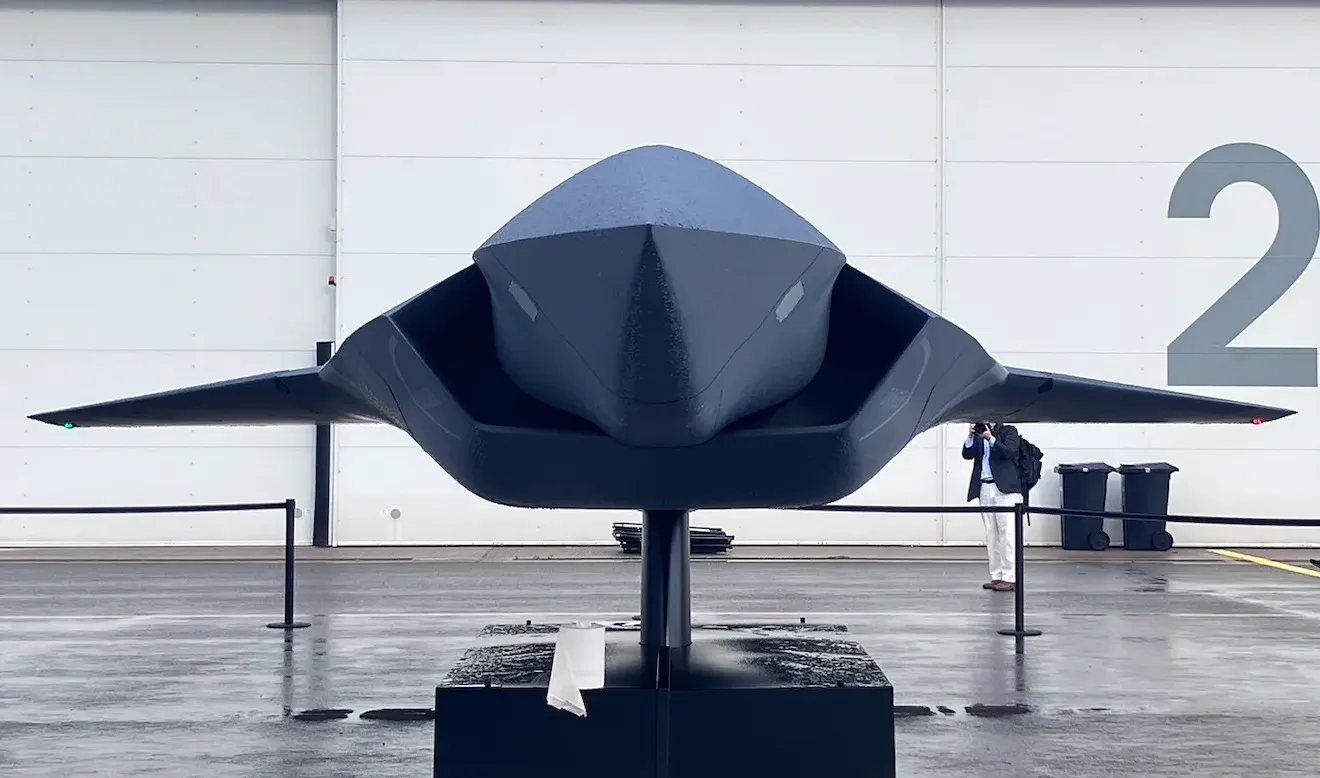
Saab has unveiled a new, high-performance unmanned combat aircraft that combines low observability, supersonic speed, internal weapons transport and advanced autonomy. Called the Autonomous Collaborative Platform (ACP), it is intended to act as a “loyal wingman” for the Gripen E, but it opens a new chapter in the space as Saab’s ambitions appear to be significantly greater.
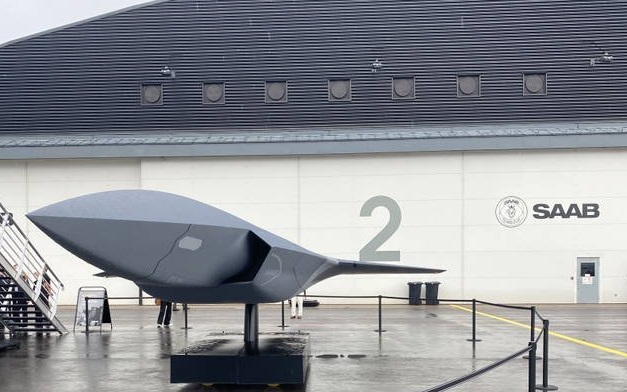
Saab, as part of the celebrations at Malmen Air Force Base for the 100th anniversary of the Swedish Air Force, presented a full-scale mock-up of the A3 aircraft on August 21 in Sweden, revealing the operational direction of the Autonomous Collaborative Platform (ACP) program.
The A3 is not yet a flying prototype aircraft nor has a production program been approved. However, it represents the design level to which Saab wants to take the technology currently being developed through two smaller unmanned technology demonstrators, the A1 and A2.
As mentioned, Saab does not see the ACP as a low-cost drone that will be used en masse and will be expendable. On the contrary, it is a high–end unmanned combat aircraft, designed to survive and operate in environments where the presence of a manned fighter would be dangerous.
From Loyal Wingman to Autonomous Collaborative Platform
The current name ACP is relatively recent. Saab had previously used the terms Collaborative Combat Aircraft (CCA) and Unmanned Aerial System (UAS) for this particular program, which is part of the broader Swedish framework KFS (Koncept för Framtida Stridsflygplan), i.e. the doctrine defining the architecture of future Swedish combat aircraft. (TWZ)
It is recalled that the company had already presented a corresponding concept of a supersonic and stealth unmanned aircraft in 2024, with features that approach the philosophy of today’s A3: blended wing-body fuselage, internal weapons stores, low-observability air intakes and a design optimized for supersonic flight.
Yesterday’s development shows that Saab is continuing to work on the concept and is not a plan created in response to the recent explosion of interest in CCA.
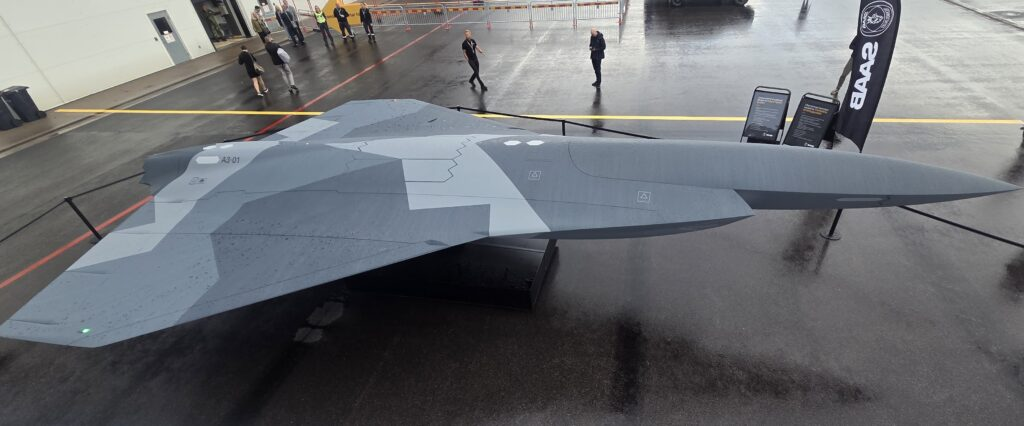
A truly supersonic UCAV
The most important technical feature of the ACP is that Saab does not follow the approach of most CCAs/“loyal wingman” which mainly emphasize long range, low cost and weapons carrying capability.
The A3 is designed as a low-observable supersonic unmanned aircraft.
The revealed configuration features:
- tailless blended wing-body design,
- strongly swept back wing of short span
- strong separation of the upper and lower fuselage along its front section
- side air intakes of the DSI type (Diverterless Supersonic Inlet), i.e. without moving parts for effective flow management at transonic and supersonic speeds.
- fully internal fuel and weapons transport,
- engine whose front compressor is completely shaded by the structure of the intake and air duct, as well as a specially shaped nozzle,
- surface shaping to reduce RCS. radar signature.
The design shows that Saab is trying to achieve a difficult balance: low RCS and internal weapons on the one hand, high speed and low drag in the supersonic zone on the other.
The challenge is that stealth requirements with large internal weapons stores increase the volume of the fuselage and usually burden the aerodynamic behavior. Saab has already publicly addressed this challenge during the development of the previous loyal-wingman concept, where the goal was to combine low radar signature, high speed and BVR air combat.
F414: a link to Gripen E
Of particular interest is the choice of engine for the first two demonstrators.
The A1 will use the General Electric F414, the same basic engine type used in the Gripen E/F. The F414 delivers approximately 22,000 lb thrust, giving the demonstrator the performance required for supersonic flight.
Saab already has extensive experience in integrating, maintaining and operationally exploiting the F414 through the Gripen E, while a common engine between the ACP and Gripen could significantly reduce support costs and simplify maintenance of a future production successor based on the A3 ACP.
Regarding the two demonstrators:
The A1 will be used primarily to demonstrate the feasibility of building and flying a low-observable supersonic UAV.
The A2 will be the next step, with a greater emphasis on advanced materials, sensors, mission systems and weapons-carrying tests.
The A1 is expected to make its first flight in about 15 months. The Swedish government has set a particularly challenging target: to go from initial concept to first flight within 36 months, and the A1/A2 program has secured funding until 2030.
What weapons will it carry?
Saab has not released a specific weapons list for the A3. However, the presence of internal weapons bays is a key element of the design.
This suggests that the ACP is not intended to simply function as a sensor platform or data relay hub for the Gripen.
A future configuration could consider carrying air-to-air missiles for BVR engagements, stand-off weapons or specialized electronic warfare equipment. However, these are operational capabilities that have not yet been announced as official equipment for the A3.
Gripen E as a “mission commander”
The real value of the ACP is likely to lie not in the drone itself, but in the system created around it.
Saab envisions the Gripen E as a tactical mission commander, capable of controlling one or more ACPs, while also working with GlobalEye early warning and control aircraft. This practice is already in use with the current generation Gripen C/D.
Saab has in recent years significantly increased its investment in artificial intelligence and operational autonomy technologies. In late 2025, the company announced that it had conducted Gripen tests with AI, while also developing collaborative aircraft and swarming technologies.
The ACP should therefore be able to operate largely autonomously, without requiring constant control from the Gripen, which is particularly critical in an environment of intense electronic warfare.
A future ACP should be able to continue its mission even when communications with the manned aircraft or ground command centers are interrupted or degraded.
Saab even has an active research project (mission–critical runtime assurance for autonomous combat aircraft) with subjects such as autonomous decision-making, machine learning, fallback behaviors, resource allocation and safe transition between advanced and certified functions.
This shows that the autonomy of the ACP is not treated as a simple software feature, but as a core part of the system architecture.
Two to three ACPs for each Gripen?
One of the most interesting figures provided by Saab concerns the cost.
According to Peter Nilsson, the life cycle cost of an ACP could be about a third of the corresponding cost of a Gripen, while the purchase price will depend on the level of capabilities requested by the customer. Saab estimates that a high-end ACP could cost about half of a Gripen E, although this is a program-level estimate and not an official production price.
This creates an interesting power ratio.
Instead of:
1 Gripen + 1 pilot
a package could be created:
1 Gripen + 2–3 ACP.
The Gripen will remain the manned decision-making center, while the ACPs will dramatically increase the number of available sensors, weapons and attack platforms.
Saab even emphasizes that the ACP is not designed as “one Gripen to ten drones”. The high survivability and performance mean that it will be a relatively expensive unmanned aircraft.
The connection to the next Swedish fighter
Perhaps the most important dimension of the program lies beyond the ACP.
Saab believes that the development of the unmanned aircraft can be a technological stepping stone for the successor to the Gripen.
The Swedish Air Force has not yet decided whether to develop a new domestic manned fighter after the Gripen, whether to join an international sixth-generation program or whether to move towards a more “uncrewed-first” architecture. The decision is expected to be made around 2028 to 2030.
In this light, Saab wants to have gained real experience in technologies that will be necessary for any of these options by then.
The same “DNA” being developed for the A3 can be transferred to a future manned fighter: blended wing-body, low observability, high speed, advanced mission systems, distributed sensing, AI and cooperative operation with unmanned aircraft.
The Swedish option
The ACP is essentially a way for Sweden to keep all its options open.
If the Swedish Air Force chooses a new manned fighter, the ACP technology could be part of its architecture.
If it chooses to participate in an international sixth-generation program, the Swedish expertise in autonomous collaborative aircraft could be a significant negotiating and industrial advantage.
And if it ultimately chooses a mixed force of manned and unmanned aircraft, the ACP could be one of its key pillars.
