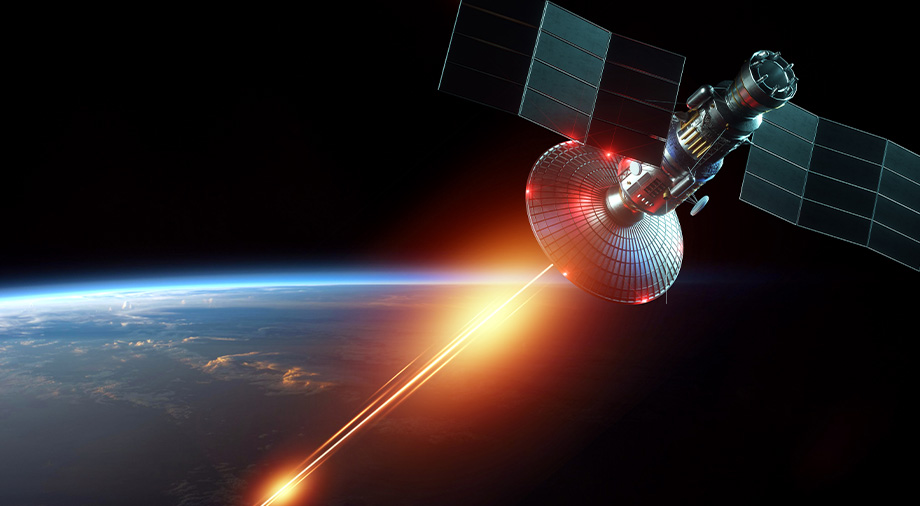
The war in Ukraine has accelerated the prospect of future space wars. In a statement on October 26 at the Outer Space Thematic Debate of the 77th Session of the United Nations General Assembly, the Deputy Head of the Russian Mission, Konstantin Vorontsov, warned that the use of civilian space infrastructure facilities and commercial satellites in armed conflicts by the United States and its allies, may make them legitimate targets for Russian retaliation (for more information please read the analysis titled “Russian Tirada-2S and S-500 Weapon Systems Can Target Western Satellites“).
Taking advantage of the forum, the Russian Federation reiterated the need for international commitments on the weaponization and militarization of space to prevent a full-blown arms race. Vorontsov expressed concern about US efforts to deploy weapons systems in space “designed for the threat or use of force.”
The remarks are in line with an earlier joint China-Russia statement in February 2022 opposing plans to turn space into an arena of armed conflict. To this end, both sides expressed the need to advance the Russian-Chinese draft treaty to prevent the placement of weapons in outer space as well as to strengthen the role of the UN Committee on the Peaceful Uses of Outer Space as a coordination platform for international cooperation and the development of international space law.
Similarly, the US State Department and NASA pioneered the Artemis Accords – or a non-binding statement of principles and rules established in the 1967 Outer Space Treaty – to ensure the safe and transparent civilian exploration of space and promote “ peaceful cooperation in space exploration and scientific endeavours’.
The Militarization of Space
Countries around the world are making unprecedented commitments to civilian space exploration as well as its militarization. According to the Secure World Foundation’s 2022 Global Counterspace Capabilities report (https://swfound.org/counterspace/), “an increasing number of countries are seeking to use space to enhance their military capabilities and national security” by developing a wide range of dual-use defensive and offensive technologies.
In addition to active investments in anti-space programs by France, India, Iran, Japan and North Korea, dominant players such as China, Russia and the United States are leading the way in research, development, testing and systems and weapons, increasing the risk of future conflicts in space.
This raises several topical and legally difficult questions to which the Russian delegation to the UN indirectly refers:
- Indirectly involved in the armed conflict are Elon Musk’s SpaceX/Starlink satellite systems, which both the Pentagon and Ukrainian officials claim are vital for Kiev’s military to communicate on the battlefield, and could become legitimate targets of Russian retaliation;
- Should a non-state actor responsible for providing vital satellite infrastructure for both military and civilian use be considered a party to the ongoing armed conflict?
- In the event of an attack by a state actor on non-state satellite infrastructure, what should be an appropriate response?
- Is it appropriate to extend the principles of international humanitarian law to conflicts in outer space? And if so, which rules of engagement (jus ad bellum and jus in bello) should prevail?
- Finally, what are the limits of international law regarding the means and methods used to wage war in space?
The International Law and the Dilemmas that arise
The current international space treaties that came into force in the 1960s and 1970s are decidedly vague about the prospects for military activities in outer space, much less about the prospects for armed conflict in outer space. Existing conditions are simply not fit for purpose. Technological advances have outstripped the legal community’s ability to evolve existing international law guidelines regarding the civil-military nexus and potential for conflict in space. Any attack on critical mixed-use satellite infrastructure will require the active involvement of the international legal community and a review of the jurisdiction of international criminal law and the international laws of armed conflict or international humanitarian law regarding objects and targets in outer space.
The basic principles of international humanitarian law of distinction between civilians and combatants or political objects and military objectives, proportionality and necessity are established benchmarks for assessing the legality of jus in bello conduct, impose the required limits on the use of force and are good though insufficient sources to analyze transnational conflicts, including those that potentially extend beyond the terrestrial sphere.
International law allows states to resort to armed force only in cases of self-defense or aggression that requires the parties to the conflict to distinguish between political objects and military objectives and to use force proportionate or such as to prevent “accidental loss of civilian life, injury to civilians , damage to civilian objects or a combination thereof, which would be excessive in relation to the specific and immediate military advantage expected”. Therefore, states intending to attack the satellite infrastructure of other states will have to balance the intended military advantages against the prospects of damage and civilian casualties associated with it.
Provided the attack was not indiscriminate, the legal dispute could arise when, in the fog of war, it could become increasingly difficult to make appropriate distinctions between private civilian satellite systems assigned to state militaries in order to to help them achieve military objectives in a -state conflict and to raise the question of whether a civilian satellite system assigned to a military entity to further its military objectives in an interstate conflict ceases to be a political object and therefore it is no longer immune to attack by armed opposing forces.
The creation of appropriate legal instruments that would provide the necessary legal guidance on fundamental dilemmas of the international law of armed conflict in space, illustrated by the above questions and expressing general principles of international law applicable to the extraterrestrial domain, is a necessary condition for the evolutionary path of modern conflicts. This will include expanding the powers of existing institutional mechanisms to arbitrate legal disputes between state and non-state entities involved in the space arms race and to provide advisory opinions on urgent international legal issues, while creating an operational framework for space diplomacy.