
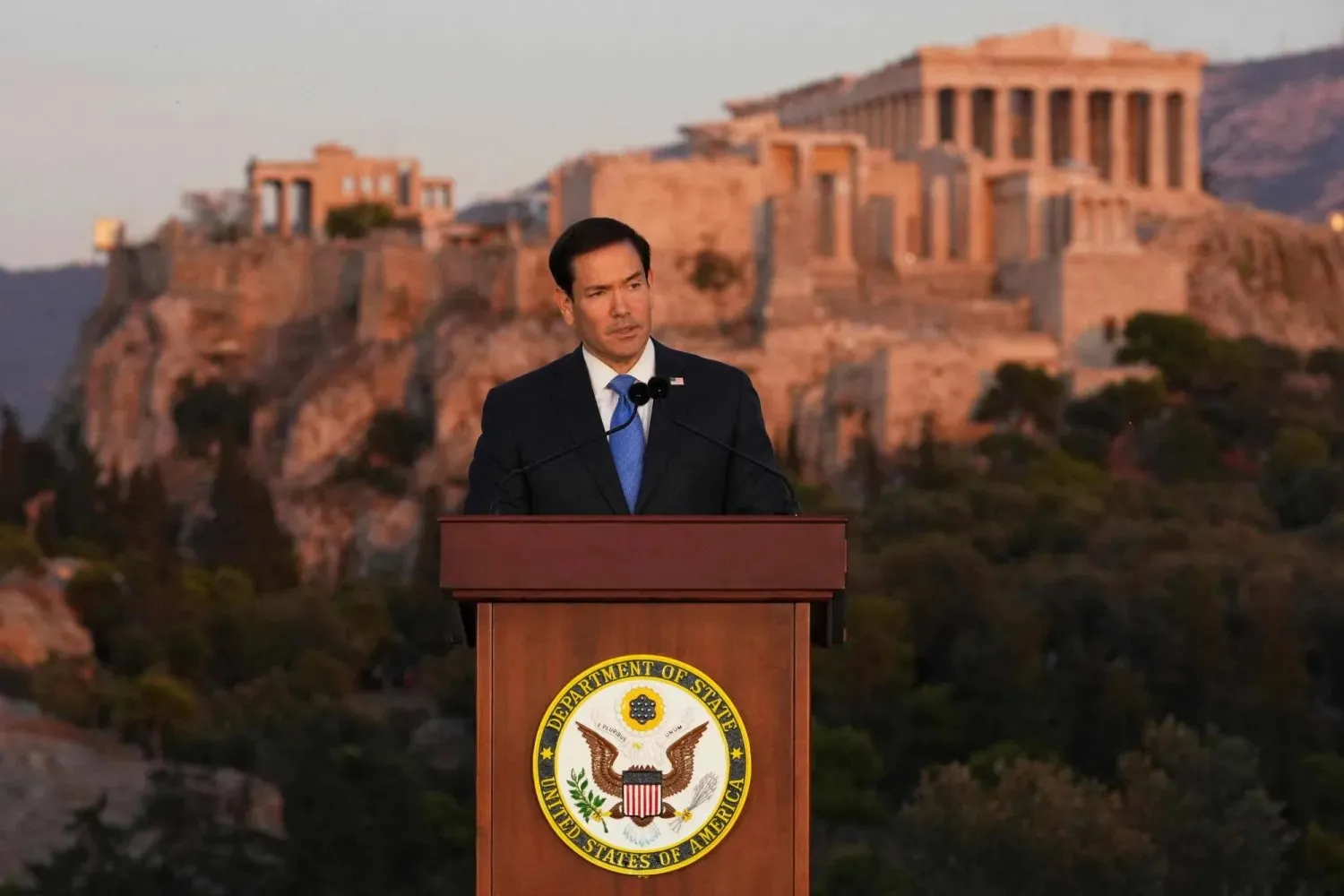
Marco Rubio’s speech at the Pnyx was not merely a diplomatic address peppered with references to ancient Greek history. It was an attempt to ideologically reshape American conservatism—and specifically the MAGA (Make America Great Again) movement—at a time when the question of political continuity in the post-Donald Trump era has taken on particular significance.
Rubio did not, of course, announce a bid for the U.S. presidency. However, the choice of venue, the staging of the speech, and—above all—the breadth of his historical and philosophical references invite a political interpretation: the U.S. Secretary of State is attempting to position himself as an ideological heir to Trumpism, capable of providing the movement with a more coherent historical and cultural narrative.
After all, MAGA was built largely on denouncing political elites, promising to purge the establishment—the famous “drain the swamp” pledge—and opposing “woke” culture. While these elements proved politically effective, they do not, in themselves, constitute a comprehensive worldview.
Rubio appears to recognize this need for expansion. Thus, he attempts to transform “America First” from a political slogan aimed solely at an American audience—and therefore perceived as “hostile” by the rest of the West, which, in the Trump era, feels and experiences disdain from the US—into a broader ideology of Western renewal. He does not content himself with the promise that America will be great again; he seeks a historical explanation for why the West was once great and a political formula for how it might regain that position. To this end, he turns to ancient Greece.
The choice of the Pnyx is, therefore, pivotal. The site where one of the most significant political experiments in human history took shape is transformed into a backdrop for legitimizing a modern nationalist vision. And therein lies the fundamental contradiction of the speech: the invocation of Athenian democracy is not necessarily accompanied by an acceptance of the political principles that defined it.
Reclaiming Antiquity: An Enduring Political Technique
The attempt to legitimize modern political agendas by invoking ancient Greek heritage is, of course, nothing new for Rubio. Since the Renaissance, antiquity has repeatedly served as a reservoir of symbols, ideas, and political models. The French Revolution looked to Greek and Roman history for examples of civic virtue and democratic participation. Nineteenth-century nationalist movements invoked ancient origins to establish the legitimacy of modern nations. Even Nazism sought to appropriate elements of Greek aesthetics and the Spartan military tradition, integrating them into a radically different, racial ideology.
Thus, the same historical legacy has been used to underpin contradictory political agendas: democracy and authoritarianism, liberty and discipline, national independence and imperial expansion. Rubio follows in this long tradition of the selective political use of history when he famously declares: “Athens gave us democracy. Plato and Aristotle gave us Western philosophy.” The problem, of course, is not the reference to antiquity itself. Rather, it lies in its transformation into infinitely malleable political material, from which each era selects whatever suits its own self-image.
Here, Rubio argues that the essential legacy of the Greeks is not confined to institutions or philosophical ideas but resides in deeper traits: ambition, competitiveness, daring, and the pursuit of glory. This marks a crucial shift. Ancient Greece ceases to be primarily the locus of foundational political thought and is transformed into the cradle of a timeless Western heroism—an idea that was developed far more extensively in the medieval West and, later, in the Romantic movement of the 19th century.
To put it plainly: Rubio does not approach history as a historian examining the contradictions of a significant ancient society that shaped the present—both ethically and structurally. Instead, he approaches it as a politician seeking arguments in the past to support a pre-existing ideology; the political stance comes first, and the historical interpretation follows, serving to entrench and justify beliefs that are already unshakable.
Athens as a symbol of nationalism, yet stripped of its democratic core
In Rubio’s speech, it is evident—and he states this himself—that the central political axis is nationalism, manifested as the absolute prioritization of the national interest. Here, Rubio argues that the ancient Greeks understood there was nothing selfish about devotion to one’s homeland or the defense of its interests, thereby portraying them as clear-eyed, pragmatic observers of human nature.
This invocation is not historically unfounded. The ancient polis did indeed constitute a robust political community, the defense of which was a fundamental obligation of its citizens. However, equating the ancient polis with the modern nation-state overlooks a crucial distinction: in the Athenian democracy, the political community was inseparable from the active participation of citizens in the exercise and oversight of power.
Moreover, authority was not legitimized merely by serving the city’s greatness; rather, it was subject—at least for the restricted body of citizens of that era—to processes of public accountability, debate, and scrutiny. To turn to Aristotle, he articulates a fundamental principle in the Politics: “A citizen, in the strict sense, is defined by nothing so much as by participation in judgment and in the exercise of authority” (Politics, III, 1275a). In other words, the citizen is defined primarily by their participation in judgment and in the exercise of power.
Athens was, of course, not a society of universal political equality. Women, slaves, and resident aliens were excluded from political participation. Yet, its democratic innovation lay precisely in the institutional organization of collective self-government. With Rubio, by contrast, the emphasis shifts from the citizen who holds power to account to the nation that seeks power. And this difference is no mere detail; it represents the gulf between a political tradition of self-government and a modern ideology of national power.
Excellence without Measure: Half of Greek Philosophy
Perhaps the most revealing part of the speech is the description of ancient Greek excellence as the new model for action: “To be the best, the strongest, the most beautiful, ever approaching perfection.” Thus, Rubio presents ancient Greek society as a perpetual struggle for superiority, where competitiveness and ambition were the driving forces of the civilization.
This is certainly not an arbitrary interpretation. The Homeric phrase «αἰὲν ἀριστεύειν καὶ ὑπείροχον ἔμμεναι ἄλλων» (“aièn aristeúein kaì hypeírochon émmenai állōn”) (Iliad, VI, 208)—”to always excel and surpass others”—indeed expresses a heroic ideal of constant distinction. Yet, ancient Greek thought is not exhausted by Homer or the heroic pursuit of glory. Aristotle, in the Nicomachean Ethics (II, 1106b), articulates a different perspective: «Ἡ ἀρετὴ […] μεσότης τις ἄρα ἐστίν» (“Virtue… is a kind of mean.”)
Virtue is linked to moderation, not to the limitless pursuit of superiority. Similarly, the Delphic precepts «γνῶθι σαυτόν» (“know theself”) and «μηδὲν ἄγαν» (“nothing in excess”) (mēdèn ágan) express a profound tradition of self-knowledge and the recognition of human limits. Herein lies the weakness of Rubio’s historical inquiry. He highlights excellence while sidelining restraint. He extols the struggle for self-improvement while downplaying wisdom. He invokes power without giving equal weight to the need to keep it in check.
Furthermore, the aesthetic of physical perfection, ceaseless conflict, and superiority that Rubio embraces bears similarities to elements of the ideological language later appropriated by racialist and authoritarian movements. This does not mean his discourse is synonymous with Aryan ideology. It does mean, however, that divorcing excellence from moderation and self-knowledge renders the invocation of Greek antiquity historically one-sided and politically problematic—especially given that the ancient Greek world was acutely aware of the danger of hubris.
Thucydides and the Limits of Power
The contrast becomes even clearer if we turn to Thucydides. In the famous Melian Dialogue (History of the Peloponnesian War, 5.89), the Athenians articulate the raw logic of power: «Δυνατὰ δὲ οἱ προύχοντες πράσσουσι καὶ οἱ ἀσθενεῖς ξυγχωροῦσιν» (“the strong do what they can and the weak suffer what they must.”) The powerful impose whatever their strength allows, and the weak yield. Thus, we have a phrase that could serve as a historical argument supporting the realist view of international relations expressed by Rubio. Yet Thucydides does not stop there.
His narrative places this logic within the trajectory of an Athens that, despite its immense power, was led to ruin. Consequently, the tragedy of Athenian hegemony was not a lack of ambition; it was also an inability to recognize the limits of its power. This aspect of Greek history is absent from Rubio’s heroic narrative—and its absence is crucial.
The Decline of the West and the Premise of Western Superiority
The second major ideological premise of Rubio’s speech is that the West is threatened primarily by its own decline. The US Secretary of State thus describes a West that is ashamed of its achievements, weakens its armed forces, abandons its industry, and cedes sovereignty to “foreign” supranational bureaucracies. Meanwhile, the rise of other powers—such as China—is portrayed as a consequence of this void.
This line of reasoning rests on a strong assumption of Western primacy: that the historic rise of others is explained primarily by the Western retreat. Yet, why must the growth of China, India, or other societies be interpreted chiefly as the result of someone else’s decline? And why not acknowledge that the economic and technological ascent of billions of people is also an expression of their own creativity, education, organization, and ambition?
Here, it is worth recalling Herodotus: «ἐπιστάμενόν με τὸ θεῖον πᾶν ἐὸν φθονερόν τε καὶ ταραχῶδες ἐπειρωτᾷς ἀνθρωπηίων πρηγμάτων πέρι».(“You ask me about human affairs, knowing that the divine is entirely jealous and prone to upheaval”) (Histories, I, 32). In other words, human fortune is unstable and volatile. This awareness of historical flux stands in contrast to the notion that the West holds an almost natural position at the pinnacle of the world. At some point, we must agree that history is not a fixed ranking of civilizations on a scale of “excellence and dominance.”
It is a continuous process of interaction, creation, conflict, and transformation. Acknowledging this reality does not diminish the truly supreme achievements of Western civilization—and of Ancient Greece in particular. On the contrary, it allows for an understanding of them without the need for constant comparisons of superiority or a revanchist quest for the next era of “hegemony.”
From Alexander the Great to Cortés: Constructing a Heroic Lineage
Rubio also attempts to link ancient Greek ambition with Christian Europe, the Renaissance, the great voyages of discovery, and American expansion. Thus, in his narrative, Alexander the Great, Caesar, Charlemagne, and Cortés are all placed within a unified tradition of conquest and historical greatness.
This is a historical synthesis that is striking in its formulation—and possesses considerable appeal for a lay audience—yet is profoundly selective. For these conquests were not merely adventures of courage and creativity; they also entailed wars, destruction, enslavement, and the violent upending of entire societies. American expansion, in particular, did not take place on a historically empty continent.
The pre-existing societies were not simply obstacles to the progress of a new civilization; they possessed their own substance, a foundation of values, and a right to life and continuity—rights that Western pioneers failed to respect, largely wiping out the indigenous populations of the Americas. Thus, here too, Rubio—himself of recent immigrant background—opts to portray the conqueror rather than the conquered, the latter being simply “absent” from the scene. Of course, his heroic narrative is not necessarily false in every specific detail; yet it is incomplete, as it preserves the glory while distancing itself from the cost.
A New Western Crusade
Ultimately, all elements of Rubio’s speech converge into a unified political vision. Ancient Greek arete (excellence), the Christian heritage, nationalism, military might, technological superiority, and American leadership are woven together into a new narrative of Western renaissance. He envisions a West that regains its self-confidence, re-arms, re-industrializes, and asserts primacy in the technologies of the future.
And therein, a “Pax Americana” would once again emerge—a “historically correct” order of things, characterized by a friendly American paternalism, albeit in a sterner, Trumpian guise. It is evident that Rubio is invoking the revival of a “crusading” vision—a historically necessary collective mission wherein the rebirth of civilization demands rallying together, struggle, and faith in a higher purpose. Yet, the heroic simplicity of this narrative presents a serious problem.
Contemporary challenges—the technological revolution, economic inequality, international rivalries, the crisis of democracy—cannot be met solely with self-confidence, national pride, and determination. Rather, they require institutions, knowledge, self-criticism, and the capacity for international cooperation without resorting to “endless” war, whether hot or cold.
Above all, they require the recognition that a planet of eight billion people encompasses a far wider array of needs, ambitions, and power projections than a Western “rebirth” pursued through what increasingly resembles the violent imposition of will. It is worth recalling here the “Trumpian” contradiction wherein the US President’s boast of having “stopped eight wars” is undermined by the new war he is currently waging against Iran—as well as the massive trade war against the entire globe, alongside a host of open threats (ranging from peace-loving Canada to powerless Greenland). Thus, the narrative of power reasserts itself, despite the rhetoric of peacemaking.
The Political Stakes
In summary, Rubio’s speech at the Pnyx is of particular interest as an intervention in the internal evolution of the MAGA movement, given that the possibility of the speaker harboring presidential ambitions has already been the subject of widespread discussion.
Yet, therein lies the political significance of his intervention. As an aspiring successor, he seeks to imbue Trumpism with historical depth, cultural self-awareness, and a narrative capable of surviving beyond its founder. But the contradiction remains.
Rubio chose a site symbolizing democratic self-governance to articulate a vision that prioritizes power, competition, and greatness. Ancient Athens, however, bequeathed more than just the pursuit of excellence; it also bequeathed the capacity to challenge authority, the practice of public debate, and the awareness that no power is immune to the peril of hubris.
Perhaps, ultimately, this is the speech’s greatest irony: that in his attempt to resurrect the heroic spirit of ancient Greece, Rubio overlooks one of its most vital lessons. That true greatness lies not only in the ability to acquire power, but also in the wisdom to recognize its limits.
The interesting thing? That in this way—contradictory and with a selective reading of history—Rubio is perhaps one of the most fitting successors to the MAGA movement; for he embodies the defining traits of a movement that is, at its core, intensely populist, identifying problems in absolute terms while proposing the threat or actual use of violence as the universal solution—alongside an unceasing “march forward” that sweeps aside every institution, every safeguard, and every restraint.
Pruning the herms of the new era, desecrating the “sacred” tenets of democratic process, and indirectly glorifying the capable yet mercurial Alcibiades—who served Athens, Sparta, and the Persians with equal vanity. Thus, the Pnyx—set against the backdrop of the indomitable Parthenon—remains a shrewd starting point for a new Western irredentist crusade; yet it leaves us no wiser, let alone more optimistic, about the outcome.