Andriy Biletsky, commander of the 3rd Army Corps of the Ukrainian Armed Forces, announced this week that his units are successfully carrying out Operation Vivaldi.
The first phase (of four), according to him, is nearing completion: Russian force units in the area of the city of Lyman—which were attempting to cross the Siverskyi Donets River opposite Sloviansk—have been pushed back beyond the Chornyi Zherebets River (a tributary of the Siverskyi Donets).
Judging by published videos, the position of the Russian force grouping has indeed deteriorated as a result of the Ukrainian forces’ prolonged (months-long) offensive. However, there is as yet no evidence that Ukrainian forces have pushed the enemy back beyond the Chornyi Zherebets.
The Lyman Front
In early 2025, Russian troops (the 20th Army) crossed the Chornyi Zherebets River near Makiivka, and in the summer, forces (the 25th Army) crossed it further south near Torske. Since then, these two groups have attempted to break through to Lyman from the north and east. In early summer 2026, they launched an attack on the city but failed.
At this point, the Russian offensive achieved its greatest success. Advance units of the 20th Army were spotted on the outskirts of Sviatohirsk, penetrated 10–12 kilometers into the Ukrainian rear as far as the Oskil River, and even crossed the Siverskyi Donets River with a small force near Pryshyb, east of Sviatohirsk. Meanwhile, the 25th Army entered Lyman and attempted to reach the crossings south of the city.
However, at the same time, a counteroffensive was launched by the 3rd Corps of the Ukrainian Armed Forces. By July, Russian troops had been driven out of Lyman (with the exception of the southeastern outskirts). Later, Ukrainian forces launched attacks in other areas: against the northern flank of the 20th Army near Karpivka and Redkodub, against its southern flank near Yarova, and—at the junction with the 25th Army—from a salient near the village of Stavky.
In early September, Vladimir Putin unexpectedly announced that Russian forces had captured Sviatohirsk. The timing of this announcement could not have been worse: at that very moment, the 20th Army was retreating from the forests east of Sviatohirsk and from other sectors of the front. By the time Biletsky made his statement, published videos had confirmed the advance of Ukrainian forces in the Yarovaya and Novoselivka areas; from the Redkodub and Krapovka areas to the village of Sredneye; from the Stavky salient; and from Lyman to the rear of the 20th Army at Kolodezi and to the outskirts of Zarechnoye on the Chyorny Zherebets River.
Meanwhile, the 25th Army of the Russian Armed Forces continues to hold positions in the Lyman area. It is not yet clear whether its positions at Zelenaya Dolina and Shandrigolovo remain intact. There is as yet no visual confirmation that Ukrainian forces have reached the Chyorny Zherebets or crossed the river (as claimed by some unofficial Ukrainian sources).
Biletsky did not reveal plans for the subsequent phases of the offensive. It is worth noting that several weeks ago he received a new assignment and now commands not only a corps but also the newly formed operational-tactical group “Center,” designed to defend Sloviansk and neighboring Kramatorsk against the advance of the Russian Armed Forces from the north and east.
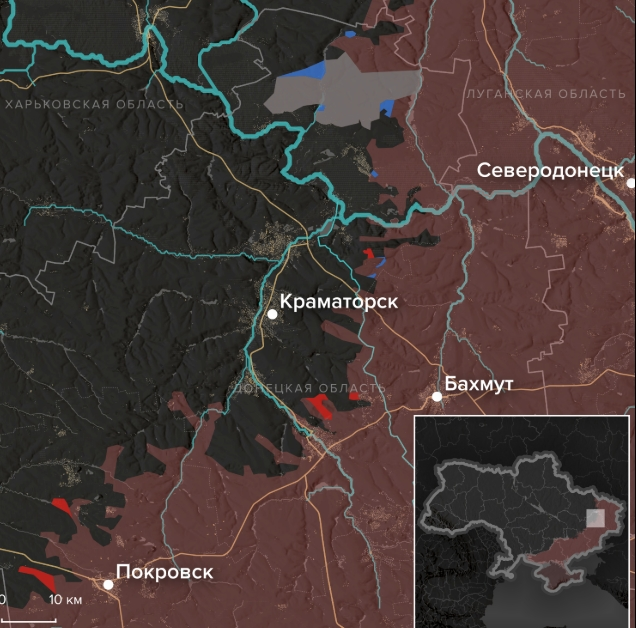
It is highly likely that Ukrainian forces will attempt a counterattack to halt the far more dangerous Russian offensive along the southern bank of the Siverskyi Donets River toward the town of Mykolaivka, and along the Siverskyi Donets–Donbas Canal toward the eastern outskirts of Druzhkivka and the southern outskirts of Kramatorsk.
In recent days, Ukrainian units—reinforced by the 46th Airmobile Brigade (which previously fought at the junction of the Dnipropetrovsk, Zaporizhzhia, and Donetsk regions) as well as at least one assault regiment—have been conducting a counterattack in the Rai-Oleksandrivka area, southeast of Mykolaivka.
Russian Offensive on Druzhkivka and Dobropillia
It appears the Russian command realized that the troops advancing on the Sloviansk-Kramatorsk complex could not achieve their objectives with the forces initially available. The group attempting to advance toward Druzhkivka from the west, along the Kazennyi Torets River, was reinforced by units from the 90th Tank Division and the 41st Combined Arms Army—forces that had previously fought for over a year in the border region of the Dnipropetrovsk and Zaporizhzhia oblasts—as well as by the 46th Ukrainian Brigade (which had also been redeployed to the central Donbas).
This reinforced Russian force managed to advance several kilometers along the Dobropillia-Kramatorsk road and came close to the outskirts of Druzhkivka. Simultaneously, some of the troops previously advancing in the area between Dobropillia and Druzhkivka were assigned a new mission: to increase pressure on Dobropillia from the east.
Another Russian group launched an offensive aiming to bypass Dobropillia from the southwest. However, these Russian attacks have not yet resulted in a decisive breakthrough. Both armies are evidently preparing for the autumn-winter campaign and the fierce battles southwest and southeast of Kramatorsk, for which they are massing forces in the central part of the Donbas.
Orikhiv and Malaya Tokmachka
Russian forces captured Malaya Tokmachka, a village that became famous more for its name than for its operational significance. To confirm this, the Russian command organized extensive aerial video footage showing soldiers raising Russian flags throughout the village.
Meanwhile, according to maps published by Ukrainian forces, the frontline had already retreated several kilometers northwest of Malaya Tokmachka.
The capture of Malaya Tokmachka was made possible not by the efforts of the Russian 70th Motorized Rifle Regiment—which had been fighting for it for years—but by the rapid advance of neighboring units.
Russian troops from the “Dnepr” group reached the outskirts of Orikhiv via Novodanilovka (a local Ukrainian “stronghold” that serves as the anchor for the entire Ukrainian defense in the central part of the Zaporizhzhia region). At the same time, another large Russian force group (“Vostok”), advancing from Huliaipole—despite months of Ukrainian counterattacks—reached the Orikhiv-Novomykolaivka road, effectively getting behind the Ukrainian 118th Mechanized Brigade defending Malaya Tokmachka. Consequently, defending the village became impossible.
The situation for Ukrainian forces near Orikhiv continues to deteriorate. The Russian command has deployed forces from one of its airborne assault divisions southwest of the city, with the clear intention of encircling the city from the west as well.
This division had previously been deployed along the banks of the Dnieper River south of Zaporizhzhia, near the village of Stepnohirsk.
During the summer, Ukrainian forces launched counterattacks in the Stepnohirsk area. Even then, it was suspected that this had been made possible by the withdrawal of Russian paratroopers from the sector to an undisclosed part of the front.
Now, they have reappeared near Orikhiv, precisely as Russian forces launch a decisive offensive against the city.