



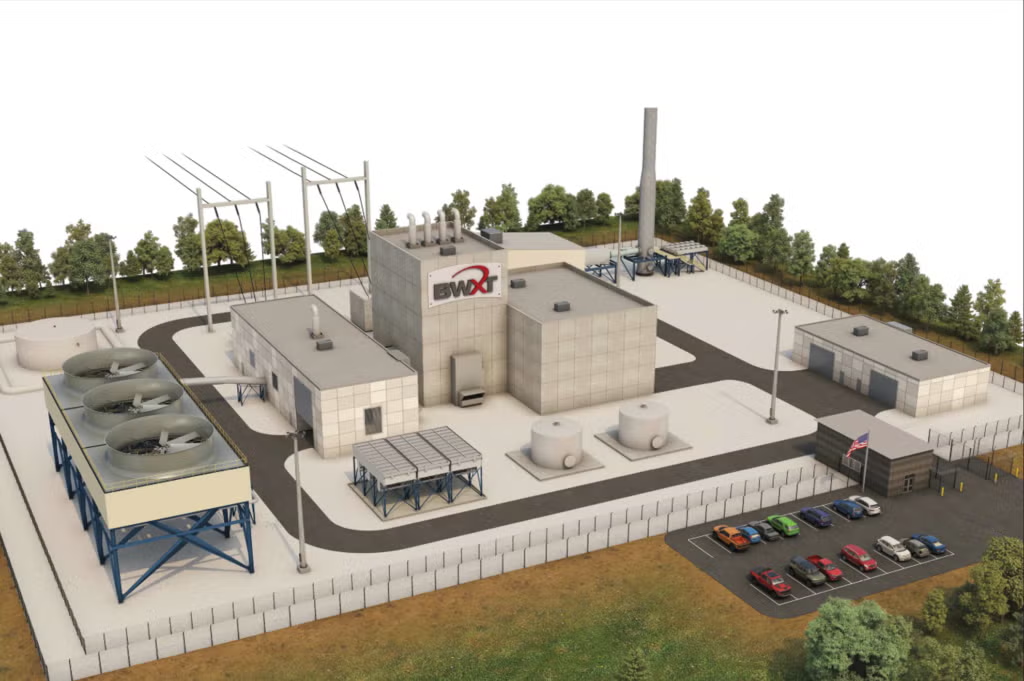
The U.S. Army is taking a major step toward adopting nuclear power at military installations by selecting five companies to develop and deploy a new generation of nuclear microreactors.
The Janus program, worth up to $2.2 billion, aims to create a more resilient and independent energy infrastructure for the U.S. military.
The basic business logic is that in a future high-intensity war, the U.S. electrical grid can no longer be taken for granted. Cyberattacks or even enemy attacks on critical infrastructure could disrupt power supply to military bases. At the same time, transporting large quantities of fuel to remote facilities can become particularly difficult. A similar situation can arise from major natural disasters.
In this sense, nuclear energy, with its specific application, can become a “game changer,” as Jeff Waksman, assistant secretary general of the Undersecretary of the Army at the Pentagon, argues.
Five companies, five bases
The five companies selected and the facilities (major US Army bases) where they will deploy their systems are:
- Antares Nuclear – Fort Bragg, North Carolina
- BWXT Advanced Technologies – Fort Campbell, Kentucky
- General Atomics Electromagnetic Systems – Fort Hood, Texas
- Radiant Industries – Fort Benning, Georgia
- Westinghouse Government Services – Fort Drum, New York
Up to 20 MW from reactors
Microreactors are significantly different from nuclear power plants. They are small, factory-built units designed to be transported and installed in different locations. Depending on the design, the units can produce from about 1 to 20 MW of electrical power.
For a military base, such a power source can power critical systems such as command and control centers, communications, radar, support facilities, data centers, and future energy-intensive systems such as directed energy weapons.
Their value lies not only in the production of electricity but mainly in energy autonomy. A reactor installed within a base could continue to operate even in the event of a loss of connection to the grid.
Milestone in 2028
The Janus program’s goal is particularly ambitious, as the Army seeks to have at least one small reactor operational by September 2028. The deadline is tied to 2025 executive orders that gave the U.S. Army a central role in accelerating the development of nuclear power for the Department of Defense.
It should be noted, however, that not all five companies are expected to have a reactor operational by 2028. The program is designed to maintain competition among the companies and to cut off funding for future milestones if a contractor fails to meet its goals.
From Energy Security to War Capability
The significance of the Janus program goes beyond saving electricity costs. The U.S. Army believes that future operations will require increasingly large amounts of electrical power, particularly due to the proliferation of UAS, electronic warfare systems, sensors, communications networks, and directed energy weapons.
At the same time, the ability to generate electricity locally reduces reliance on pipelines, fuel trucks, and the commercial grid, which is increasingly under pressure from new large consumers such as data centers. This is even more valuable for remote facilities such as those in Alaska.
The Janus program is thus an interesting example of how energy infrastructure is being transformed into a parameter of military power. If the program is successful, American bases of the future could have an independent, continuous, and highly resilient source of electricity, capable of maintaining critical operational functions even when the broader electrical grid has collapsed.

