



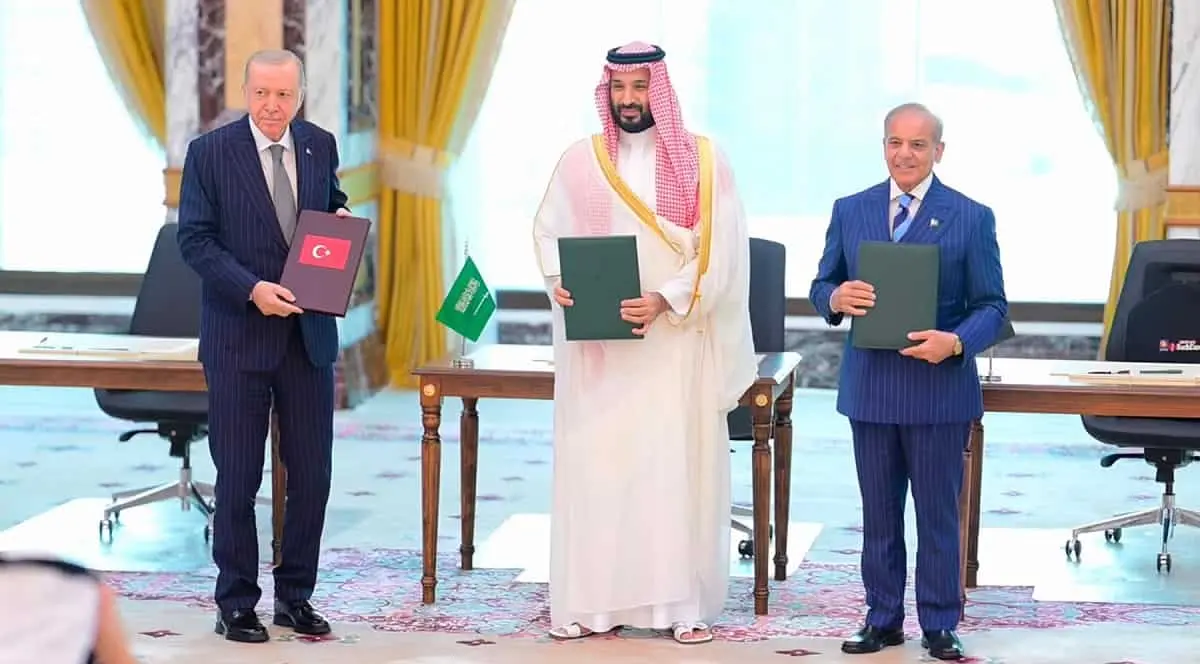
The defence pact between Saudi Arabia, Pakistan, and Turkey has the potential to become a new pole in the emerging new international system. Especially if it proves to be a hybrid of an “Islamic NATO,” which is what the signing of the Pact in the Muslim holy city of Mecca is clearly attempting to propagate (for more analysis on this issue please read the article titled “The “Islamic Defence pact”, a new pole in the international system – the Abraham Accords in danger“).
The starting point for the change in relationships that led to the agreement was set as October 7, 2023, when Hamas’s invasion of Israel led to chain reactions and military conflicts that gradually changed the image of the Middle East. And of the entire world, since it has the potential to decisively influence plans and desires for the new planetary balance…
But let’s take the reasoning a step further. Identifying October 7 and the wars that followed as a consequence automatically puts two countries in the frame. The first is Israel and the second is the United States. Both are part of the geostrategic equation of the region. Israel has always been a central actor as a country in the region, while the United States was the balancing factor.
The US, always serving its own national security interests, played the role of guarantor of the security of allied countries. It had been recognized by the Gulf monarchies as the country that ensured peace with its special military weight. The Islamic revolution of the Shiites in Iran in 1979 was another landmark moment in the course of the long-suffering geographical region of the planet.
Washington’s defeat at that time with the loss of Iran determined developments for many decades. The subsequent resurgence of the Shiite-Sunni conflict set the tone for security issues in the region. Today, Washington has clashed with Iran again, siding with Israel, with the pretext and real cause, at the same time, being Tehran’s nuclear activities.
The resilience that the Iranian theocratic regime has demonstrated is once again changing the balance in the Middle East… In essence, it constitutes another defeat for the US on the same front. It is recalled that a number of countries have pledged that they will have no other choice but to go nuclear if Iran acquires nuclear weapons, including Turkey and Saudi Arabia, while Pakistan, which is a participant in the defense pact, is responsible for the most organized network of nuclear technology proliferation in history. Let us not forget this…
Searching for an alternative geopolitical policy
The current war has consequences on two levels: The preservation of the theocratic regime in power exacerbates the security problem of the Sunni regimes. Its overthrow was the unacknowledged goal in Washington and Jerusalem. Combined with the general behavior of the Trump administration and the peculiar “bullying” towards friends and allies, it has decisively damaged the credibility of the American security guarantee.
Countries in the region, instead of choosing one-dimensionally the continuous financing of the desires of the American president, seem to choose the path of groupings among themselves, with the aim of creating an alternative solution to their security problem. Iran, always under the condition that the regime will continue to control the Islamic Republic, rightly scares the entire Middle East.
The war has obviously exhausted it. However, the regime’s resilience to overthrow attempts and its proven ability to hit any country in the region hard with its ballistic arsenal, combined with indirect control of the Bab el-Mandab Straits through the Houthis in Yemen, by definition sets the bar very high.
The three countries of the defense pact, on the one hand, wish to be assured if the US shows reluctance to provide a security umbrella. On the other hand, they reasonably expect that the collective pursuit of the security goal will bring better results against Washington.
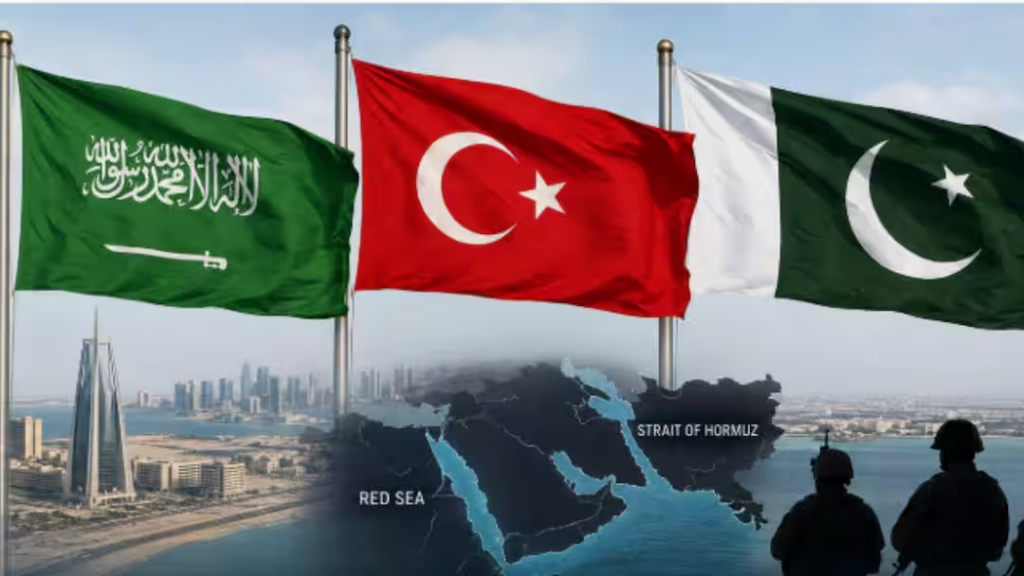
Strength… and flexibility in union?
And one more thing: At a time when the planet is sliding… willingly towards a revival of a Cold War and “blocs”, with the autonomous maintenance of channels of communication, at will and without exceptions with all the powers of the world being persecuted, does the defense pact facilitate, through collectivity, contacts and consultations, bypassing “bans”?
The case of Pakistan needs further in-depth study. The country is not geographically located in the Middle East. Pakistan borders the geographical space of the Middle East. At the same time, it has strengthened its relations with the USA of Donald Trump, in a development that has angered neighboring India. Pakistan, at the same time, maintains good-functional relations with Iran. This is also demonstrated in the active mediation aimed at overcoming the impasse of the war with the USA.
Consequently, the participation of the Pakistanis in the defense pact plays a very interesting role. The declared goal of the pact may be deterrence and collective defense. Islamabad, however, should be considered certain that it will continue its mediation attempts to find a way out of the Sunni-Shiite relations in the Middle East. Although thousands of Pakistani soldiers were in Saudi Arabia in the context of the implementation of the previous bilateral agreement.
Turkey’s obsession with Israel
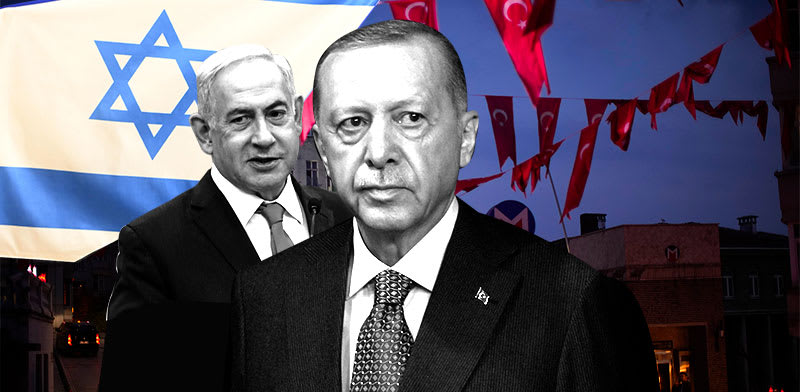
Turkey’s main motivation for joining the defense pact should be considered to be the problematic relations with Israel and the prospect of this Cold War front turning into a hot one… Obviously, the billions of dollars from the Saudis attract both Islamabad and Ankara and are a strong part of the motivation.
However, the analysis would not be complete if the potential impact that the defense pact will have on the famous Abraham Accords, the cornerstone of American policy in the Middle East in recent years, with the main goal of strengthening the security of the Israeli state, is not taken into account.
The spontaneous conclusion is that Turkey is positioning itself in a way that will allow it to play a role in any revival effort. The situation in Syria is becoming more complicated with each passing day, and the possibility of Turkish and Israeli forces coming face to face is not negligible.
Everything is judged on the ground
Given the inclusion in the defence pact that “an attack against one will be considered an attack against all,” how will this work at the level of deterrence, a concept that is also nominally present in the text of the joint statement? What is certain is that the Israeli state will attempt to render the declaration unreliable in practice.
- If the Israelis launch a strike against Turkish forces in Syria, what margin of successful intervention will Riyadh and Islamabad have on the ground?
- Is it possible that this issue was not raised in the months before, when the participants had negotiated the terms of the defence pact?
In addition, if the defense pact becomes a pole of attraction for other Muslim, Middle Eastern and non-Muslim countries, then the scene will have changed drastically. The prospect, that is, of the pact evolving into an “Islamic NATO”. The defense pact may, at first glance, give such a character to the agreement. However, it will be judged in practice.
However, Erdogan kept his tone low in his statements, apparently to avoid causing reactions from the Alliance of which Turkey was already a member (NATO), but also because realistically, we will see how it will develop. It should be noted, however, the… copying of Greek rhetoric regarding the strategic cooperation with Israel, as he made sure to state that “it is not directed against anyone”!
A “cultural” parameter
In conclusion, there is another issue that has not been taken into account, although it is of paramount importance. It concerns the difference in political systems between the Western world and those of the countries of the defense pact. In other words, it is an informal… “cultural factor” that may prove decisive.
Everything is more or less known about Erdogan’s “elected dictatorship” in Turkey. Pakistan also has democracy and elections. However, everyone knows the power and special weight of the Pakistani armed forces and their secret services. As for Saudi Arabia, it is also a very centralized regime characterized by the absolute power of the monarch.
In the USA, to give an example, whatever President Trump says publicly does not automatically entail implementation. In contrast to what is happening in Saudi Arabia, where Mohammed bin Salman has the first and last word. There is no Congress there that can successfully oppose the royal will. There are no “checks and balances”.
It is also extremely doubtful that anyone, whether from the army or from the intelligence services and the various ministries, will be willing to disagree with the general direction of the leader and argue freely. Although these positions are usually occupied by members of the Saudi royal family. Not by some politicians or technocrats.
Consequently, how can anyone be sure that anything that some leadership takes personally will not happen, will be offended, and as a result, the defense pact that was signed with so many expectations will be seriously damaged in practice? And because Erdogan’s “licking” and his adaptability towards the Saudis is well documented, the problem will not arise from there.
The game of balances
What will happen if the exact opposite happens? If, for example, the famous Saudi leader raises the issue of Turkey’s inclusion in the Abraham Accords?
And a second example: What will happen if, in the event of a Greek-Turkish crisis, the Saudis, after a performance by the -clearly annoyed by the development today- Greek diplomacy- asks Erdogan to back down?
It is not possible to tolerate an insulting underestimation of Greece’s contribution to the proven protection of Saudi Arabia from Iranian attacks.

