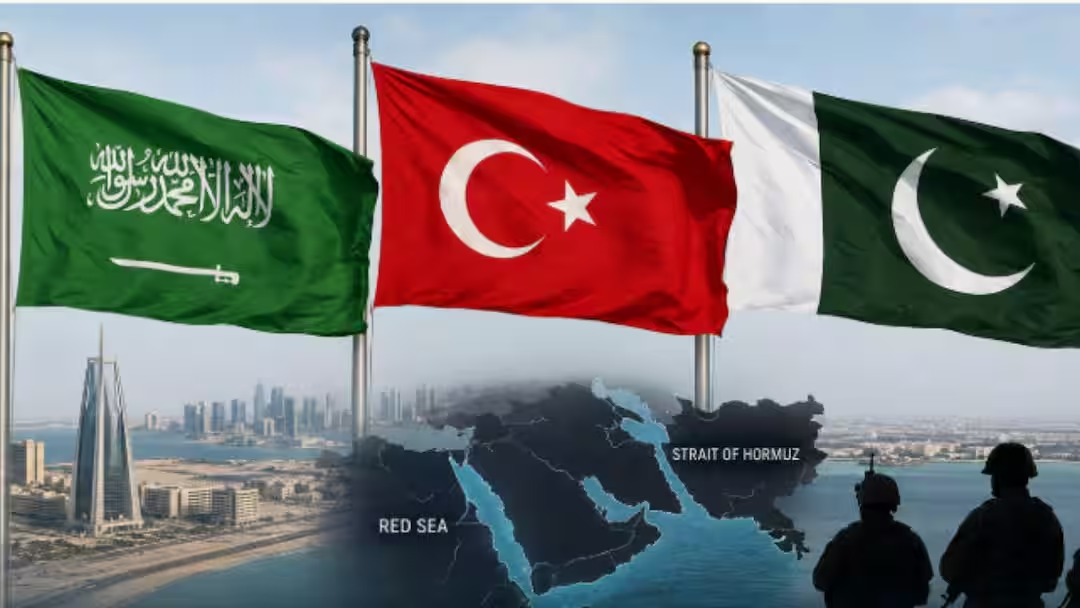
The publicity given to the signing of the trilateral defence pact between Saudi Arabia, Pakistan and (NATO member country) Turkey is entirely proportional to its importance, which is obviously regional, but also with a clear influence on the new global distribution of power being sought.
The gradual disengagement of the US as the guarantor of the security of the Middle Eastern countries, forced by Iran to agree to the new regime of the Straits of Hormuz, led these three (first countries?) to be led into a defence agreement.
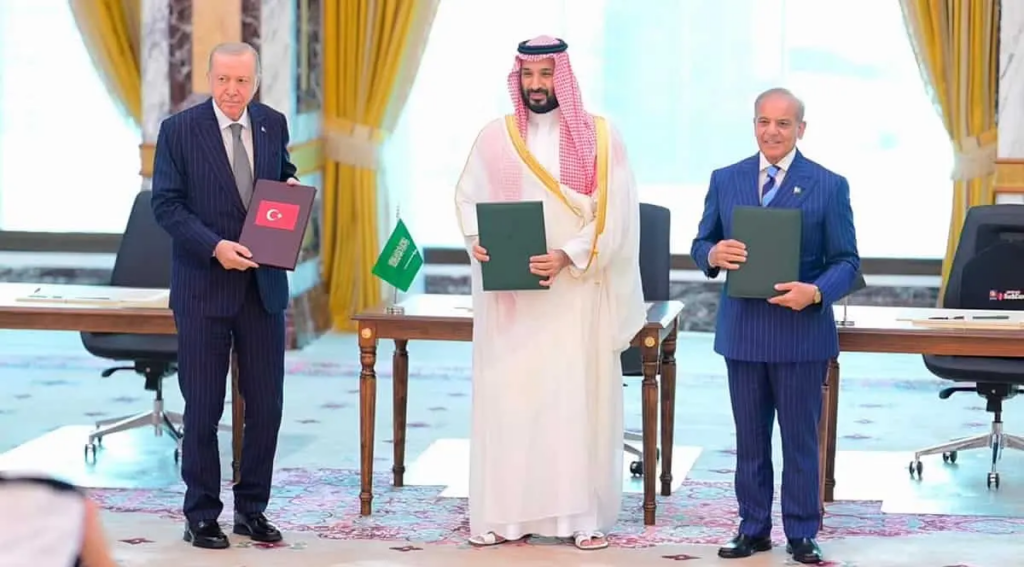
Hosted by Mohammed bin Salman of Saudi Arabia, who welcomes Pakistani Prime Minister Shehbaz Sharif and Turkish President Recep Tayyip Erdogan in Jeddah. Negotiations for the substantive expansion of the bilateral defense agreement between Riyadh and Islamabad (Strategic Mutual Defense Agreement) were underway and had intensified in recent months.
Initially, it was not clear whether the Pact would include a provision that an attack on one party would be treated as an attack on all. “The agreement aims to strengthen collective deterrence against any aggressive action and stipulates that any military attack on one of the three countries will be considered an attack on all,” states the statement from the Pakistani Foreign Ministry, which is also mentioned in the statement by the foreign ministries of Saudi Arabia and Turkey.
This reference constitutes a qualitative upgrade. It was not easy to include such a condition, especially given the geographical extent of the Pact and the potential adversaries of its participants! For example, why wouldn’t Riyadh want to avoid being obligated to get involved in a potential Turkey-Israel war? Similar calculations apply to the potential India-Pakistan and Greece-Turkey fronts!
October 7, 2023 – The starting day of the rapprochement of the three countries
What is of key importance is identifying the events of October 7, 2023 as the genesis of all these developments. The invasion of Hamas forces into Israeli territory and the massacre that followed.
The fierce response of the Israeli state, initially against Hamas, gradually reaching the point of targeting Iran itself and the rest, in addition to Hamas, the “arms” of its strategy in the Middle East (Hezbollah in Lebanon and the Houthis in Yemen). Almost three years have passed since the start of this ongoing war that involved the United States in the Middle East. Initially, it was to the benefit of Russia due to the forced shift of American attention from Ukraine.
This is none other than the realization that the role of “non-state actors”, but mainly the organizations Hezbollah and Hamas, which played a pivotal role in developments in the Middle East for about half a century, has reached its limits. Now, they generate developments that escape the control of their traditional state patrons and the consequences can be catalytic, in undesirable directions.
The extremist Islamic organizations were mainly financed by the Arab monarchies of the Gulf, because they were used for decades as a relief valve for internal problems. They shifted the attention of Arab societies to the traditional, convenient enemy: Israel. However, the exacerbation of the Shiite-Sunni conflict in the Middle East gradually changed the calculations.
Hezbollah and Hamas eventually strengthened despite the heavy Israeli military strikes. Tehran, copying the model, “appeared” the Houthis in Yemen in addition to supporting Hezbollah, as a result of which it carried out a projection of power in every geostrategically critical point of the wider Middle East. The game was becoming increasingly complex…
It is common knowledge that Hamas’s operation on October 7, 2023, was actually intended to provoke a conflict that would short-circuit the imminent expansion of the Abraham Accords to include Saudi Arabia, as it was reasonably assumed that the Palestinians would be the big victim. It is recalled that in their original form (September 15, 2020), the Accords provided for the signature between Israel, the United Arab Emirates, and Bahrain, to be followed shortly by Sudan and Morocco.
Hybrid Islamic NATO
And that’s how we got to today’s development. Could the trilateral defense pact resemble a hybrid “Islamic NATO”. The Saudi wallet combined with the Turkish performance in the defense industry and the Pakistani nuclear arsenal! Game-changing development that will affect regions beyond the Middle East!
Exactly, the above model is reminiscent of the combination of the “wallet” of the United Arab Emirates with the defense needs of India and the status of Greece as a NATO member country. The strategic partnership between India and Israel and the corresponding one between the United Arab Emirates and Israel has set a new dimension.
Somewhere in there comes another dimension that concerns the commercial-geoeconomic corridors that are being planned! How will it affect the competing strategic visions between the IMEC (India-Middle East-Europe Economic Corridor) on the one hand and the Turkish vision on the other?
IMEC is supported by the US, EU, India and Saudi Arabia (ed. by sea to the Arabian Peninsula and by rail and Saudi Arabia, Jordan and Israel, to be transported to ports such as Piraeus-Hellas (EU)!) Ankara wishes to connect the Gulf via an Iraqi port and via road and rail transport to Turkey, en route to European markets!
By participating in the trilateral defense pact, Turkey will obviously attempt to present its participation in a politically correct manner. That is, as an effort to bridge the new pact with the broader Western security architecture, strengthening its importance and role. However, since there are many gray areas and there is a long way to go from signatures and intentions to action, let’s keep it small. It is another regular Turkish move on the grand geopolitical chessboard.
- We recall the “Arab Spring” that Erdogan actively supported, as an aspiring protector of the Muslim Brotherhood.
- We recall the personal insults and insults on the occasion of the case of the Saudi journalist Khashoggi.
- We also recall the confrontation between the Saudis and the Turks in the Libyan civil war.
And now we have a defense pact signed… The quicksand of international politics in all its glory.