
The Naval Battle of Artemisium, which took place alongside the Battle of Thermopylae, was a naval conflict between the Greeks and Persians during the second Persian invasion.
At the northernmost tip of Euboea, opposite the Magnesian mountain of Pelion, lies Cape Artemisium, famous for the naval battle between the Greeks and Persians in August 480 BC. The cape takes its name from the sanctuary of Artemis Prosioa, which was located on the beach where the Greek fleet anchored during the naval battle. The key geographical position of the area (which controls the entrance from the open Aegean to the Pagasetic, Malia and northern Euboean Gulfs towards Chalkis), led to a large extent to its development during antiquity.
As no substantial excavations have been carried out to date, information about the area is mainly due to the identification of visible remains, to traditions of antiquities and to the few literary testimonies, which refer only to the sanctuary of the Goddess Artemis and the infamous naval battle of 480 BC. The inscription of Artemisium also provides important information about our area, which mentions the names of 17 Euboean municipalities (of which, however, none has yet been identified with a specific location in northern Euboea).
Already from the beginning of the 5th century BC in the Aegean region, the prospect of a conflict between the Persian Empire and the Greek city-states was looming. The Persians, having subdued the Kingdom of Lydia, also occupied the Greek cities of Ionia and later extended their rule to the neighboring Aegean islands. Tyrannical regimes were imposed on these cities by people trusted by the Persian Court.
However, the Persian administration, the local satrap who had his seat in Sardis and the royal Court of the country, had realized that it was difficult to hold the lands of Ionia as long as other Greek cities remained free on the opposite side of the Aegean.
This perception was confirmed by the events of the Ionian Revolt that erupted in 499 BC, when Athens and Eretria offered assistance to the Asia Minor cities that were trying to free themselves from the Persian yoke. The punitive reaction of the Persian Empire was not long in manifesting itself.
A few years after the suppression of the Ionian Revolt, in 492 BC, a fleet led by Mardonius attempted to invade Greece by sailing along the coast of Macedonia, but was broken up by a violent storm off Athos in Chalkidiki. This failure, which was due to the furious fury of the sea, made the Persians very cautious and wary of all future naval operations they conducted in the unexpectedly destructive Aegean Sea.
In 490 BC, another Persian fleet with generals Datis and Artaphernes, crossed the Aegean, this time sailing through the Cyclades directly to Euboea where it completely destroyed Eretria, thus punishing its inhabitants for the help they had offered to Ionia. The Persians then sailed to Attica and landed at Marathon, where the Athenians and Plataeans, led by Miltiades, crushed them.
The new failure did not discourage the Persian king Darius. In fact, it helped him realize that the conquest of Greece would require a much better organized campaign and, above all, much larger military and naval forces. Immediately after Marathon, Darius began to make grandiose plans for the next attack on the Greeks, but riots that broke out in other parts of his vast Empire prevented him from implementing them. Ten years later, in 480 BC, and while Darius had died, his son and successor Xerxes (“Xeyarsa”) was able to carry out his father’s plans.
The Methodical Preparation of the Great Persian Invasion
According to the Persian plan, the numerous army of the Empire would cross into Europe through the Hellespont and from there march through Thrace and Macedonia to mainland Greece. The naval forces that followed would sail close to the Thracian and Macedonian coasts, in order to maintain constant contact with him. A major problem for the movement of Xerxes’ naval forces was the cape of Athos and the dangerous sudden storms that occurred in the area.
The Persians did not forget that Mardonius’ fleet had been destroyed there and they reasonably wanted to prevent a similar eventuality. Moreover, in this campaign, despite the fact that their army was not transported by ships as in the previous ones, their navy had assumed a particularly vital role, ensuring the communication of the army with the Empire.
Maintaining this communication was particularly important, as the Persian army was accompanied by King Xerxes himself. For this reason, a canal was constructed in the Northern part of the Athos peninsula, at the point where the peninsula joins the main body of Chalkidiki and a very narrow isthmus is formed.
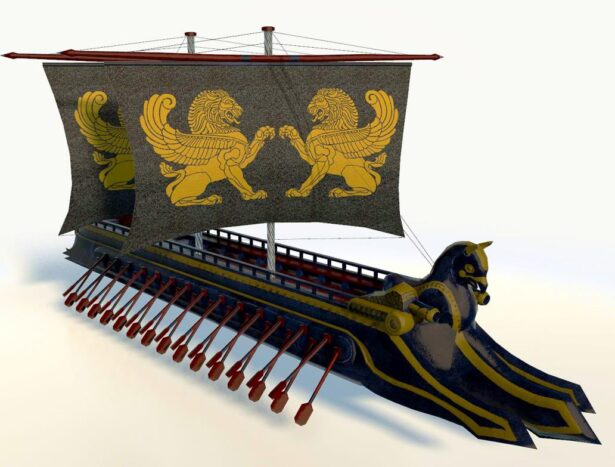
The Persian naval forces consisted mainly of Phoenician ships, but also Greek ships from the cities of Asia Minor and the neighboring islands. Naturally, the Persians did not have much confidence in the Greek crews, due to the rebellion they had attempted in 499 BC and also due to the fact that Greek citizens would have to fight with their own countrymen.
It is true that among the Greeks who served in the Persian fleet, many desired the freedom of their cities. However, others served Xerxes faithfully until the end of the campaign, either out of interest or because they considered it impossible to defeat such a large force as the one that had been assembled for the universal subjugation of Greece.
The Politico-Military Organization of the Greeks
When the inhabitants of the city-states of southern Greece were informed that the Persian army was approaching, they were terrified because of its enormous size. Many believed that any resistance was futile and preferred to remain neutral or declare allegiance to the Persians.
Those cities that decided to resist, judging that only by cooperation among themselves would they have hoped to succeed, organized a conference in Corinth to coordinate their action. A basis for this gathering of Greek cities was the alliance founded by the Spartans led by their city and members of several cities of the Peloponnese.
The initial purpose of the alliance was to protect Sparta from the attacks of Argos, but due to the developments it was used to unite the Peloponnesians against the Persians.
Other Greek cities from Central Greece agreed to cooperate with the Spartan alliance and thus created the first major alliance between the Greek cities in order to prevent an external invasion.
In the official decisions of the alliance, its members appeared under the title “Greeks” and were completely equal to each other. Each city had its own representatives (“promoters”) and its opinion could be heard regardless of the size of its population, its size or the military forces it could offer to the common cause.
Sparta secured the primacy in military matters and it was stipulated that the commanders of the military and naval forces of the alliance would be Spartans.
The fact that Sparta did not exploit the Persian invasion to impose its hegemony on the rest of the Greek cities and accepted that all members of the alliance were equal, clearly demonstrates an increased political insight in the face of the ultimate danger that threatened the freedom of the Greeks.
Despite the formal equality, some cities stood out due to their strength or the ability to influence other cities in the alliance. Sparta provided the most capable military units and the bulk of the alliance’s army was made up of its own forces and those of its Peloponnesian allies.
Athens provided the bulk of its fleet and had the support of the plebeians it had established in Euboea, as well as its loyal traditional allies from Boeotia, the Plataeans and Thespians.
Corinth also provided a large part of its fleet and had the support of its colonies that had joined the alliance, Lefkada, Potidaea, Anaktoria and Ambracia.
The Greek military forces numbered 40,000 heavily armed hoplites and another 70,000 lightly armed. The naval forces of the Greek alliance consisted of 400 triremes and a smaller number of pentecontores (lighter ships with fifty oars). About half of the triremes belonged to the Athenians.
The Greeks had an advantage in hand-to-hand combat, because the heavy armor of the Greek hoplite protected him from most of the blows that the lightly armed Persians could inflict on him.
However, this advantage was lost in open terrain, where the numerous Persian cavalry and the highly skilled Persian archers could deploy and act freely. The Greek alliance had little cavalry, because Thessaly, a region renowned for its horses and horsemen, preferred to declare its allegiance to the Persians.
Therefore, it was decided that the Greeks would defend narrow points, where the Persians could not use their cavalry, while the Greek fleet would support them by preventing the Persian ships from transferring forces to the rear of the Greeks.
The Military Preparations of the Rival Camps
Various calculations have been made regarding the size of the Persian fleet, many of which are indeed exaggerated. According to Aeschylus in his tragedy “Persians” and Herodotus, the Persians had 1,207 ships, of which 207 had speed and maneuverability comparable to the Greek triremes. This calculation seems to be the most correct.
However, Herodotus also mentions 3,000 smaller ships, pentikontoros and triakontoros, that is, ships with fifty or thirty oars, and other auxiliary vessels for transporting supplies, soldiers and horses. Another source mentions 850 horse-drawn ships in addition to the 3,000 light vessels.
These ships, to be manned, required more than half a million sailors, rowers and soldiers. Together with the men of the auxiliary services, the total number of people employed by the Persian fleet amounted, according to Herodotus, to one million.
This number must be rejected as excessive. During the march and operations, the Persian fleet lost several ships, as a result of which it is not easy to calculate the exact number of those who participated in the operations at Artemisium and later at Salamis.
The leadership of the Persian fleet was assigned to Achaemenids, who commanded the Egyptian ships, and to Ariabignes, who commanded the Ionian and Carian ones. All ships had Persian captains and Persian military detachments for attacks on enemy ships and to prevent possible mutiny of the crews.
The greatest problems that the Persians faced in their fleet were due to the inexperience of their officers at sea and the lack of loyalty of the crews, who had largely been recruited against their will and did not share the expansionist ambitions of King Xerxes.
In 480 BC, a new congress was convened, where initially the idea of the Greeks resisting the Straits of Tempe was supported. A delegation from Thessaly proposed to the Greeks to stop Xerxes at the Straits of Tempe.
However, the Persians learned from their subject Alexander I of Macedon that the valley could be bypassed through the Sarantaporos Pass, so due to the larger size of the Persian army, the Greeks retreated.
Shortly afterwards, they learned that Xerxes had crossed the Hellespont. Then, the wise Themistocles proposed a different strategy to the allies: Xerxes would be forced to pass through Thermopylae to reach Southern Greece.
Therefore, Themistocles suggested to the Greeks to close the narrow pass of Thermopylae, where the Persians would not be able to use their numerical superiority.
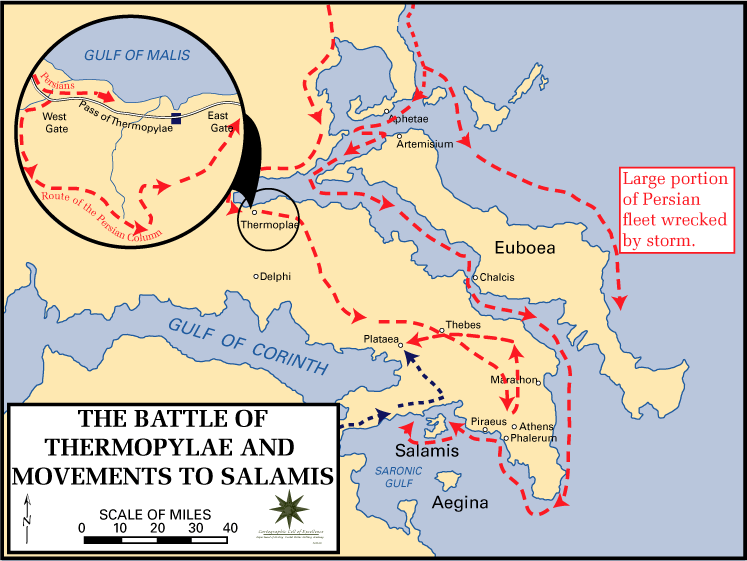
The Greek fleet moved to Artemisium, in northern Euboea, to prevent the Persian fleet from entering the Malia Gulf and striking the defenders of Thermopylae.
The position was extremely favorable because it was protected from the southerly winds by the mountains of Euboea and from the northerly winds by the Pelion massif on the opposite coast of Magnesia.
The possibility that the Persians would attempt to circumnavigate Euboea to appear in Attica or Thermopylae via the Euboean Gulf was ruled out, because it was certain that Xerxes would not risk his fleet in an operation that required a course in the precarious open sea.
Once again, the fear of a disaster similar to that suffered by Mardonius at Athos shaped the tactical choice of the Persians.
According to Herodotus, the entire Athenian fleet sailed to Artemisium. This information contradicts an Athenian decree found on an inscription in Troezen, an area where Athenian refugees fled when their city was captured by the Persians after the battle of Thermopylae, and states that the Athenians, before departing their ships for Artemisium, decided to abandon their city.
If this happened, it means that the Athenians doubted the possibility of the Persians being defeated at Thermopylae, something for which there is no corresponding indication. Herodotus, on the contrary, states that Athens was abandoned in a hurry, after it became known that the Persians had passed Thermopylae. According to the same inscription, the Athenians did not send all their ships to Artemisium but only half, about a hundred.
The remaining ships were kept in the Saronic Gulf, because they were afraid that the Persians might eventually attempt to circumnavigate Euboea to attack them. Judging by the situation and the possibilities that existed, it seems that Herodotus’ information is more correct.
The inscription of Troezen was probably created later for propaganda reasons. It is more correct to accept that the greater part (and not half) of the Athenian fleet fought at Artemisium.
The Opponents at Artemisium
Clearly the Persians had the advantage, due to numerical superiority and more quality ships. (John Francis Lazenby (1934-2024), Emeritus Professor of Classical History at Newcastle University, “The Defence of Greece 490–479 BC”, Warminster, Aris & Phillips Ltd, 1993, page 138) The Persians, according to Herodotus, had better sailors – most of the Athenian ships (and by extension most of the Greek fleet) had been recently built and their crews were inexperienced.
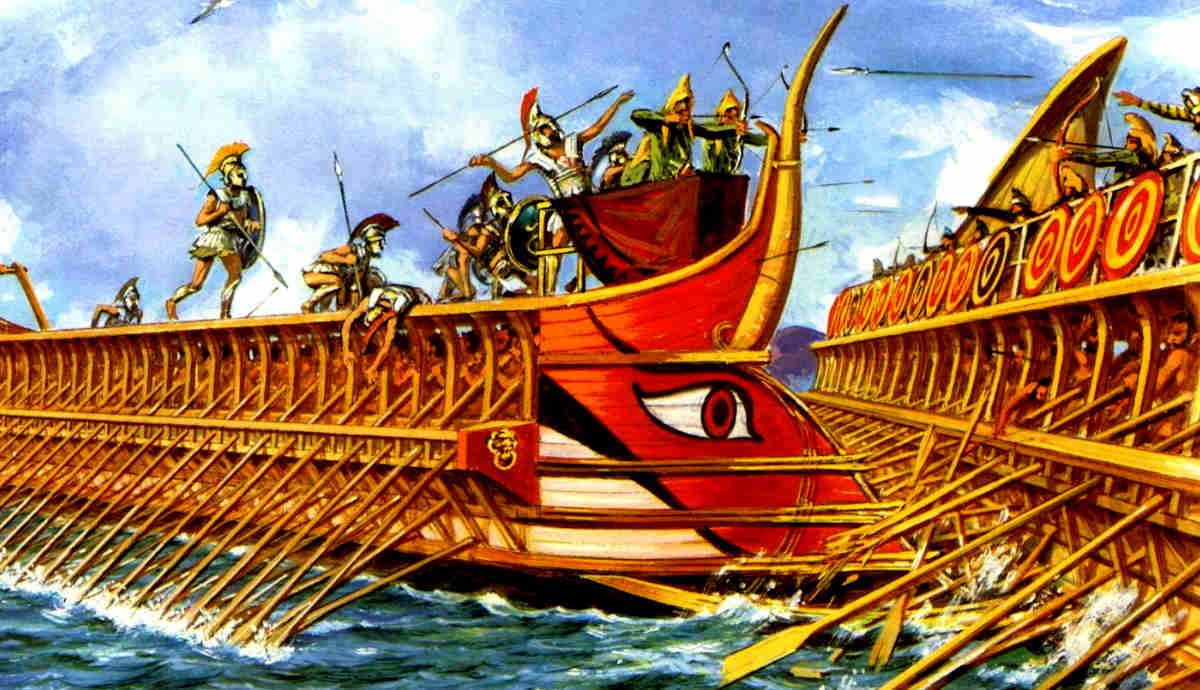
The most common naval tactic in the Mediterranean at this time was ramming (triremes were equipped with a ram), or the use of hoplites (“passengers”, like today’s marines), (same as above pages 34-37)
The Persians and the Greeks of Asia Minor had begun to use a maneuver known as “diekplous” (Xenophon “Hellenka” a’ 6,31). During this maneuver, the ship entered a gap between ships of the enemy formation and turned sharply, ramming the enemy ship on the sides.
The Persians had sufficiently experienced sailors to execute this maneuver, but the Greeks had devised a tactic to neutralize it.
There has been much debate about the fighting ability of the Greek and Persian fleets. Herodotus states that the Greek ships were heavier, and therefore less maneuverable. According to modern historians, the Greek ships were heavier by construction or had not dried out since the winter.
Others state that the great weight of the Greek ships came from the weight of the hoplites (passengers) on board, twenty of whom seem to have weighed (with their equipment) about two tons. This great weight would reasonably reduce the chances of the Greeks repelling the “dijklop”.
Nevertheless, it seems that the Greeks had more hoplites than normal, because their main tactic was the “boarding” (the raid from ship to ship, the today’s well-known “resalto”). Indeed, Herodotus reports that the Greeks at Artemisium did not sink the Persian ships, but captured them.
According to Herodotus, the Greek fleet at Artemisium initially numbered 271 triremes and nine pentecontoros. The Athenians participated with 127 triremes and had made available another 20 to be manned by Chalcidians. The remaining 53 Athenian triremes are absent from the record, which were probably left in the Euripus to be used as reserves.
The naval operations began with the dispatch of three Greek ships to the Thermaic Gulf for reconnaissance. These ships encountered ten Persians off Skiathos and were eventually captured, a fact that severely damaged the morale of the Greek crews.
According to Herodotus, the Greeks initially retreated to the Euripus Strait and then decided to return to Artemisium. However, it is more likely that the entire fleet was not moved, but only the squadron of 53 Athenian triremes, which had a reserve role.
The purpose of this movement was to guard the strait separating Euboea from Boeotia in order to prevent surprise by the enemy, if the Persians managed to circumnavigate Euboea from the Aegean side.
In July, the main operations began, as the Persian army reached Thermopylae and the Persian navy reached Magnesia, opposite Artemisium. The Persians anchored at a point between Kastanaia (or Kasthanaia, built at the foot of Mount Pelion, northeast of the modern settlement of Keramidi) and the cape of Sepia (at the southeastern tip of the Pelion peninsula, in Magnesia).
Because their ships were so numerous, it became impossible for them all to find a place on the coast and so they lined up in eight rows along it.
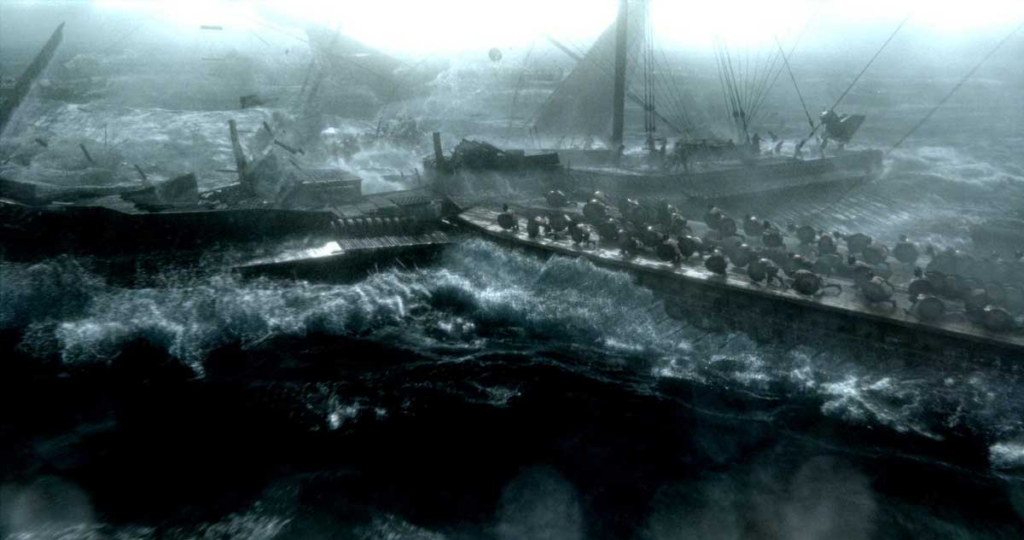
While they were in this vulnerable position, a sudden storm hit their fleet, which lasted for three days, resulting in the loss of several ships. This development encouraged the Greek crews and many believed that it was tangible proof of the gods’ favor towards the Greeks.
The Persians then moved their fleet to the Aphetes. During the confusion that prevailed at that time, 15 Persian ships were separated from the rest of the fleet and were captured by the Greeks. Various accounts have been given of the exact location of the Aphetes.
It has been claimed that they were located in the Pagasitic Gulf or south of Trikeri, but it is most likely that it was the present-day bay of Andriamis, northeast of Artemisium, in the southern part of the Pagasean peninsula. The size of the Persian fleet shook the morale of many on the Greek side. The Corinthians in particular, but also other Peloponnesians, sought to retreat to the isthmus.
If this were done, the defenders of Thermopylae would be left unprotected and there was a risk that many cities of Central Greece, seeing their allies abandon them, would end up submitting to the Persians. Finally, it was decided to remain the fleet at Artemisium for as long as the operations at Thermopylae continued.
The Attempt to Trap the Greek Fleet
The leaders of the Persian fleet decided to block the Greeks at Artemisium even if it meant risking the circumnavigation of Euboea. A squadron of 200 Persian ships was ordered to attempt the circumnavigation in secret.
When these ships reached the Euripus, they would alert the Persian fleet to attack the Greeks. The latter would retreat to Chalkis, where the ships that had completed the circumnavigation of Euboea would be waiting for them.
The Greeks were informed of the Persian plan by the famous diver Skyllias Skionaeus, who swam the distance from Aphetes to Artemisium, about 18 km, to alert them. Herodotus prefers the more convincing version that the famous diver used a boat.
Scyllias also reported on the heavy damage the Persians had suffered from the recent storm. At Artemisium the Greeks decided to retreat at night to the Euripus to avoid being surrounded. Their aim was to search for the 200 Persian ships there and neutralize them before they could surround them.
Themistocles, the leader of the Athenian fleet and to a large extent the organizer and creator of the Athenian naval power, was opposed to the plan of retreat (after the Battle of Marathon, silver deposits had been discovered in Lavrion.
Themistocles convinced his fellow citizens to exploit the profits for the construction of a fleet and not to receive them in the form of a state subsidy, as they had originally planned. Thus, when the Persian threat reappeared, Athens was ready to face it with its fleet).
At the urging of Themistocles, the Greeks attempted a test attack against the Persians in the afternoon to determine their capabilities and tactics. When they saw the Greek ships attacking, they hoped for an easy victory, due to the small number of opposing vessels.
The Persian ships sailed, met the Greek ships about halfway between the enemy anchorages and managed to get around them.
However, the Greek triremes, with excellent coordination, formed a circle with their guns facing outward, ready to face the enemy attack. They then launched an attack, trying to break through the Persian line and get to the rear of the Persian ships.
The conflict lasted until sunset, when the two opponents separated. For the Greeks, this operation was crowned with great success and about 30 Persian ships were captured. Thus, it was decided not to retreat. The decision to avoid retreat was absolutely correct.
During the night, stormy winds prevailed, so the 200 Persian ships that were trying to sail around Euboea were wrecked on a dangerous coast called Koila.
The storm also caused damage to the Persian ships that were in Aphetes, among other things because it dragged the wrecks of the previous day towards them.
The next day, the 53 Athenian ships that were in reserve in the Euripus sailed to Artemisium, carrying the news of the destruction of the Persian squadron.
After this failure, the Persians abandoned the idea of attempting the circumnavigation of Euboea and concentrated their efforts on Artemisium. Because their ships had suffered significant damage from the previous night’s rough seas, they decided not to attempt anything until they had repaired them.
Thus, the initiative passed to the Greeks, who in the afternoon of the same day launched a new attack against the Persians. This time, they did not sail but remained anchored at Aphetes. The Greek fleet managed to approach and, without resistance, destroy the Cilician ships, which were on the outer side of the bay.
As night fell, the Greek fleet returned quickly to Artemisium. The Persians did not attempt to pursue it due to the advanced time.
The Final Naval Battle at Artemisium
The next day the Persians attempted to regain the initiative and in the middle of the day they sailed from Aphetes with their entire fleet. The Greeks preferred not to sail to the middle of the strait but to remain at Artemisium in order to take advantage of the narrowness of the space.
Both fleets lined up facing each other in a semicircle. The Persians tried to lure the Greeks towards the middle of the strait in order to attempt to surround them again or push them towards the coast and block them there.
However, they made sure that the ends of their formation were very close to the coast, in order to prevent the possibility of their encirclement. The clash that followed was particularly fierce.
Heavy losses were inflicted on both sides, without a winner emerging. Half of the Athenian ships were damaged, while five Greek vessels were captured by the Egyptian ships of the Persian fleet.
Among the Greeks that day, the Athenian Cleinias, the father of Alcibiades, distinguished himself. The agile Greek ships caused significant damage to the Persians, who, however, due to their size, managed to maintain their formation and avoid defeat.
The Greeks essentially emerged as the winners, because they managed to achieve their goal once again, namely to prevent the Persians from entering the Maliac Gulf.
After the end of the naval battle, a trireme arrived at the Greek anchorage with the Athenian Avronichus, son of Lysicles, who announced the Greek defeat at Thermopylae and the heroic death of the defenders of the strait.
The Greeks decided to withdraw immediately, in order to avoid the risk of being surrounded. There was, moreover, no reason for the ships to remain at Artemisium. The defense of Thermopylae, which they were supporting, had collapsed. The Greek fleet headed for Salamis, with the aim of helping to evacuate Attica.
During the retreat, Themistocles made sure that his ships approached all the points where there was drinking water and therefore it was possible for the ships of the Persian fleet to make a stop to refuel, in order to leave messages to the Ionians and the other Greeks who were in the Persian fleet.
With these, he asked them not to fight their fellow countrymen with passion, to try at every opportunity to create problems for the Persians and to convince the Carians, who maintained good relations with the Greeks of Asia Minor and were to a certain extent Hellenized, to do the same:
“Men of Ionia, it is not right that you fight against your fathers and enslave Greece. It would be better for you to fight on our side. But if that is not possible, at least during the battle stay on the sidelines and persuade the Carians to do the same.
But if you can do neither, if you decide to stay on the side of the greater power, when we come to blows, act like cowards and remember that we are of the same blood and that the cause of the enmity with the barbarians came from you.”
Regardless of the impact these appeals had on the Greek and Carian crews of the Persian fleet, they certainly greatly increased the Persians’ distrust of them.
The Greeks’ Gains From the Battle of Artemisium
The Greeks emerged from Artemisium essentially victorious, although they retreated. They had succeeded in preventing the Persian fleet from passing as long as was necessary for the continuation of the land operations and had caused the Persians heavy losses.
In total, the Persians lost about half of their warships during the operations and due to the storms that hit their fleet, which greatly changed the balance of forces before the great conflict in the waters of Salamis.
The Persian fleet had lost about four hundred ships due to a storm in Magnesia, while later it lost another two hundred ships in Euboea, which it sent to trap the Greeks.
In addition, the morale of the Greek crews was extremely high, because they found that they could defeat the Persians thanks to their superior tactics and the speed and agility that distinguished the triremes compared to the cumbersome ships of their opponents.
Plutarch, in his work “Themistocles” (part of the larger work “Parallel Lives” in the fourth comparative biography with Camillus) writes that, although the naval battle did not significantly change the course of the war, it greatly benefited the Greeks:
“The naval battles, which were then fought against the barbarian fleet in the straits, did not exert a great influence on the general situation, but gave the Greeks the greatest experience, because from the dangers they learned that neither the multitudes of ships, nor the splendors of the officials, nor the elaborate cries and paeans of the barbarians inspire fear in men who know how to fight and are bold, but must, despising all this, rush against the enemy and fight them.”
The Battle of Artemisium, according to Tom Holland, is not considered important, as the Greeks did not manage to stop the Persian fleet [as analyzed by the English classicist historian and novelist Tom Holland in his work “Persian Fire”, London, Abacus Editions, (2005) pages 338-341] – on the other hand, neither did the Persians manage to destroy or weaken the Greek fleet. (in the same pages 294-295).
On the other hand, according to Holland, Lazenby and Herodotus, it was the first experience for the Greek crews, which proved decisive in the naval battle of Salamis – the Greeks had learned the tactics of the Persians (as reported by Herodotus, Lazenby and Holland).
In the waters of Artemisium, the freedom of the Greeks was not definitively judged, but the charismatic Greek seamanship was certainly certified and the way was opened for the subsequent cosmogenic success of Salamis.
“ὅθι παῖδες Ἀθαναίων ἐβάλοντο φαεννὰν κρηπῖδ’ ἐλευθερίας”
“Where the children of the Athenians laid the bright foundation of freedom” – Pindar for Artemisium


