



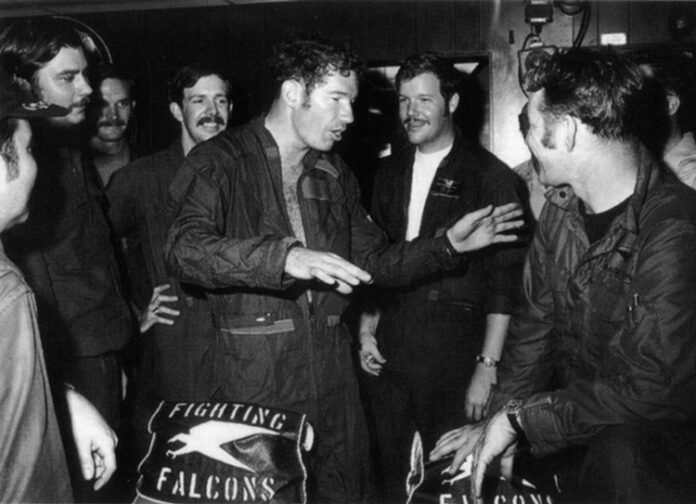
Randy “Duke” Cunningham, the fighter pilot and first American ace of the Vietnam War, has died at the age of 83. Cunningham, known for his successes in the skies of Vietnam, passed away on August 27, 2025, in Little Rock, Arkansas, after a long battle with health problems. His name is synonymous with USN Airmen, TOPGUN, and the era when the Phantom was the absolute lord of the skies.
Born on December 8, 1941 in Los Angeles, Randy Cunningham served for 20 years in the U.S. Navy, leaving behind a legacy that has inspired generations of Navy aviators since. His career was marked by outstanding achievements, particularly during the Vietnam War, where he flew F-4J Phantoms as part of VF-96. Together with his back-seater, Willie “Irish” Driscoll, they became the first American aces of the war, shooting down five enemy aircraft in various missions, culminating in the dogfight of May 10, 1972, which established them as legends in aviation history.
This epic dogfight began during a large-scale bombing operation on the Hai Phong railway stations in North Vietnam, which was Cunningham’s 300th combat mission. Returning from an anti-aircraft suppression mission, the F-4J Phantom codenamed “Showtime 100” from the aircraft carrier USS Constellation, along with its wingman, found itself faced with multiple threats.
Initially, two MiG-17s appeared behind them, firing their guns at them. Cunningham executed a sharp left turn, taking advantage of the MiGs’ high speed and inability to maneuver, causing one to overshoot and expose itself. He then fired a Sidewinder missile, destroying the MiG, which crashed to the ground in flames. A short time later, while assisting their commander who was surrounded by eight MiG-17s, Cunningham spotted a MiG that was directly threatening, and after warning the other pilots to maneuver, launched another Sidewinder, shooting it down as well, while avoiding the parachute of the North Vietnamese pilot who had ejected.

The climax came when, on the way to the coast, they encountered a MiG-17 believed to be flown by the North Vietnamese ace “Colonel Tomb” or Nguyen Toon (Nguyễn Tuân), known for shooting down 13 American aircraft and considered an excellent pilot, and of course very dangerous (although years later the existence of such a pilot was questioned). The MiG came head-on at an altitude of 10,000 feet, firing its guns. Cunningham avoided the fire with a slight turn and pulled the power levers, bringing the Phantom into a sharp climb, “pulling” 6 G, hoping to be in an advantageous position for an attack.
To his surprise, the very light MiG followed, coming within 100 yards of him, their cockpits facing each other. A fierce four-minute dogfight ensued, with alternating climbs and descents, rolling scissors, and each pilot trying to get the other’s “tail.” Cunningham accelerated on afterburner to escape, but the MiG followed him, firing continuously.
At a critical moment, during the third head-on collision, Cunningham employed a tactic he called a “cheat.” He essentially let the MiG begin its climb, then applied the airbrakes, lowered the flaps, and reduced engine power, dropping to less than 150 knots, close to stalling, as the MiG passed overhead. Then he activated the afterburners and pulled back the stick, to get behind the MiG. The North Vietnamese ace stopped the climb, “cut” the engine, and his aircraft stopped and began to fall. Then the American launched the third Sidewinder, which, although it initially seemed to fail, hit the target and the enemy fighter exploded.
This triple shootdown in a single day, with the last being the fifth in total, made Cunningham and Driscoll the only Navy aces in the Vietnam War, applying lessons from the first class of Top Gun. It must be said that Cunningham used the newer AIM-9J, which was more reliable than the older AIM-9 models. This does not diminish Cunningham’s achievement, of course, as the AIM-9J had a success rate of only 13% (compared to 5 to 8% for older models) in Vietnam.
As they approached the coast, their aircraft was hit by a SAM missile (probably an SA-2), causing hydraulic failure and a short time later loss of control. Cunningham and Driscoll successfully ejected over the South China Sea and were rescued. After their last downing, several senior officers considered nominating Cunningham for the Medal of Honor, the highest military decoration in the United States. However, he insisted, “Whatever I get, I want Willie to get, or I won’t accept it.”
Ultimately, both were awarded the Navy Cross, the second highest award in the United States Navy and Marine Corps. This act shows the character of Cunningham, who always prioritized teamwork and dedication to his colleagues, recognizing the vital contributions of back-seaters like Driscoll, who operated as WSOs (Weapons System Operators) handling radar and weapons.
After the war, Cunningham continued to contribute to aviation training, serving as an instructor at the Navy’s TOPGUN School and later as commander of Fighter Squadron 126 (VF-126), an enemy force simulation unit at Miramar Air Force Base in California. There, he helped develop tactics that improved the performance of American pilots, based on his experiences in Vietnam. In 2020, he was elected president of the American Fighter Aces Association (AFAA), where he proposed amending the definition of the “Ace” category to include back-seaters, recognizing their contribution to dogfights and emphasizing that victory is a team effort.

After retiring from the Navy in 1990, Cunningham entered politics, being elected as a Republican to the U.S. Congress for California’s 50th congressional district, where he served eight terms from 1991 to 2005. As a member of Congress, he focused on national defense and veterans issues, drawing on his military background.
However, his political career was overshadowed by a major corruption scandal. In 2005, Cunningham resigned from Congress after pleading guilty to charges including conspiracy, bribery, tax fraud, and mail and wire fraud. Specifically, he admitted to accepting at least $2.4 million in bribes from defense contractors in exchange for favorable decisions and contracts, including lavish gifts such as homes, yachts, and other goods.
In March 2006, he was sentenced to eight years and four months in prison, the longest sentence ever imposed on a member of Congress at the time. He was released in June 2013, after nearly seven years in prison, and spent several years under house arrest and supervision. After his release, Cunningham stated that he regretted his actions and continued to speak about his experiences in Vietnam, using them as an example of ethics and accountability.
In the final years of his life, Cunningham frequently shared his stories at conferences and in books, inspiring young pilots with lessons in courage, tactics, and ethics. In the last eight months of his life, he was repeatedly hospitalized for heart problems and other health issues, but he remained active until the end, maintaining his signature optimism and humor.
His death on August 27, 2025 marks the end of an era, leaving behind a legacy of courage, leadership, and dedication, as well as lessons from the darkest moments of his life. Randy “Duke” Cunningham was a top pilot who had a bad run as a politician, but his mistakes did not erase his military exploits. His memory will live on in aviation circles as an example of a man with great successes and serious mistakes.

