


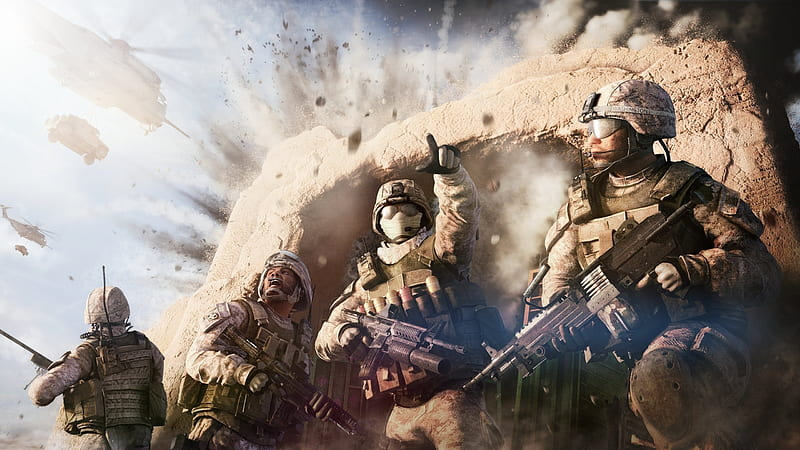
The constant invocation of the indisputably great advantages of Artificial Intelligence (AI) in military applications has created the widespread belief that it is a “magic” solution that will bring about revolutionary changes in the way operations are conducted and by extension in the nature of war.
Partly true and in certain areas currently feasible, but the full military exploitation of the possibilities it offers requires the collection and processing of a huge amount of data that will train it in the core of military applications.
A typical example of the possibilities and limitations of AI are the experiences of the 3rd Mobile Brigade Combat Team (3rd MBCT) “Rakkasans” of the 101st Airborne Division (Airborne Assault) “Screaming Eagles” that recently saw the light of day.
The brigade has been integrating AI tools into its operational planning processes for about a year and last April was deployed for training at the Joint Readiness Training Center (JRTC) in Louisiana, where it participated in a series of dual-action tactical post-combat exercises (TPCEs) against the 1st Battalion, 509th Infantry Regiment, a unit whose permanent mission is to act as the “enemy.”
As the brigade commander, Colonel Rain Bell, stated during a roundtable discussion with US defense media organized by the US Army, the formation utilized Large Language Models (LLM), which it trained based on US Army operational doctrine, inter-service doctrine, as well as the doctrine of the 101st Airborne Division.
In addition, it fed them with operational products (such as standard procedures, document/signal templates, etc.) used by the brigade. As a result, each of the brigade’s four Headquarters Offices (HO) (1st – personnel, 2nd – information, 3rd – operations – exercises, 4th – logistics) developed and trained its own specialized digital assistant (bot) to support it in understanding the operational environment and accelerate decision-making.
He cited as an example that the 2nd Brigade’s digital assistant integrated and processed the 25,000 detection reports generated by the brigade’s organic drone sensors over 10 days of operations, enabling a clearer picture of the operational environment.
“We found that the use of AI was particularly useful in many areas, but we also identified areas where we did not want to use it,” Bell said. “The AI-assisted mission analysis is extremely useful, but we found that it cannot be used to formulate the Commander’s Intent, which is solely my responsibility,” he added emphatically.
He also noted that AI, despite the assessments of experts and military personnel, was not used to develop Alternative Courses of Action (COA), as LLMs are unable to perceive three-dimensional space and, therefore, are not suitable for formulating action plans. “At this point, the experience of a competent staff that knows how we conduct operations and can properly plan the operation is required,” he pointed out.
On the contrary, the ability of AI to be used effectively as an adversary (“Red Team”) in the evaluation and simulation of alternative action plans before engagement with the adversary, i.e. the identification of possible weaknesses or even the questioning of the assumptions of the Staff, was demonstrated. Additionally, the time saved by using AI in Mission Analysis and the production-issuance of orders, made it possible to allocate it to conducting war games (on average four hours) to evaluate multiple alternative actions and scenarios for the development of the operation.
In order generation and issuance, the results of AI were impressive. “We would receive the Operations Order (OPORD) from the Division and using AI we could issue the Brigade Warning Order (WARNORD) in less than 30 minutes,” said Colonel Bell.
As a typical example, he cited defensive operations, where standard practice during JRTC training is to issue the brigade order at the time the “enemy” deploys reconnaissance assets and the defensive phase of the exercise begins. As a result, the brigade battalions have minimal time to complete their own operational planning and organize their defensive positions.
However, with the use of AI, the process was completed 72 hours earlier. The battalions completed the operational planning cycle, installed 100% of the planned obstacles, reviewed and tested their plans, and then installed additional obstacles, and despite the fact that the “enemy” launched three chemical weapons attacks and used unmanned ground vehicles to clear corridors through the defensive obstacles, the defensive location held.
“In this way, we leveraged AI to accelerate the “Observation-Orientation-Decision-Action” (OODA) loop, so that we could operate faster [higher pace] than the opposing force (“enemy”),” concluded the brigade commander.
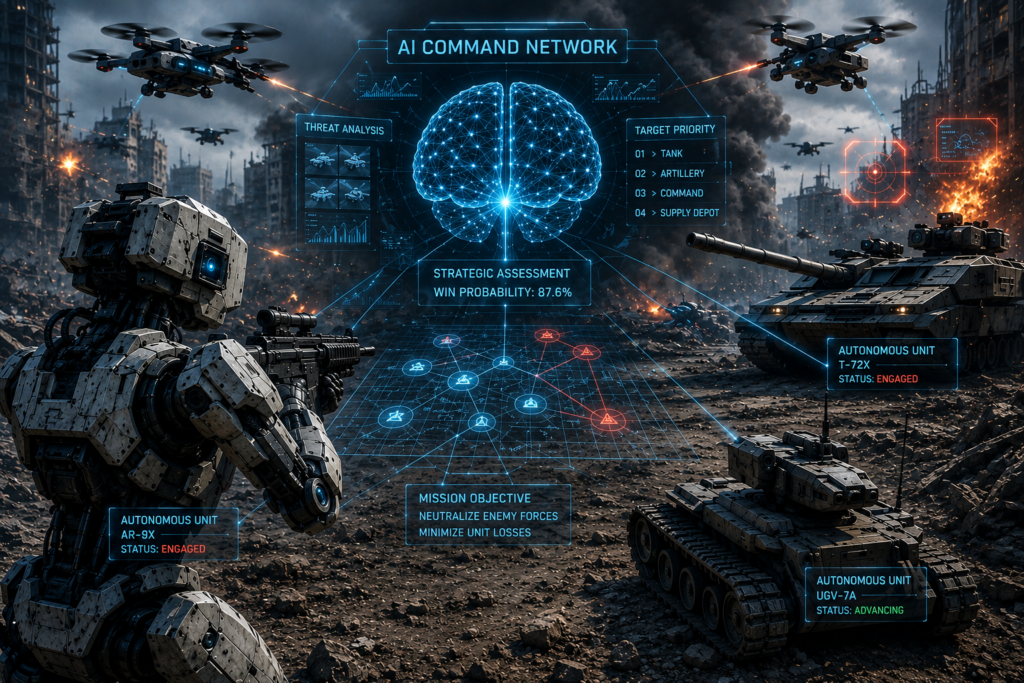
Humanoid Robotic Fighters
As the emergence and testing of humanoid robots becomes more widespread, the tactical development and integration into operational use of AI agents with physical substance in the real world, including unmanned ground vehicles and anthropomorphic robotic fighters, which will be able to understand the mission objectives and make decisions to achieve them without human intervention, is one of the greatest challenges for the utilization of AI in military applications.
However, to achieve this, specialized training data for AI is required which should be produced by human experts, that is, military personnel with combat tactical experience.
However, in contrast to the continuous progress in hardware, software and architectures of AI models powered by industry and academic institutions, it is necessary to clearly define what data is required and to design and implement a comprehensive strategy for their production, collection and management.
Of course, commercial and academic models can be used that, after being modified, can perform specific operational scenarios or actions (in the latter case simple and repetitive, such as walking).
There is also the possibility of adopting commercial or academic high-performance models that can be trained to perform routine tasks, such as reacting to enemy contact or executing a rifle squad attack.
However, their training requires the specialized data mentioned above, which must be created, collected and labeled by a human or a trusted system.
This is a process that cannot be compressed in time and it goes without saying that specialized data constitute valuable intellectual property that should not be considered for distribution even to allied/friendly countries. And this very finding sets a specific framework for the plans and actions of our country.