



Iran has a very large and diverse arsenal of mines. Most of the mines have been sourced from China and Russia, which are the world’s largest producers of marine mines. Some of its mines may also be Iranian-made.
In any case, it has an arsenal of 5000 to 6000 mines. It also has many ships to mine. It should be borne in mind that mines are a very cheap weapon starting from anchored mines worth only around 1500euro or more, such as modern smart mines, which can sink ships of both commercial and military value worth billions. So the mine, which is considered the “weapon of the poor,” is a big threat.
The U.S. claims to have sunk most if not all of Iran’s mine-laying ships, but do not forget that sea mines can also be set by non-combat ships, such as commercial ships, fishing boats and submarines. The threat of narcotics is always there.
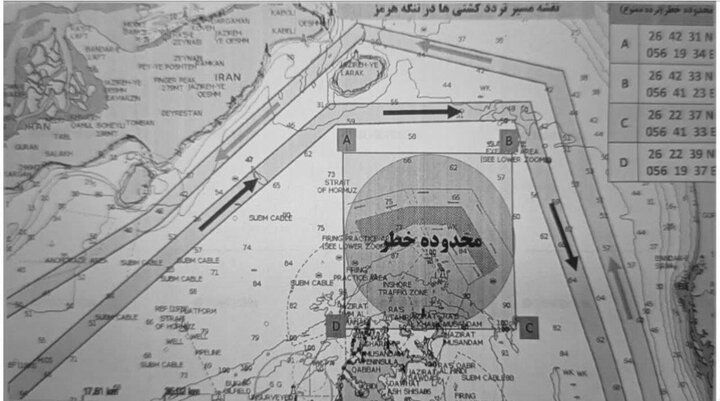
It is certain, however, that mines have been set by Iran, since Iran itself, after almost a month since the beginning of the war, gave the limits of its sea minefield and defined a channel of safe navigation, as shown in the map below, for use by merchant ships. This channel has two zones (please look the photo above).
One zone is an entry zone into the Persian Gulf and the other is an exit zone from it. One zone passes north of Larak Island where there is an Iranian naval station and the other zone passes south of Larak Island. The main reason is for Iran to be able to control which ships enter and which ships leave the Persian Gulf, but also to collect tolls or “transit fees” as it now calls them. Iran argues that the main reason for the channel’s existence is the safety of international shipping.
The question is how will Iran, after signing the ceasefire, be able to clear the minefield if it does not have anti-narcotic vessels?
An online survey of Iran’s naval forces does not appear to have mine-hunting or mine-mining vessels, while it appears to have several mine-laying vessels. The possibility of clearing marine mines is limited when there are no anti-mine vessels, i.e. minesweepers or mine-hunters. Only with divers is it possible for a force to clear mines in very shallow waters up to 30 meters deep. For mines in deeper waters, anti-mine ships are needed. So Iran will have a weakness in clearing much of the minefield where the depths reach 100 meters or more.
At this point, it is appropriate to highlight 4 violations – illegalities of the International Law of the Sea committed by Iran.
1. When a state decides to mine in a marine area it is mandatory to give the limits of mine-laying to protect neutral merchant ships. Iran did so about a month after the start of the war with the United States and subsequent mine-laying.
2. Mining of international waterways such as the Strait of Hormuz is prohibited. Iran mined them.
3. Mine clearance is prohibited when the mining state does not have anti-mine vessels to clear the minefield to be created. It is incompatible with the principles of State responsibility for a State to set mines for its operational purposes and, at the end of hostilities, to transfer the burden of clearing the minefields to third States or to the international community.
4. It is prohibited to levy tolls or transit fees in international straits such as the Strait of Hormuz. Iran has already imposed and collected fees or tolls from transiting ships.
Iran has reached a secret agreement with Oman to impose tolls on unfriendly merchant ships. The money is shared but most of it is held by Iran because it exercises control over the Strait of Hormuz. These resources are likely being used by Iran to make up for losses due to the disasters it has suffered since the war with the US.
The International Community, through the UN and IMO, should impose sanctions on Iran for the above violations.
