



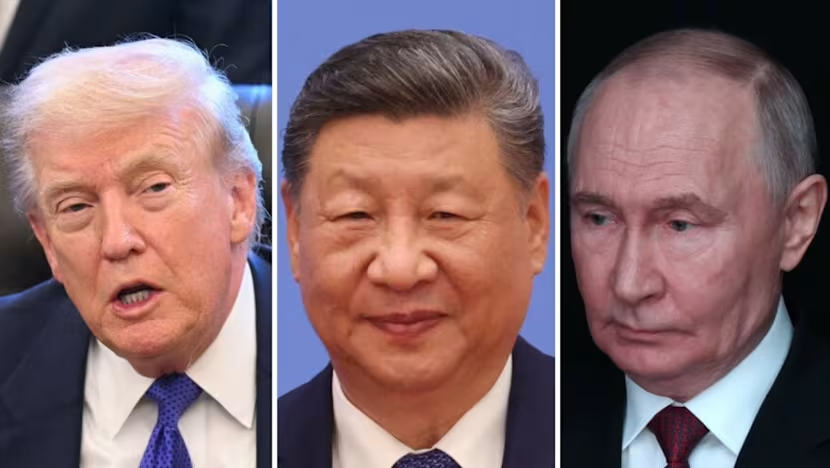
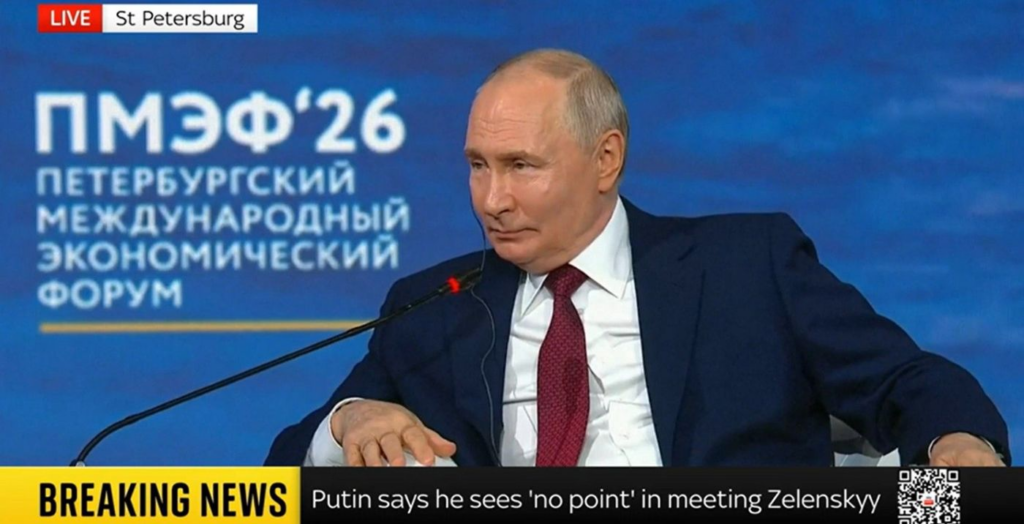
Fermentations on both of the main war fronts of the era, that of Ukraine and that of Iran, give hope of initiating an end to the conflicts. This is obviously far from the prevalence of peace. However, stopping the bloodshed is by definition a positive development. Our topic in the present analysis is whether or not the simultaneous manifestation of intention to disengage from the conflicts is coincidental. The recent negative attitude of Russian President Putin to a meeting with his Ukrainian counterpart Zelensky is considered to concern the level of tactical operations.
Even this alone will not be easy on both fronts. It is precisely this difficulty that demonstrates the need for cooperation between the great powers. For this to happen and for it to bring about the desired result, each side, in this case Washington, Beijing and Moscow, will have to ensure a minimum of at least its objective goals. A first basic question that arises is whether the US involvement in the war against Iran has ultimately brought closer, as an inalienable reality, the recognition of the multipolar nature of today’s world.
In other words, whether US President Trump has realized in practice that military power as a tool for imposing the US will has limits. Especially if he uses it to a partial extent. In this specific case without the involvement of ground forces, obviously to avoid losses. Its limited use, in practice, led to everyone adapting more quickly to the new reality. Without implying that the involvement of troops on the ground and the acceptance of losses would ensure a different outcome.
At the same time, it will also serve as confirmation that interdependence in the modern world continues to be an inherent characteristic. The difference in power, in the military field, is not sufficient in itself to neutralize the advantages that each country possesses separately, which it will use in the attempt to “regulate” the behavior of the opponent, so that it moves at acceptable levels.
But let us look at the two fronts separately, before attempting to connect the developments.
Ukraine
After the “grandiose” handling of the war by Moscow in the first phase of the invasion of Ukraine and the proof on the field that it would not be just a “walk”, adaptation followed. This is a model that has appeared many times in Russian history.
But as much as Russia’s frivolous entry into the war is true, so is the gradual adaptation to the circumstances, with all that this implies for the final outcome of the conflict. This happened in Ukraine as well. The goals were adjusted and the focus of the effort was focused on the border region and further south on the area that historically constituted “Novorossiya”, in the regions of Donetsk, Luhansk, Zaporizhia and Kherson, a large part of which has been occupied by Russian forces.
Many see a stalemate in the conflict. Western military reinforcements to Kiev, especially the revolutionary tactical use of unmanned land, air and naval platforms, combined with the exploitation of Russia’s reluctance to escalate the conflict by mass mobilization, have led to a stalemate.
Combined with the ever-increasing costs, it seems that we are close to a point of equilibrium where the belligerents consider it advantageous to seek terms of disengagement. This does not, of course, amount to peace, as finding the right terms that will allow both sides to successfully “sell” an agreement domestically will not be an easy task.
The only thing certain is that in order for there to be a gradual disengagement, each side will be called upon to limit its goals and the agreement will create hope for the next day. Simply put, at this stage, maximalisms usually… go for a walk. And those who insist on not seeing reality and approaching the strategic problem in ideological terms will not only be overcome by developments but will also end up graphic and disreputable. This warning mainly concerns Europe.
Iran
One of the same applies to the Iranian front. The US sided with Israel and launched attacks, mainly on Tehran’s nuclear infrastructure. The unacknowledged goal of regime change is not being achieved, according to all indications so far. The assessment of the results in the field of neutralizing the Iranian ballistic arsenal, including the launchers, is also problematic.
Overall, Tehran’s resilience is proving to be of key importance. At the same time, the increasing pressure that the White House feels within the US, in view of the midterm elections, the lively questioning of support for the Israeli state even in the Republican camp, the high cost of the conflict, and the energy-economic impasse resulting from Iran’s de facto control of the Strait of Hormuz, which is hitting the average American hard, describe Trump’s motivation for disengagement.
However, these data have been detected by the Iranian side, which has adopted a tough stance. It does not seem to be in a hurry to end the war. It does not project an image of weakness, trying to cancel the communication message of the great disasters caused by the bombings by the US-Israeli. Besides, these disasters are now a given.
However, on the one hand, they have not managed to achieve the declared and unseen objective. The cancellation of Tehran’s ambitions in the nuclear field and the overthrow of the regime. Tehran does not refuse to negotiate, but it does so on terms of equality with the superpower and succeeds in passing the message that it does not surrender, having exposed Trump in practice many times, who is quick to publicize optimistic predictions.
How do the fronts intertwine?
This is the current situation on the Ukrainian and Iranian fronts. Reality has buried the approaches that were based on Western-origin ideological schemes. Washington seems to understand that cooperation with Beijing and Moscow is a prerequisite for the basic balance of today’s world.
The US involvement in Iran was hurting China, while winking at Vladimir Putin’s Russia. The supply of Ukraine with critical weapons systems and missiles was objectively problematic, while it restored Moscow’s special weight in the negotiation with Beijing. However, on the one hand, China is showing great composure and appears unaffected by the developments. On the other hand, the Sino-Russian relationship does not seem to have been damaged. On the contrary, if judged by the visits of Trump and Putin to Beijing, it is clearly warmer…
Now, Washington seems to need Sino-Russian assistance to achieve the fastest disengagement from the war fronts. The price, however, will be the cancellation of the American strategy to exclude Beijing and Moscow from the Middle East! No matter how many times Washington has attempted the famous “Pivot in Asia”, the shifting sands of the region have trapped it – as it turns out -. And it requires understanding…
- So will Russia and China be a prerequisite for “escape” from a war that Washington believed would be short and trophy-laden?
- What will they ask for in exchange for assisting, possibly as guarantors (Moscow against Israel and Beijing against Iran) in the sensitive nuclear issue?
- And how much time will it take, given that trapping the US in the region serves the interests of its competitors?
- Consequently, how easily will such a negotiation conclude?
- The minimum that the Iranians will ask for in order to agree will not be the lifting of economic sanctions?
- So who will have won the “political war”, regardless of the outcome of the military one?
In Washington, perhaps they should refresh their historical knowledge and adapt the lessons to today.
History
Because in the US they seem to have forgotten that they have not been by Israel’s side since the first day of its founding. They were there after the Middle East became the focus of the USSR’s attention at the height of the Cold War. And if today some believe that its end justifies disengagement, let them remember that history abhors gaps. Someone will fill them, causing a violent reshuffle of the regional geopolitical deck. It will be a matter of time before the US realizes the need for a complete reset.
But how great will the damage be? Geography is inescapable. Israel’s small size and the search for strategic depth explain the importance of the two countries of Greece for the Israeli state. Beyond the historical trauma of the Holocaust, which decisively affects international attitudes and behavior (ed. Many read it as a kind of “persecution syndrome”), this small size does not leave much room for flexibility. If it loses, it is lost. At least that is what the elite from one end of the Israeli political spectrum believes.
Real peace will only exist if national, religious and other visions are addressed, combined with insecurities. There is a psychological background to everything, beyond the problem itself. There are also interests that sometimes fuel them. But certainly, what there is no room for relaxation. Any kind. A spark is enough to bring about destruction. Again. Now, it remains to be seen whether the bloodshed on both fronts will stop.


