



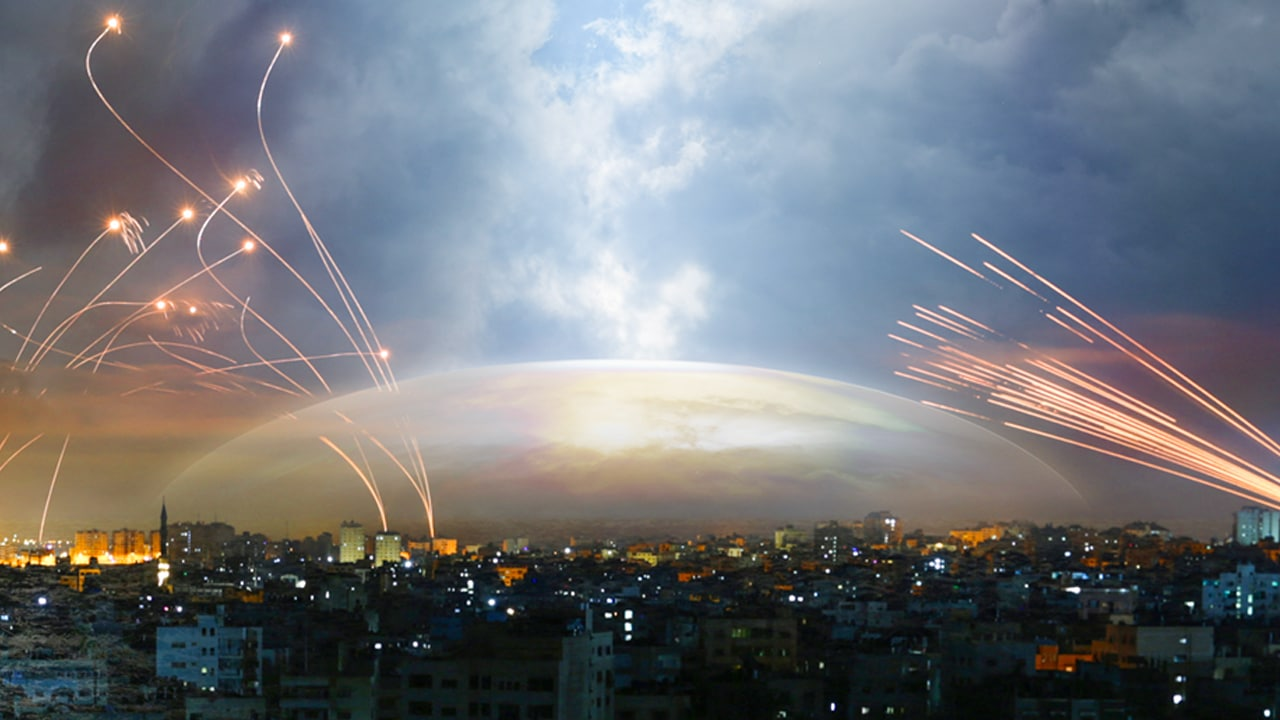
Due to geopolitical developments in Eastern Europe (war in Ukraine) and respectively in the Middle East (War in Iran and more generally in the Persian Gulf), many countries are either looking to buy an anti-ballistic-anti-aircraft dome or to develop it themselves. The anti-ballistic-anti-aircraft system “Iron Dome” of Israel is the only system that has been tested in practice, that is, during the ongoing Iran-Israel and Israel-Hezbollah wars respectively. The “Iron Dome” is manufactured by the Israeli company Rafael Advanced Defence Systems.
Given that a country, before buying and using it, must first evaluate it operationally, so that there are tangible results from its respective military staffs, in the following analysis we will try to classify the effectiveness of the “Iron Dome” in recent conflicts in the Middle East and whether or not this is the system that protects the citizens of Israel in practice.
Iron Dome is a mobile short-range air defense system developed for Israel by Rafael and Israel Aerospace Industries, with additional support from the US company Raytheon. It was first deployed in 2011, and is the innermost dome of the Israeli air defense network. The “David’s Sling” system covers the middle layer, while the “Arrow” missile system protects Israel from long-range missiles. David’s Sling, which has been operational since 2017, is designed to intercept medium- and long-range ballistic missiles. The Arrow system (II and III), also operational since 2017, is used to intercept missiles that travel beyond the Earth’s atmosphere.
Iron Dome was designed to intercept short-range missiles and is not a universal defense solution. It has two main limitations.
1. It has a limited ability to simultaneously engage a large number of targets. In the case of mass attacks, when the number of incoming missiles exceeds the interception capacity, it cannot fully respond.
2. The second limitation is technical. Iron Dome is not designed to intercept medium- and long-range ballistic missiles or high-speed targets. Its effectiveness is negligible when dealing with such threats.
The purpose of Iron Dome is:
a) to detect incoming airborne threats,
b) to assess their likely impact point, and
c) to intercept.
Each element of the Iron Dome system was designed to focus on one aspect of this mission. An all-weather fire control radar system detects and tracks potential targets at ranges of 4–70 km. An Iron Dome array is equipped with three or four interceptor launchers, each carrying up to 20 Tamir interceptor missiles. The Tamir missile has a warhead that detonates next to the incoming missile only when the missile is within range, determined by an electro-optical sensor that can scan 360 degrees.
Israel is protected by 10 Iron Dome arrays, which operate to protect the country’s infrastructure and citizens. Each array can defend up to 100 square kilometers. They are strategically placed around Israeli cities to intercept missiles heading towards these populated areas.
By applying artificial intelligence technology, the system is able to distinguish whether incoming threats will land in a populated or unpopulated area, ignoring these cases, thereby reducing operating costs and minimizing unnecessary defensive launches. However, if the “Door” determines that the missile is predicted to land in a populated area, the interceptor missile is launched towards the target.
This is a significant advantage that weighs in favor of the Iron Dome. If, for example, If Hezbollah fires ten rockets and misses nine, Iron Dome can probably intercept the one threatening missile. If Hezbollah fires a hundred and misses ninety, that presents a greater challenge, but given the system’s proven success rate, most, and probably all, of the threat can be prevented. But if we extend this dynamic to hundreds or more rockets, the advantage shifts in favor of the attacker.
Iran’s strategy in the war involves mass launches of different types of missiles designed to overwhelm Israel’s defensive capabilities, a modus operandi used daily by the Russian military to overcome Ukrainian air defense arrays: Swarms of drones on the front lines to clear the way for missiles to strike when defenses are exhausted.
Since the start of the war on February 28, Tehran has reportedly fired more than 350 ballistic missiles at Israel, about half of which were carrying cluster munitions, according to Israeli military sources. Cluster missiles are capable of releasing anywhere from 24 to 80 bombs upon landing, over an area of up to 10 square kilometers. This requires increased operational complexity for Iron Dome, the system of which has been saturated by these Iranian attacks, the IDF spokesman admitted.
In addition, Iranian drone attacks, many of which are cheap and mass-produced, are also contributing to this pressure. As recorded by the Tzofar early warning system, suicide drones outnumber missiles in terms of alerts, forcing the constant activation of defense systems. When the volume of simultaneous threats exceeds the response capacity, missiles and munitions inevitably penetrate the Iron Dome shield.
Although Iron Dome has shown a promising track record over the past decade, the system itself is designed to be effective against short-range missiles, which travel at low speeds compared to state-of-the-art cruise missiles and missiles that can travel 2-3 times faster than the speed of sound. In the future, the system’s advantages could be limited by the ever-increasing number of weapons in the hands of the adversary and the advancement of its military technology. Obviously, any defense or equipment will be obsolete after a certain period of time unless it is modified and tested in new scenarios. It could be said that the Iron Dome is going to be obsolete in the near future, while its current effectiveness against short-range missiles is at best unclear and probably overstated. Iron Dome is undoubtedly high-tech. But so is Israel’s PR campaign around it, a reality produced by the global news system.
If Iron Dome is not working well, why are Israeli casualties from rocket attacks so low?
Israel has a vast system of shelters, arranged so that citizens can easily find protection within tens of seconds of the warning they receive on their mobile phones. The app’s message indicates the general area where a rocket impact is expected. Depending on the location of the people who receive the warning message, they know whether or not they should find shelter. (How many shelters do the countries interested in acquiring Iron Dome have for the protection of their population? Essentially, the protection of Israeli citizens is due to the combined system of the very close existence of shelters and their valid warning. So is Iron Dome an exaggeration guided by other types of expediency?


