




The European Commission’s study on the sustainability of the debt of its member states (Debt Sustainability Monitor 2025) predicts for Greece that its public debt will remain more than double the Maastricht limit of 60% in the medium term (at 124% of GDP in 2036).
In essence, the current Greek governments are implementing a political and economic management of a permanent bankruptcy and economic decline. And this as Greece will remain with high debt, trapped in a production model of low productivity while its long-term fiscal position is undermined by the absence of investment, the aging population and the increase in the related social transfers in the health system and the pension system.
At the same time, an attempt is being made, based on the proposals for the constitutional revision submitted by the government, to make austerity permanent (by reducing it to a constitutional rule, based on the German model of the “fiscal debt brake”), that is, to remove from future governments – which will be elected by the vote of the Greek people based on the democratic order – the possibility of fiscal expansion in order to address legitimate social needs.
It should be noted that Greece, like the other EU countries, has already accepted and incorporated into its law the new fiscal rules, which came into force in 2024, bringing the “expenditure cutter” to the fore.
How will the “constitutional” Fiscal Debt Brake work?
Specifically, in the four-year fiscal plans submitted to the European Commission, limits on the increase in net primary expenditure are agreed upon, which cannot be changed retrospectively.
Based on the new rules, excess surpluses cannot be used for relief measures or other types of expenditure, if the expenditure increase limit is approached.
According to the rationale of the revised proposal, Greece will reassure partners and markets that a constitutional barrier will be put in place, so that a future government cannot overturn the steady course of debt reduction, which the applied economic policy has ensured.
This is a provision that directly distorts the democratic order, as the level and quality of consensus that has been achieved in Germany is currently not possible in Greece.

Also, in the event of a force majeure crisis (as in the case of the Covid19 economic crisis), the steps and the timetable for returning the economy to growth should be clearly defined.
This is supposed to commit future governments to a recovery plan, which the opposition parties will have the opportunity to co-form in the dialogue that will precede it.
The goal is for the “fiscal stability clause”, which the government wants to ratify constitutionally, to maintain consistent fiscal policy in perpetuity, so that the Greek debt is reduced (!) below 60% of GDP, once the country has repaid all the loans it received from the three rescue programs it implemented in the period 2010-2020.
The problems with the constitutionalization of austerity
While fiscal discipline may be a sound proposition or slogan after the adventures of the Greek debt crisis, the issue is
(a) how to produce a growth outcome within the framework of a distorted model – the “cafe economy”, – of low productivity and low foreign investment. Given that after the positive consequences of the capital inflows of the Recovery Fund have passed (with the end signal falling at the end of 2026 as by then all projects should have been completed and payments made) Greece is running out of Foreign Direct Investment (the relevant tables almost zero the relevant indicator).
(b) It is obvious the social explosion that will be caused as the goal of debt reduction will be ensured only by the reduction of social transfers and public investment (collapse of public infrastructure, such as that seen in the railways, and of the state’s presence in key sectors such as Education and Health).
(c) There does not seem to be a comprehensive plan to ensure the country’s economic sovereignty in an environment of high economic instability and geopolitical rearrangements.
(d) While fiscal discipline is being constitutionalized, the same is not true for the mechanisms that control the virtuous use of public money – the accountability mechanisms against corruption.
The abasement of the mechanisms for the administration of justice and the series of scandals that “endemic” the Maximos Mansion (Office of the Greek Prime Minister) with the pervasive smell of corruption, will enable governments to continue buying party votes with European and national resources, exacerbating a crisis of legitimacy amidst savage austerity.
High structural surpluses – The unattainable target
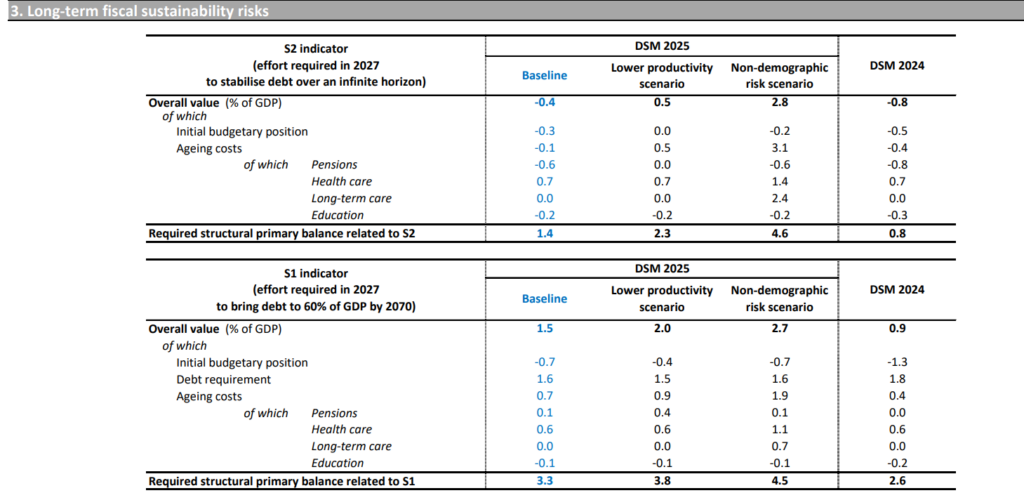
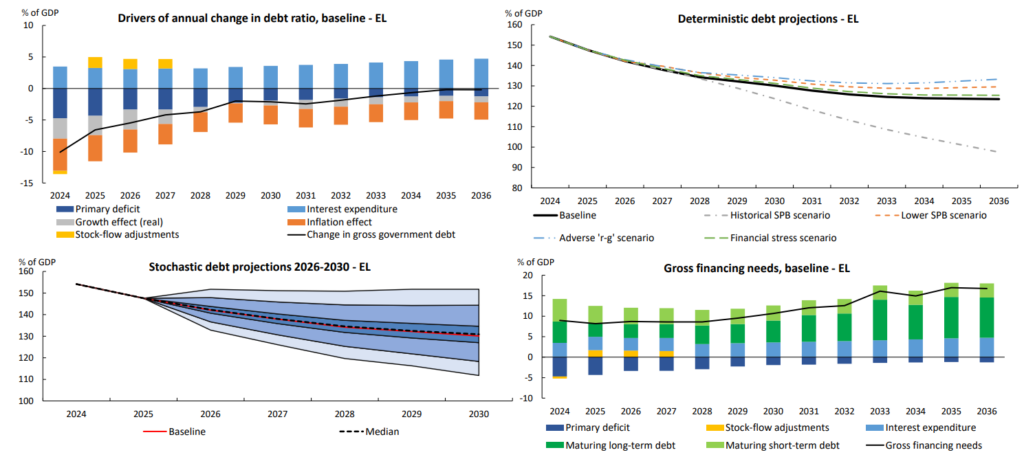
According to the baseline scenario of the European Commission’s Debt Sustainability Analysis (DSA), public debt is projected to decline but remain high in the medium term, reaching around 124% of GDP in 2036.
The decline in the debt-to-GDP ratio is due to the (uncertain to note…) assumption of a structural primary surplus of 1.8% of GDP from 2026 onwards, excluding changes in the cost of population ageing.
In this scenario, it is assumed that fiscal policy remains unchanged from 2027 onwards.
The Commission notes that this level of structural primary balance (in the baseline scenario) is considered rather ambitious compared to historical fiscal performance. Debt deleveraging also benefits from another favorable (albeit diminishing) “snowball effect” until 2033.
The “snowball effect” in public debt describes the dynamic by which the debt-to-GDP ratio automatically increases or decreases due to the correlation between two variables: the nominal lending rate and the nominal growth rate of the economy.
The gross financing needs of the general government are expected to increase to around 17% of GDP by 2036, reducing fiscal space accordingly.
Uncertainty in the global economy – The risk of rising interest rates
Stress tests identify additional sources of vulnerability in the Greek fiscal position.
In the adverse interest rate-growth differential scenario (where the interest rate-growth differential worsens by 1 percentage point compared to the baseline scenario), in the lower Structural Primary Balance scenario (where it decreases by 0.5 percentage points) and in the financial stress scenario (where interest rates temporarily increase by 4.5 percentage points compared to the baseline scenario), the debt-to-GDP ratio in 2036 would exceed the baseline level by approximately 10, 6 and 2 percentage points respectively.
This means that in the event of an inflationary explosion due to e.g. a geopolitical confrontation over tariffs or a supply chain disruption, Greece’s fiscal position will deteriorate disproportionately compared to other countries due to its high debt levels.
Note that the primary balance corresponds to general government revenue minus general government expenditure, excluding interest on public debt.
Structural means that the size is: adjusted for the economic cycle (cyclically adjusted) and free of temporary or one-off measures.
On the contrary, in the scenario where the Structural Primary Balance. returns to the 15-year historical average (i.e. 4.9% of GDP), the debt ratio would be lower than the baseline by about 26 percentage points in 2036.
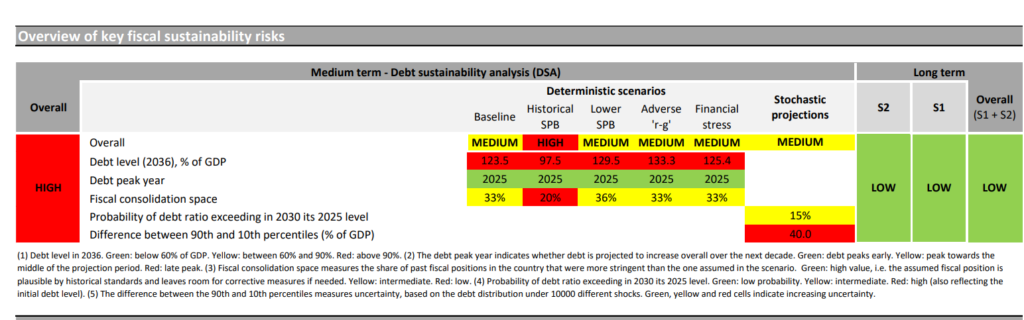
The stress tests give a 15% probability that the debt/GDP ratio in 2030 will be higher than in 2025, which indicates medium risk given the high initial debt level.
The baseline scenario may show a gradual reduction in debt, but the range of possible outcomes is large — about ±20 points around the median forecast.
This implies a medium level of risk, not because the baseline scenario is bad, but because uncertainty in the international economic environment is high.
Fiscal stability is desired
The reasonable concern expressed in the Commission’s report is whether Greece will manage to consistently produce primary surpluses of 2% of GDP each year and – even more importantly – structural primary surpluses of 1.8% of GDP over such a long time horizon, so as to maintain debt sustainability.
The immediate risks identified by the Commission
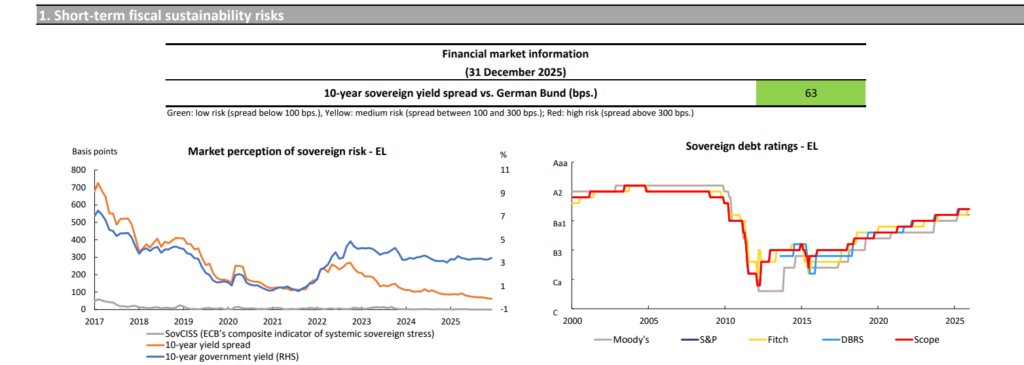
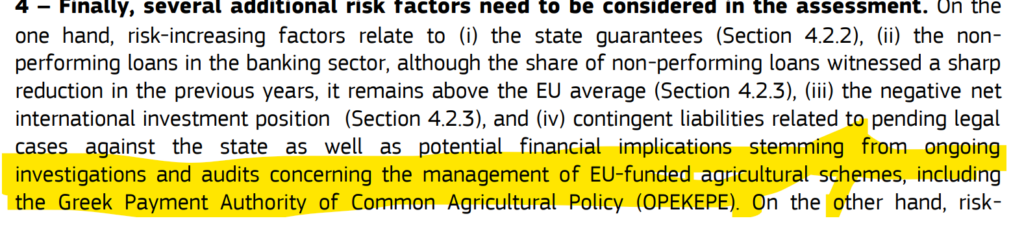
In addition to the evolution of fiscal data, the Commission identifies 3 main fiscal risks, including the OPEKEPE scandal, which could burden the downward trajectory of debt in the short term.
Factors that increase the risk include:
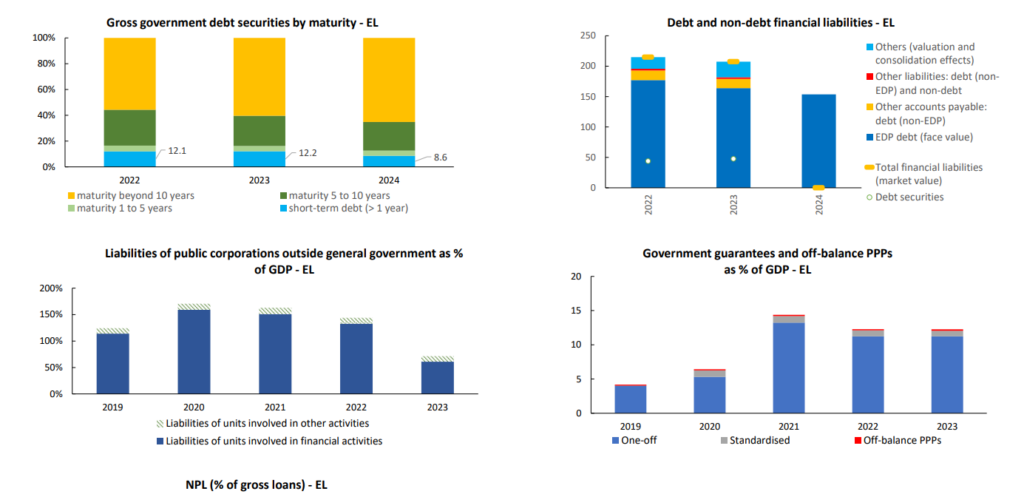
(i) State guarantees,
(ii) Non-performing loans in the banking sector — despite their significant reduction in previous years, their rate remains above the EU average,
(iii) The negative net international investment position (which will worsen after the completion of the inflows from the Recovery Fund)
(iv) Contingent liabilities related to pending court cases against the State (such as the issue of the 13th and 14th salaries to the State and the retroactivity of these liabilities or forfeiture of loan guarantees), as well as possible fiscal implications from ongoing investigations and audits related to the management of EU-funded agricultural programs, including OPEKEPE.
The distortion of European agricultural subsidies with heavy government responsibilities and involvement as revealed by the OPEKEPE scandal not only destroys the country’s primary sector but also threatens fiscal stability both in the form of refunds and fines. This is a “black hole” of unknown dimensions.
Low long-term risks as long as… everything goes well!
The assumptions of the European Commission’s baseline scenario of no change in fiscal policy:
(i) structural primary surplus, before changes in the cost of aging, of 1.8% of GDP from 2026 onwards.
(ii) inflation that converges linearly to ten-year inflation expectations
(iii) nominal short-term and long-term interest rates on new and refinanced debt that converge linearly from current levels to market forward rates until 2035•
(iv) real GDP growth rates according to the Commission’s autumn 2025 forecast for the period 2028–2036 (average 0.7%)•
(v) ageing expenditure according to the 2024 Ageing Report.
In addition, the assumption of no change in fiscal policy from 2027 onwards means that the fiscal adjustment committed to by Greece in its medium-term plan beyond 2026 is not taken into account.
Since Greece fully implement the adjustment path, the debt will follow a lower trajectory than in the baseline scenario for the Structural Primary Balance.
Factors in the debt structure that mitigate the risk
Factors that mitigate the risk are related to the debt structure:
(i) the majority of the debt is still held by official creditors with low interest rates,
(ii) the high level of cash buffers,
(iii) the relatively long average maturity of the debt compared to peer Member States, and
(iv) the fact that the public debt is entirely denominated in euro, which excludes exchange rate risk.
Climate Change and Tourism Revenues
The end of the Commission’s research note describes another risk for the Greek economy as it is disproportionately dependent on tourism, given the impact on GDP and employment in the Hospitality, Food and Entertainment services – notably according to provisional data from the Bank of Greece for 2025, tourism revenues exceeded 20 billion euros in the period January – September 2025 – with an increase of approximately 9% compared to 2024.
The adverse scenarios of worsening climate change reflect negative fiscal developments that will affect the course of debt in the short and long term depending on the speed of response to a new model.


