



The Federal Reserve’s recent decision to cut the federal funds rate by 50 basis points to a range of 4.75% to 5%, despite inflation still above its 2% target, apparently politically targeted, has disturbing similarities to the monetary policy mistakes of the late 1970s.
Then, under pressure to stimulate economic activity, the Fed eased monetary policy at the wrong speed. What was the result? Inflation soared as high, if not higher, depending on the measure of inflation. This culminated in Fed Chairman Paul Volcker putting the brakes on the money supply, driving interest rates even higher.
The result was a normal, if painful, double-dip recession before inflation settled down and the economy expanded during the so-called Great Moderation.

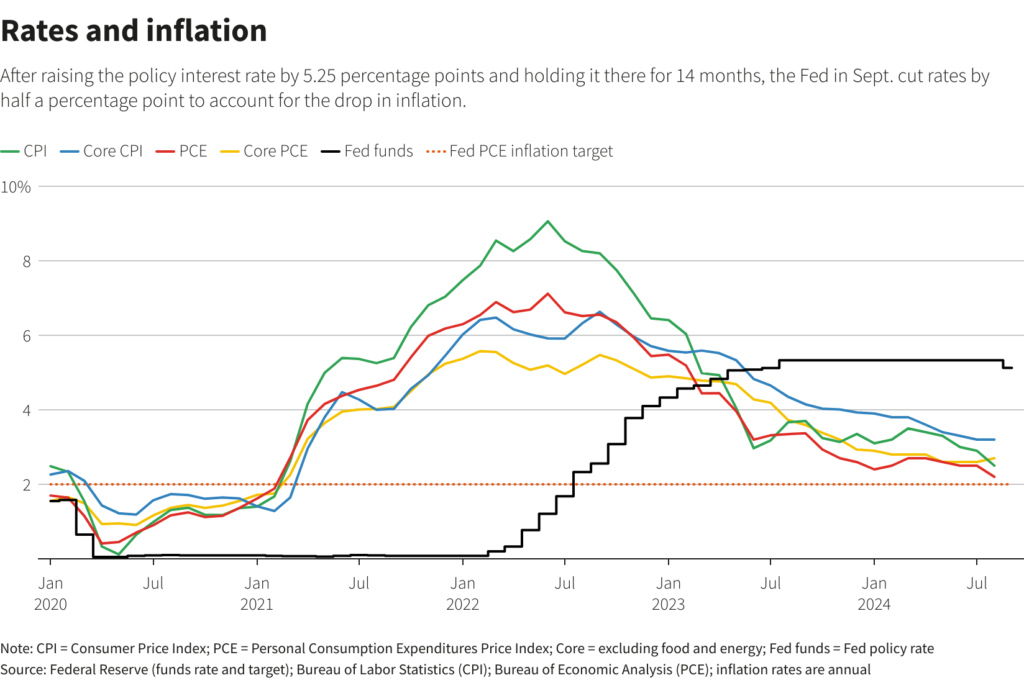
The Fed’s recent decision comes as inflation, although moderating, remains high.
- According to the latest Consumer Price Index (CPI) data, inflation rose 2.5% year-on-year in August, with the core index (excluding food and energy) rising 3.2%.
- The Personal Consumer Expenditure (PCE) index, the Fed’s preferred measure of core inflation, showed an increase of 2.6% year-on-year in July, further confirming that inflation is well above its 2% average inflation target.
- The risk is clear: a repeat of the premature rate cuts of the 1970s could stoke inflation once again, forcing even tougher corrective measures later.

The problem on the Fed’s balance sheet
The Federal Reserve’s balance sheet expanded dramatically during the COVID-19 pandemic, nearly doubling from $4 trillion in February 2020 to nearly $9 trillion in April 2022.
This rate remains 75% higher than the pre-pandemic level in combination with holding many risky assets. This massive increase in the money supply has distorted the functioning of the economy, contributing to inflationary pressures and artificially boosting demand in the economy as the supply has decreased – creating a permanent imbalance.
Instead of relying on rate cuts, the Fed should focus on aggressively reducing its balance sheet. Milton Friedman’s ideas remain as relevant today as ever: inflation is “always and everywhere a monetary phenomenon.”
- The rapid expansion of the Fed’s balance sheet and excessive money printing during the pandemic are key factors that caused the persistent inflation we face today.
- Shrinking the balance sheet would help reduce excess liquidity in the system, curbing inflation more effectively than interest rate cuts alone.

The distortion of fiscal policy
While monetary policy is one part of the equation, we cannot overlook the role of fiscal policy in the current inflationary environment.
Government spending has soared since 2020 during the pandemic lockdown, with the gross national debt jumping by nearly $13 trillion since 2019 to $35.3 trillion.
The House of Representatives, rather than address this spending crisis, is set to pass another massive spending bill before the September 30 deadline. As currently designed, this bill contains few significant spending containment measures.
Sweeping the problem under the carpet without addressing the structural imbalance in public finances weakens the growth momentum. When government spends recklessly by redistributing productive private resources to finance politically determined goals, the supply of goods and services is distorted.
And with the Fed printing so much money in recent years, we have a clear explanation for persistent headline inflation that peaked at 9% in June 2022. However, inflationary pressures remain in the economy.
This creates a vicious cycle where excessive government borrowing leads to higher interest payments, requiring further borrowing and money printing by the Fed to keep interest rates close to their target.
The only way to break this cycle is through fiscal discipline – curbing government spending, reducing the deficit and eliminating unnecessary programs – and greater economic growth.
Government interventions in the form of taxes, regulations, and excessive spending distort the functioning of the market, stifle entrepreneurship, and create inefficiencies.
These interventions increase business costs, leading to higher consumer prices and reduced economic growth.
Instead of focusing on interest rate cuts and temporary relief, policymakers should aim for long-term solutions to address the root cause of inflation: excessive money printing.
Mixed messages from the Fed
The latest statement from the Federal Open Market Committee (FOMC) signals an upbeat view that inflation is making “further progress” towards the 2% target.
The Commission also emphasizes that it has “gained stronger conviction that inflation is moving in a sustainable manner” towards its target.
However, this belief is misplaced given the persistent inflationary pressures evident in the data. The energy index is down 4% year-on-year, but core inflation remains persistently high and core service sectors continue to experience upward price trends.
The uncertainty
Cutting interest rates under these conditions risks rekindling inflation, just as the Fed’s premature monetary policy, including rate cuts, in the late 1970s exacerbated inflation and led to economic instability.
The FOMC’s decision to reduce the target range for the federal funds rate, while signaling its commitment to further rate cuts if conditions are “right,” is creating uncertainty in markets.
This mixed messaging signals that the Fed is willing to sacrifice long-term price stability for short-term gains, which could lead to more aggressive corrective action. Given the double dip recession of the early 1980s, there is considerable cause for concern.
Fiscal and monetary solutions
The Fed’s dual mandate is to ensure price stability and the maximum employment rate.
1. With inflation still above target, his focus should be on controlling inflation – the Fed’s balance sheet and inflation are the only two things he can control.
This underlines the need to achieve the goal of ensuring price stability rather than trying to stimulate economic growth.
History teaches us that early interest rate cuts—such as those in the 1970s—lead to higher inflation, more aggressive rate hikes, and economic contraction.
A more prudent approach would involve reducing the Fed’s balance sheet more aggressively, which would help absorb excess liquidity, fueling inflationary pressures.
2. In addition, Congress must deal with fiscal diversion by increasing public spending head on.
A balanced approach to fiscal policy, with spending limits tied to a maximum rate of population growth and inflation, would help stabilize government finances and reduce the deficit.
The Rand Paul Six Penny Plan proposal proposes a “federal budget resolution that will balance spending and revenue within five years by cutting six cents from every dollar projected to be spent over the next five fiscal years.”
Without these structural reforms, inflation will continue to threaten Americans’ purchasing power.
3. In addition, the government should remove barriers to productivity by reducing excessive regulations and taxes that stifle growth.
Allowing the free market to function effectively without the distorting effects of government policies will promote sustainable, long-term growth.
A critical moment for the economy
The Federal Reserve and Congress are at a critical juncture.
The Fed’s decision to cut interest rates prematurely risks repeating the costly and damaging mistakes of the 1970s, where loose monetary policy fueled inflation, leading to severe economic instability.
At the same time, Congress’ reluctance to address the deficit spending that drives the growing national debt only exacerbates the problems plaguing the economy. Now is not the time for short-term moves with political goals.
The Fed should focus on reducing its balance sheet and controlling inflation, while Congress must implement serious spending reforms to prevent further economic deterioration.
Failure to deflate means the US economy will sink into an inflationary spiral reminiscent of the 1970s – a government-induced failure the US economy cannot afford.


