



The recent moves by the US administration under Donald Trump towards Venezuela have raised questions about whether a conflict between the two American countries is likely to break out soon.
“Peace through force”
In September 2025, the Trump administration renamed the Department of Defense the Department of War, reviving a structure that existed from 1789 to 1947, signaling America’s intention to restore its power through the “peace through strength” strategy.
This strategy is based on the use of military force to achieve international goals, and was already highlighted by Secretary Pete Hegseth in statements in July and May 2025, regarding the protection of American interests in the Indo-Pacific region.
In late August, Donald Trump accused Venezuelan President Nicolas Maduro of supporting drug cartels and offered a $50 million bounty for his capture. The move was seen as a step toward legitimizing a possible military intervention.
For his part, Maduro declared on September 1, 2025, that his country would face the toughest war in the last 100 years, accusing Washington of violating international law and pledging to exercise the right of legitimate self-defense at the highest level.
The US government subsequently deployed ten F-35 fighter jets to Puerto Rico, near Venezuela, while executives such as Marco Rubio, John Ratcliffe and Stephen Miller suggested that Trump overthrow Maduro, citing the president’s support for drug trafficking networks.
Venezuela, for its part, remains under US sanctions and has strengthened its relations with China and Russia, which could reduce US influence in the region.
Absolute power for the military
Venezuelan President Nicolas Maduro has signed a decree granting him additional security powers in the event of a US military intervention, Vice President Delcy Rodriguez confirmed.
The move marks the latest escalation in tensions between Caracas and Washington, with Maduro publicly accusing President Donald Trump’s administration of plotting to oust him.
The decree allows Maduro to mobilize the armed forces across the country and give the military control of public services and the oil industry. The US has deployed a fleet of warships to the Caribbean, citing the fight against drug trafficking. Privately, Maduro has attempted to mend ties with Trump, sending a letter offering direct talks.
He has also rejected US allegations that Venezuela has played a major role in drug trafficking, saying he wants the relationship between the two countries to be “historic and peaceful.”
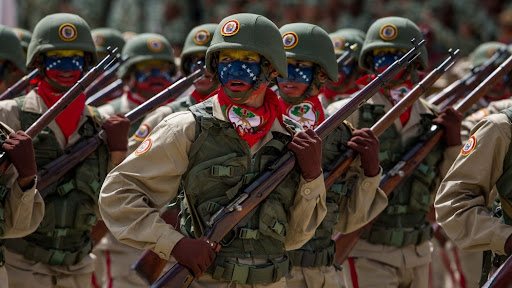
US military authorities are planning strikes on alleged drug trafficking targets inside Venezuela. At the same time, Venezuela’s armed forces are conducting exercises with volunteer militias, training citizens in the use of weapons in preparation for a possible invasion.
The powers granted to Maduro are valid for 90 days, with the possibility of renewal for another 90 days, according to the country’s constitution.
Huge strategic importance for the US
Venezuela’s strategic importance is enormous, as it has the world’s largest proven oil reserves, with 303 billion barrels, more than Saudi Arabia.
Venezuela’s rapprochement with Russia and China could threaten the US “petrodollar” system. Please also read the analysis titled “Examining the Cases of Venezuela and Ukraine in Parallel“).
For the US, maintaining Latin America under American influence is a strategic priority. The US-Venezuela friction could escalate into a full-scale military conflict, as part of a broader great power confrontation seen in 2025 in Russia-Ukraine, India-Pakistan, Israel-Iran and other regions.
US actions, from the attack on Iran to the current pressure on Venezuela, send a message of readiness to deal with future conflicts around the world. At the same time, the tension sends a clear message to China, while calling into question the international system led by the United Nations, which appears to be entering a period of doubt and insecurity.


