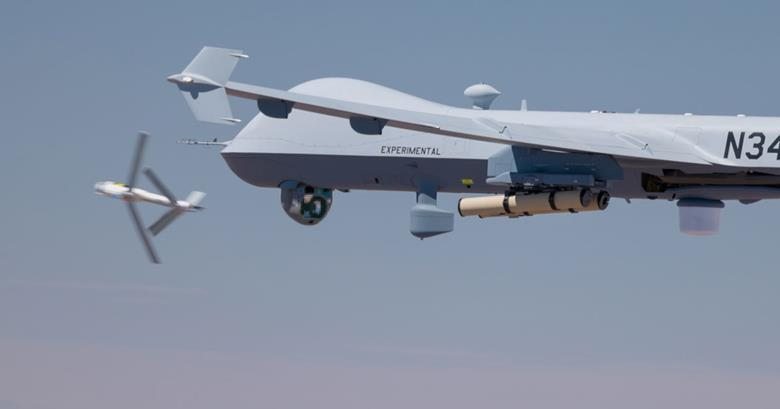
In tests conducted by the US Air Force in July 2025, a long-range unmanned MQ-9A Reaper launched the Switchblade 600 kamikaze drone.
The combination of “unmanned aircraft that also carries unmanned weapons” is one of the practices that is evolving internationally, transforming air warfare – to some extent at least – into a field of confrontation between remotely controlled and autonomously guided platforms.
In tests at the Yuma field in Arizona, the Reaper launched Switchblades, which were then handled by a team from the ground. The Reaper, known for its ability to carry out missions of dozens of hours of flight, can carry weapons, which are usually Hellfire anti-tank missiles with a range of about 10 kilometers. However, with the Switchblade (in the relevant photos the aircraft carries two of these), it acquires the ability to strike at a much greater distance, so it can remain out of danger from anti-aircraft systems. Specifically, the Switchblade 600, when launched from the ground, has a range of about 40 kilometers, but when launched from the air it reaches 175, with the Reaper also offering long-distance satellite connection.
Furthermore, since the roving munition has its own detection head with a camera, it is not necessary to have accurately located the target. But the Switchblade is launched in its general direction, and then undertakes to identify and strike it on its own. Thus, the scenarios of use and performance multiply, with the Reaper becoming the “mother” ship of roving munitions.