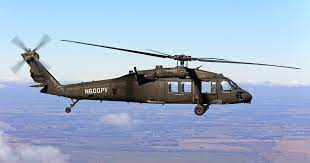
Sikorsky, a Lockheed Martin company, together with the US military’s Defense Advanced Research Projects Agency (DARPA) have demonstrated for the first time to the US military how an autonomous, unmanned Black Hawk helicopter can safely and reliably perform missions cargo replenishment as well as rescue operations. Sikorsky is working with DARPA to develop autonomous technology that will improve the safety and efficiency of the aircraft.
The flights, which took place on October 12, 14 and 18 as part of the US military’s Project Convergence 2022 (PC22) experiment, show how existing and future helicopters of the type could one day fly complex missions with reduced or no crew. Doing so will give Squadron Command and airmen more flexibility in when and how to use aircraft and pilots, particularly in low visibility environments or in contested areas.
The importance of autonomous operation
Sikorsky is working with DARPA to develop autonomous flight technology that will exponentially improve the safety and efficiency of helicopter and aircraft flights. Sikorsky’s autonomous system, known as MATRIX™ technology, is the core of DARPA’s ALIAS (Aircrew Labor In-cockpit Automation System) operation.
“In addition to increasing flight safety and reliability, MATRIX technology enables survivability in high-threat environments where Black Hawk helicopters operate today and DEFIANT X® and RAIDER X® helicopters could operate in the future. unmanned or undermanned helicopters could safely perform critical and lifesaving missions day or night in complex and contested battlefields,” said Mr. Cherepinsky, Director of Sikorsky Innovations.
The details of Yuma
During the PC22 Technology Gateway experiment, the Sikorsky and DARPA team demonstrated how the Black Hawk helicopter in autonomous operation, with no personnel on board, can deliver a large volume of blood in excellent condition by flying low and fast above the level of the ground using the terrain to cover its signature thus avoiding detection, resupply troops with external cargo, and change course mid-flight to pick up a casualty.
At the start of the flight demonstrations the pilots flew and landed the Black Hawk aircraft and then activated the MATRIX system to give full control to the flight computer. When the pilots left, the helicopter autonomously completed the following missions:
- Long-range medical supply: The Black Hawk aircraft flew 83 miles while loaded with 400 units of real and simulated blood – a total of 500 kilograms. Coming within 40 miles of its original takeoff point, the helicopter descended into a valley 200 feet above ground level at a speed of 100 knots.
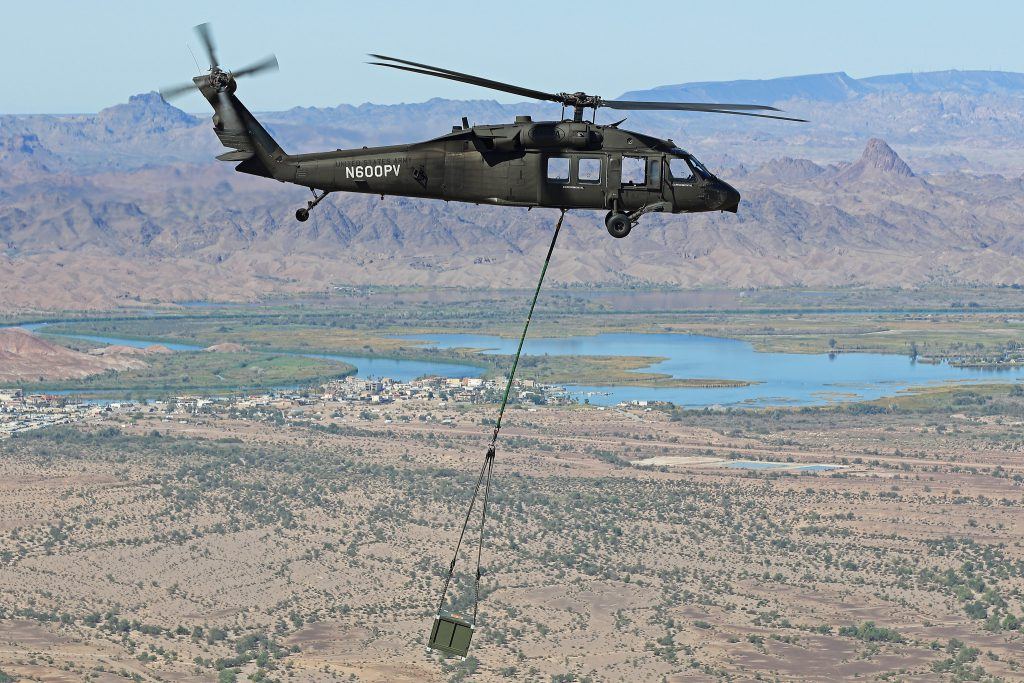
- Cargo delivery and casualty pickup (combined mission): The helicopter took off with an external load of 2,600 kg and flew at a speed of 100 knots for 30 minutes to a specific landing area. During the flight the helicopter was redirected, simulating a scenario in which a threat had to be neutralized near the landing area.
Sikorsky demonstrated how a ground operator with a secure radio and a tablet can take control of the unmanned helicopter, order it to release the cargo it’s carrying and then land to pick up a casualty from a nearby location. Once the patient, who was on a stretcher, was secured inside the cabin, the ground operator launched the aircraft. During the return flight, the health monitoring device (BATDOK), integrated into the helicopter’s communications system, transmitted the patient’s vital signs in real time to a medical team on the ground.

The next steps
Demonstrations as part of PC22 of unmanned Black Hawk flights took place for the second time this year. Sikorsky and DARPA will continue to work toward transitioning this technology for military operations such as cargo and medical supplies, patient pick-up, and commercial applications such as firefighting, cargo transportation, and aerial traffic control. urban areas.