Naval radar technology has advanced greatly, whether it is a rotating antenna radar or a fixed antenna radar. The latest technology refers to 3D or 4D AESA radars with Gallium Nitride (GaN) technology transceivers. In this context, all major electronics companies in Europe and Israel currently offer modern solutions for integration into main or secondary naval units. In this article – analysis, we will review the developments in the latest generation of naval radars.
France – Thales France
Sea Fire
The Sea Fire from Thales France is a 4-D AESA technology radar, which operates in the “E/F” frequency band. The difference between 4-D and 3-D radar lies in the arrangement of these antenna elements. A three-dimensional (3-D) radar system has antennas arranged horizontally, while a 4-D radar has elements arranged both horizontally and vertically. Sea Fire combines four (4) antennas in a fixed arrangement. Each can activate 100 different beams, which ensures a high data refresh rate and excellent performance in the field of target detection.
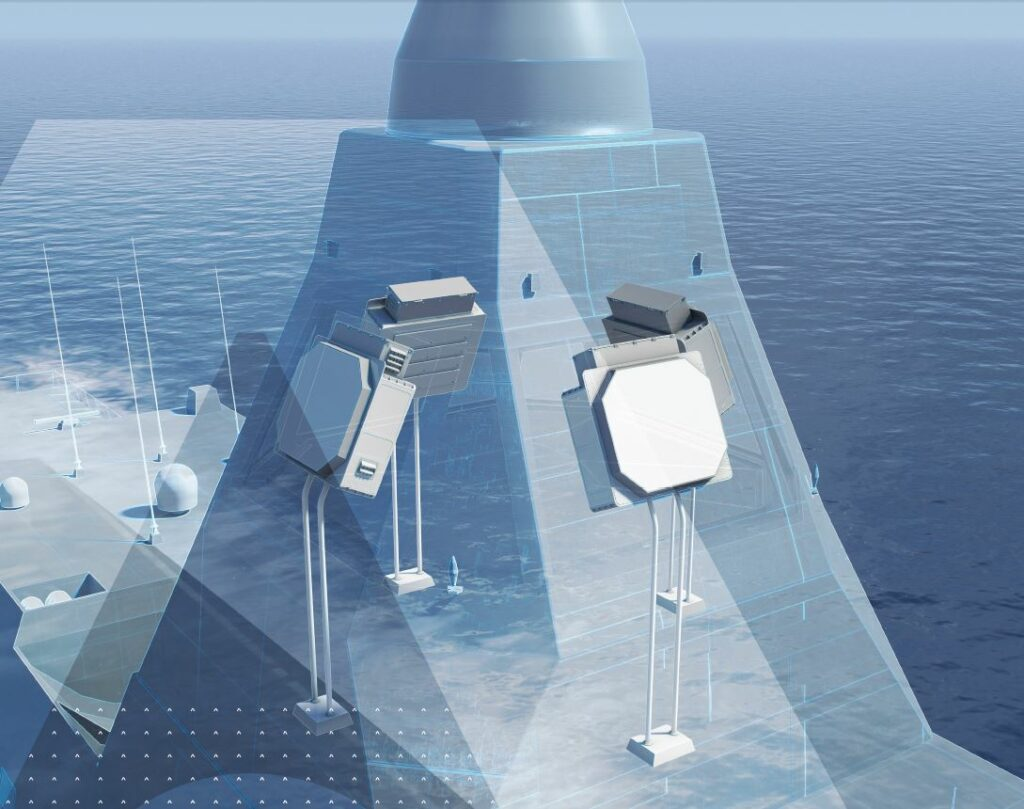
It is characteristic that Sea Fire can track 800 targets simultaneously, an image which it can transmit to other friendly means or command echelons, via a data link system. Sea Fire was developed with the philosophy of supporting a comprehensive concept for the ship’s self-protection, especially against threats such as anti-ship missiles and hypersonic missiles.
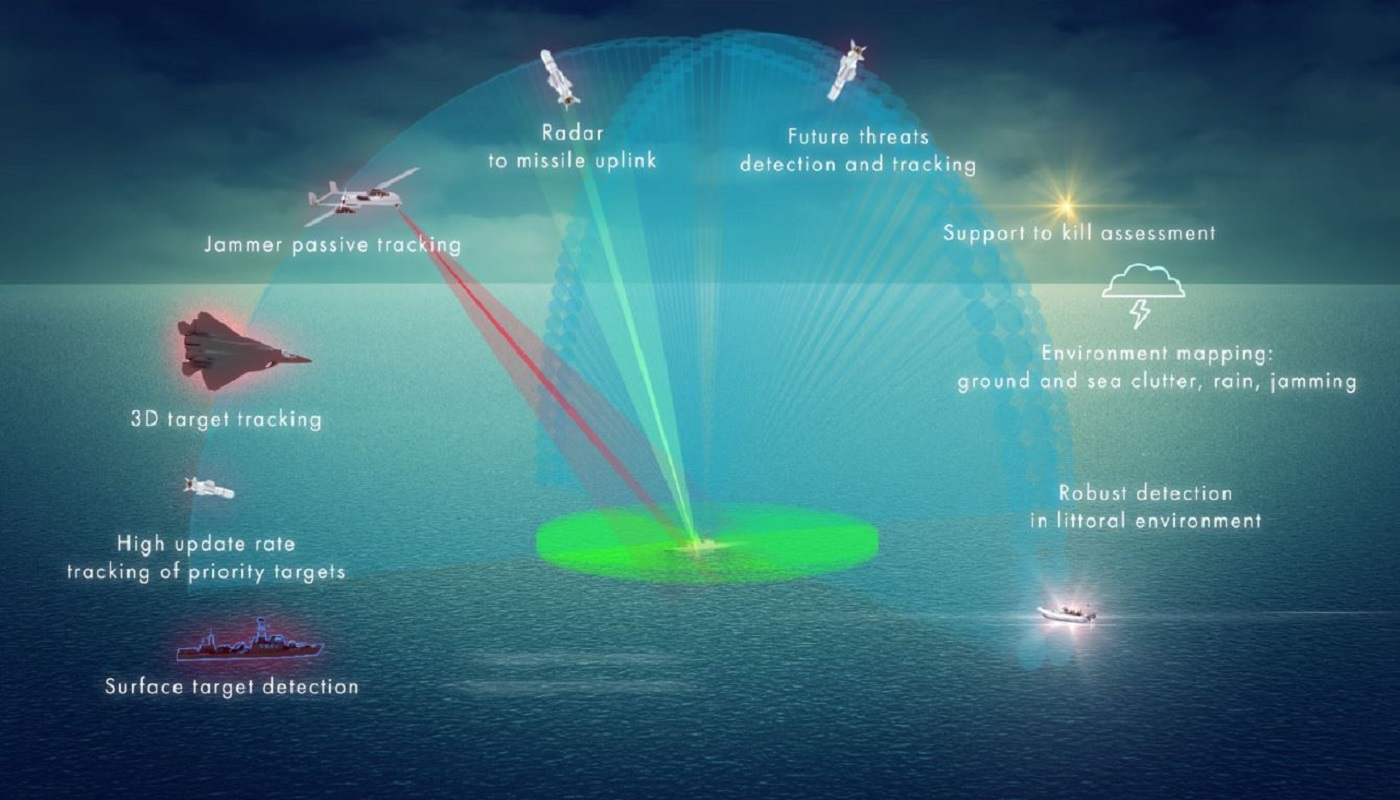
The maximum range of Sea Fire, in air reconnaissance mode, is in the order of 350 kilometers for ballistic missile-level targets, F-16-sized aircraft and UAVs, and coverage of 90 degrees in the vertical plane. The maximum range in surface reconnaissance mode is 80 kilometers. In addition to its function as an air and surface reconnaissance system, the radar also functions as a fire control system for the Aster-30 long-range anti-aircraft missiles. It also functions as a weather radar. Great care has also been taken to ensure its ease of maintenance, so that its cost, over its life cycle, is competitive.
Each of the four (4) surfaces consists of 12 sections and each of the 12 sections consists of eight (8) sub-sections. Antenna, section and sub-section can be replaced easily and quickly, if necessary, even at sea. Sea Fire has the ability to engage multiple air targets simultaneously in cooperation with the Aster 30 active guidance missiles. In practice, this capability multiplies the ship’s ability to deal with saturation attacks. Another important parameter is the ability of Sea Fire to detect targets with a low electromagnetic signature, a result of the new technologies applied in the construction of the four (4) antennas with Tx/Rx elements made of Gallium Nitride.
Netherlands – Thales Netherlands
APAR / APAR Block 2
The APAR (Active Phased Array Radar) from Thales Netherlands is the first phased array radar built in Europe in the 1990s and was integrated into the German and Dutch Navy F-124 class anti-aircraft frigates Sachsen and De Zeven Provigen in cooperation with the SMART-L long-range volume search radar also from Thales Netherlands. It consists of four array antennas with 3424 transceivers each. The range for air targets is 150 km and for surface targets 32 km. Unlike the American AN/SPY-1 radar, the APAR with the ICWI (Interrupted Continuous Wave Illumination) technique eliminated the need for illuminators on the carrier ship and allowed the guidance of 32 semi-actively guided missiles in flight simultaneously and 16 in the terminal guidance phase. It provides excellent target search and tracking capabilities, provides advanced electronic countermeasures (ECCM) techniques, provides accuracy and assessment of surface artillery missions, supports programming and guidance for missiles such as the Standard SM-2 Block IIIa and the Evolved Sea Sparrow, and performs target destruction assessment.
The APAR Block 2, is the evolution of the radar and uses four independent antennas, each with an expandable number of solid-state T/R units. This offers flexibility, scalability, and the modular design also offers high availability. In addition to the ICWI guidance method, the new radar also uses the JUWL (Joint Universal Weapon Link) suitable for the new generation of ESSM Block 2 AA missiles and the newer versions of the SM-2. The APAR Block 2 is also equipped with a processing suite that allows it to be merged with the other long-range SM400 Block 2 radar in the XS-Suite: a single radar system with 4 X-band and 4 S-band arrays on the same mast.
The main features of Block 2 are:
- Area defense against the latest emerging and evolving threats in littoral environments
- Low-altitude search for detection of very small targets on the horizon
- Weapon tracking with high update rate for engaged targets
- Multiple simultaneous fire control channels for ESSM (Block 2) and SM-2
- JUWL for ESSM Block 2 and Standard Missile family
- Target destruction assessment
- Integrated search and tracking for high accuracy and rapid response
- High operational robustness in littoral environments, high background noise and environments of intense electronic interference.
- Scalable to fit light frigates to Destroyers
Sea Master (SM400 / SM400 Block 2)
The SEA MASTER 400 (SM400) is the first non-rotating medium-range radar in Thales’ E/F band for air and surface surveillance. The radar consists of four active phased array antennas using Active Electronically Scanned Array (AESA) technology. The new 3D dual-axis multi-beam concept allows for the reliable detection of a wide range of targets in complex environments. The system is almost zero-weight as all operational tasks operate simultaneously and autonomously. The 3D dual-axis multi-beam arrangement uses detection beams positioned simultaneously in both elevation and azimuth. With the achieved increase in Doppler resolution, the SM400 detects a wide range of targets. The SM400 has the ability to detect UAVs, stealth fighters and hypersonic missiles even in conditions of intense background noise (clutter) and without sacrificing the update rate. The system offers excellent performance under all weather conditions, in coastal and offshore environments and against asymmetric threats. In this version, according to Thales, the air search range is 250 kilometers. The SM400 is in service with the Dutch Navy’s Holland class patrol boats on a Thales I-Mast 400 mast.
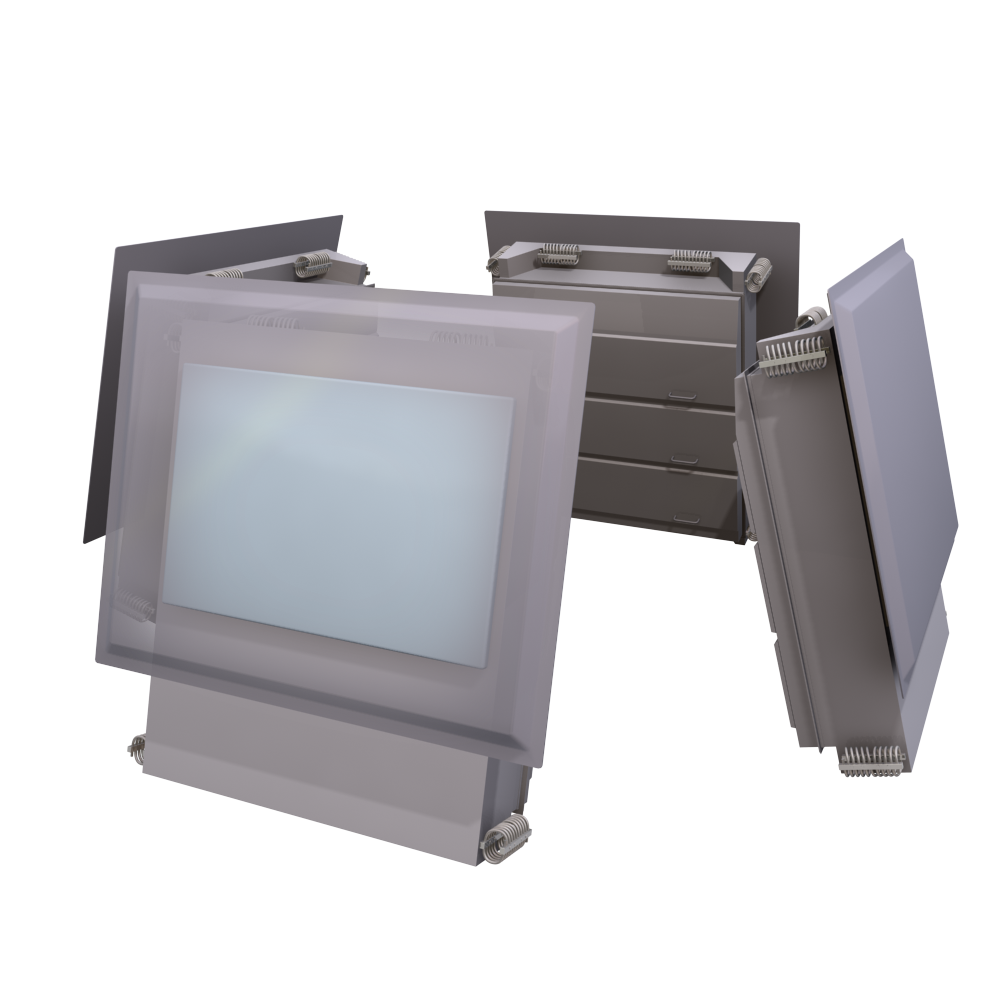
The new SM400 Block 2 version maintains and enhances the capabilities of the previous model. The main new features of Block 2 are the increase in the air search range to 400 km, the service of the new versions of ESSM and SM-2 through the integration of the JUWL link. It is expandable through the easy expansion of the transmitting and receiving units and/or software upgrades. And finally it integrates the XS-Suite which allows its merger with the APAR Block 2.
NS50, NS100 & SMART L Rotating Radars
So far, Thales has achieved success with the NS50 and NS100 families. Featuring a modular and scalable architecture, allowing its installation on OPVs, MCMVs, auxiliaries and various other platforms, the rotating NS50 has signed a contract for installation on MCMVs for the Belgian and Dutch navies, as well as for the French navy. With a maximum range of 180 and 80 km respectively against air and surface targets, and an altitude coverage of 70°, the NS50 has the capacity to track 1,000 targets and three fire control channels for artillery fire support. The new rotating NS110 model, which has also been selected for installation on the Greek MEKO 200HN frigates during the upcoming modernization, features a larger antenna that provides a maximum detection range of air targets at 280 km. Thales Nederland also offers the most capable air defense radar developed in Europe. The MM/N version, which has already been acquired by the Dutch, French and Italian navies, is the latest and fully digital version of the SMART-L L-band radar, which introduces a series of improvements, centered on a new high-power AESA antenna based on GaN TRMs. Together with dual-axis dual-beam technology, these improvements allow the radar to detect demanding threats, such as stealth, short- to long-range ballistic missiles and space objects with a range of up to 2,000 km (480 km for air targets) and the ability to track 1,000 targets.
Germany -Hensoldt
TRS-4D
The TRS-4D is offered by the manufacturer Hensoldt as both a single-antenna rotating and a fixed antenna. The former configuration is found on the USN’s newer LCS ships, while the latter is found on the German Navy’s F-125-class frigates in four element antennas divided by two on the ship’s masts. The TRS-4D is a new generation 4-D active phased array radar in the G-band. The element manufacturing technology is Gallium Nitride (GaN). The air search range in the fixed panel version is 300 kilometers and a minimum of 200 meters, while it has the ability to track over 1500 tracks.
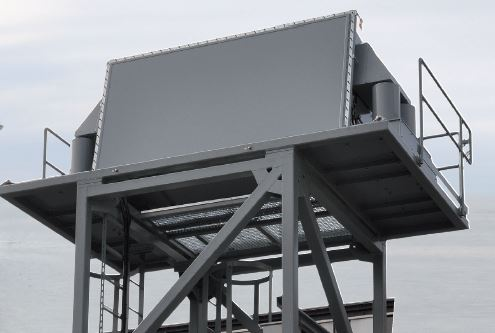
The allocation of radar resources across different scan types provides a flexible combination of volume search, surface search and high-priority tracking. This combination results in robust tracking and reliable target classification, especially with maneuvering threats. The features of the modern electronic counter-countermeasure (ECCM) ensure performance even under adverse jamming or interference. The radar has sufficient capacity for simultaneous operations even in difficult situations with high target density and in challenging coastal and offshore environments with high ambient noise. This ensures platform survivability and mission success.
Kronos DBR
Leonardo has developed a family of latest-generation 4FF X- and C-band radars alongside L-band long-range air and missile defense rotating radars and is approaching a next-generation S-band sensor. To meet the Italian Navy’s requirements for an integrated air defense system (IAMD), which includes current and future high-speed threats, including ballistic and hypersonic missiles. The latest and most modern version of Kronos is the Kronos DBR. The Kronos DBR consists of four Kronos Quad arrays operating in the C-band and four Kronos Starfire arrays operating in the X-band (a total of eight arrays). Four arrays are mounted on the forward mast and four on the aft mast, covering a 360-degree arc. According to Leonardo, the FREMM EVO will be capable of space surveillance and ballistic threat detection at a maximum range of 600-1,300 kilometers. The Kronos DBR suite features a system manager capable of controlling in real time both the two different-band radars and the ship’s new electronic warfare suite (EWS), ensuring the best use of both systems, including coordinated electronic attack capabilities.
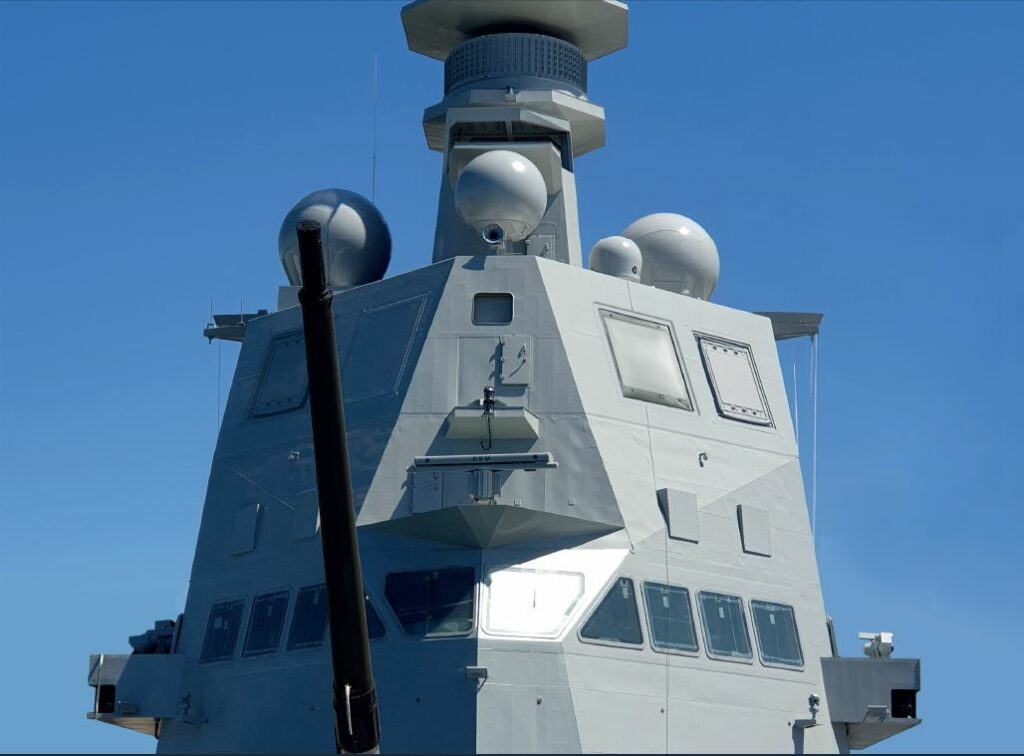
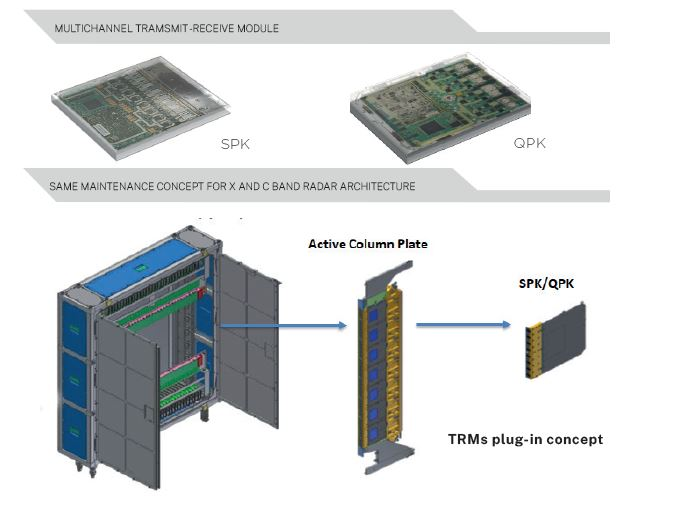
The next version of the KRONOS naval radar family is the KRONOS DBR (Dual Band Radar), with AESA (Active Electronically Scanned Array) technology, which operates in the C and X frequency bands (a total of eight panels). More specifically, the system has four KRONOS QUAD radar panels that emit in the C band and four KRONOS Starfire radar panels that emit in the X band. This combination offers the carrier ship the ability to operate in coastal waters and at the same time provide area anti-aircraft defense and anti-ballistic protection against ballistic missiles. Also, the use of the panels creates an impenetrable search dome around the carrier ship in an arc of 360 degrees in azimuth, 90 degrees in the vertical and at ranges of more than 300 kilometers in distance and 30 kilometers in height.
Each KRONOS QUAD panel consists of 2000 TRM elements. The KRONOS QUAD is ideal for long-range reconnaissance, area air defense with the guidance of ASTER 30 missiles and has the ability to autonomously search and track tactical ballistic missiles and ballistic missiles of up to 1300 km. It is also used for self-defense and providing firing data for the ship’s guns.
On the other hand, the KRONOS Starfire is for short-range reconnaissance and high-definition image creation, ideal for detecting small cross-section targets and operations in coastal waters. In addition to the usual functions of a radar such as air-sea reconnaissance, missile guidance, providing data for guns and ship self-defense, this particular radar has the ability to search, detect periscopes and categorize and target underwater targets. This particular radar combination has been installed on the large offshore patrol vessels PPA and is also to be installed on the newer FREMM Evos ordered by the Italian Navy.
The next two members of the family and the newest are the KRONOS GRAND MOBILE HP and the KRONOS POWER SHIELD LAND. The main difference between these two radars compared to the previous ones is the TRM technology which is GaN and not GaAs, resulting in a 30% greater search range compared to the previous models. Of course, the company does not specify whether the KRONOS GRAND NAVAL and KRONOS DPR are also GaN technology. More specifically, the KRONOS GRAND MOBILE HP, which has also been selected by the Greek Air Force to be installed on the Crete firing range, also operates in zone C and maintains all the capabilities of the previous KRONOS ΜOBILE model. Maximum range for air survey over 300 km in range and 30 km in height and the ability to manage up to 500 tracks. It has a mechanical rotation rate of 60 rpm and an AESA beam shift of +/- 45 degrees in azimuth and +/-60 degrees in elevation. IFF Mode 1,2,3/A,C,S,4 & 5 support and ECCM capabilities. The mean time between failures (MTBCF) is over 2000 hours of operation and the time to change a TRM is less than 45 minutes. The radar is carried on a standard 20 ft cage and has the ability to go from moving to stationary within 15 minutes. The system operates with only two users and has the ability to operate remotely.
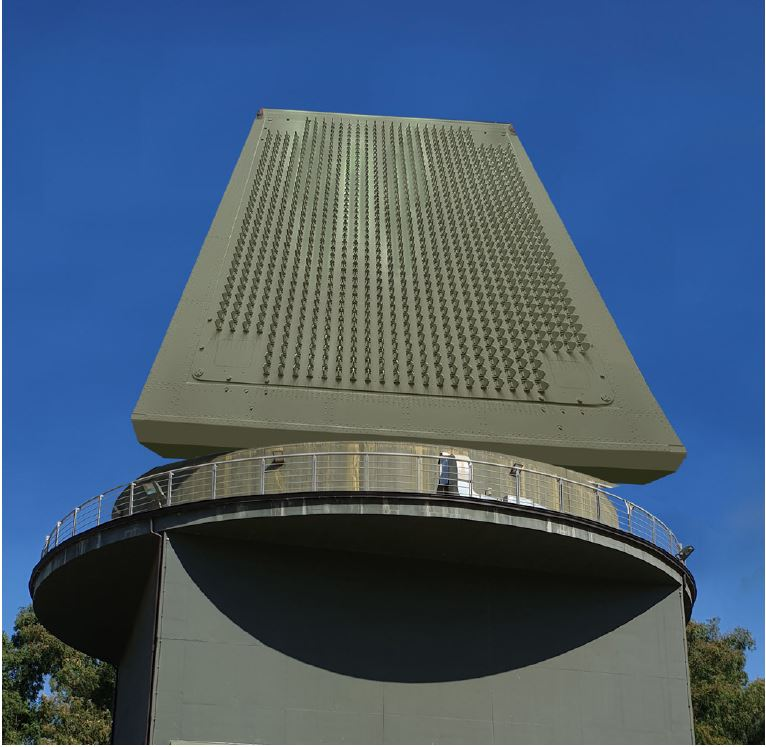
The KRONOS POWER SHIELD is a fully digitalized multi-function radar that uses an AESA antenna with high-gain GaN Tx/Rx modules for long-range detection of ABT (Air Breathing Targets) and medium-range ballistic missiles. It can operate as a rotating radar, at 15 rpm, or in fixed mode aiming at the expected direction of the incoming threat. The new software-defined radar features a digital antenna architecture based on 1000+ TRMs grouped into DAT (Digital Active Tiles), which implements a complete radar chain for each individual radiation element.
KRONOS POWER SHIELD, while providing support for extended long-range air surveillance and fighter air operations, is also capable of providing early warning and guidance data to SAM (Surface to Air Missile) systems for MRAD (Medium Range Air Defence).
The main features of KRONOS® Power Shield are:
- Detection of Air Breathing Targets (ABT) up to 500 km range and 30 km altitude.
- Detection of ballistic missiles up to 1500 km
- Altimeter coverage up to 90°
- Azimuth steering angle up to 90°
- Scan rate 4 seconds (in rotation mode)
- Target management capability > 1000 targets
Finally, Leonardo has started the development of a powerful next-generation S-band radar in 4FF configuration, based on the requirement of the Italian Navy to equip the future AAW destroyers under development under the DDX program.
Italy – GEM Elettronica
GEM Elettronica has specifically designed the Columbus X-band 3D multifunctional radar for shipboard and coastal surveillance. It offers simultaneous surveillance and tracking of short to medium-range air and surface targets, as well as target designation. Weighing less than 400 kg, the electronically stabilized IFF integration radar antenna, rotating at 10-60 rpm, can detect low-signature threats such as unmanned aerial systems, while providing target identification and navigation. The radar’s digital signal processing is carried out via fiber optics. With solid-state TRM systems and LPI (Low-of-Probability Intercept) functions, digital beamforming at altitude along with digital pulse compression with fully coherent pulse processing for noise elimination, frequency modulation flexibility and pulse repetition frequency (PRF) variation, the air-cooled Columbus radar has a maximum range of over 120 km, a maximum altitude coverage of over 60 degrees, along with a three-dimensional tracking (air and surface) capability of over 300 targets. Its low weight, 200 kg in the Mk2 version, makes it ideal for installation on small vessels such as offshore patrol vessels.
Sweden – SAAB
Giraffe Family
The latest version of the Swedish company’s Sea Giraffe family of systems, the 1X model, is a lightweight X-band radar designed as a primary 3D surveillance radar for smaller vessels such as patrol vessels and autonomous vessels, and secondarily as an auxiliary surveillance/target indication sensor for larger platforms. With a mass of less than 150 kg, the Sea Giraffe 1X covers the entire search volume every second and provides accurate 3D data for all aerial targets in the search volume, as well as on the surface. The X-band functionality offers higher resolution, which, together with the refresh rate, is key to detecting and distinguishing low radar cross-section threats such as drones, while the software-defined architecture allows for upgradeability to address new threats.
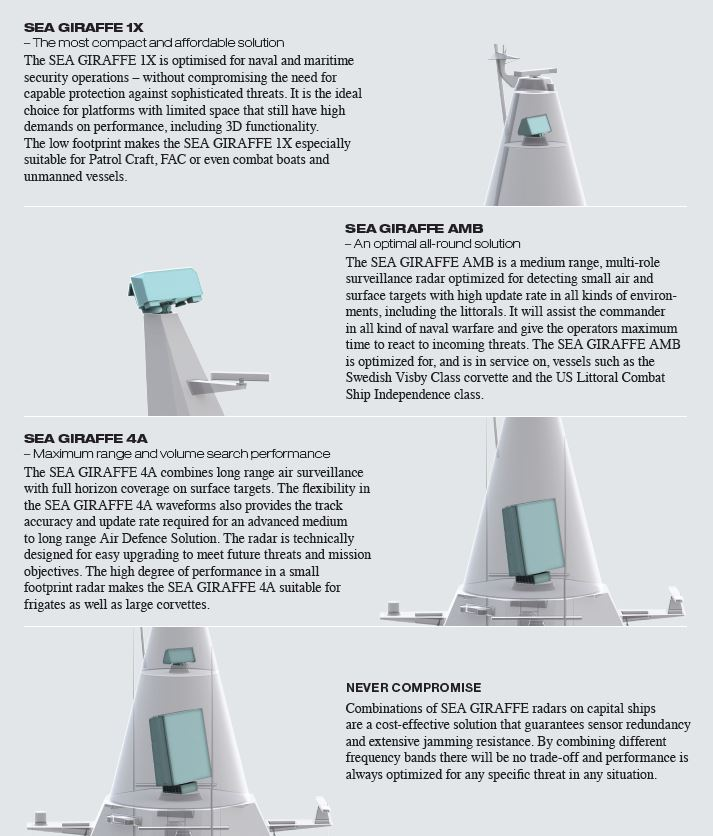
Saab also offers the multi-functional Sea Giraffe 4A “Fixed Face” or rotating S-Band radars, which provide long-range air surveillance and defence with full horizon coverage for surface targets. Combining the battle-proven designs from the previous well-known Sea Giraffe AMB and Arthur families, with an all-new fixed antenna radar sensor suite based on a digital AESA beamforming antenna incorporating GaN technology, the Sea Giraffe 4A offers a maximum range of 350 km to meet medium to long-range air surveillance and target indication requirements. It provides 360° horizontal coverage and up to 70° elevation with a very high and flexible 3D target update rate. Combining the Sea Giraffe 4A FF with the Sea Giraffe 1X rotating radar in Saab’s multi-sensor solution based on the company’s lightweight integrated mast, the radar suite provides optimal overlapping performance and redundancy for air and surface surveillance, hypersonic target detection and tracking, unmanned systems capability through the Enhanced Low, Small and Slow target (ELSS) classification, alongside detection and warning functions.
United Kingdom – BAE SYSTEMS
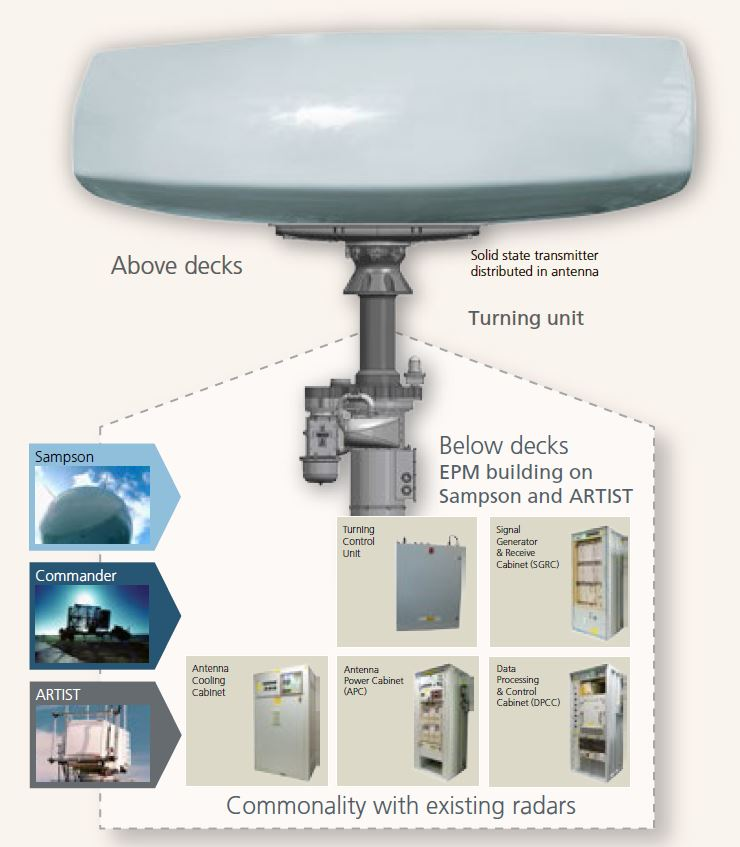
BAE SYSTEMS, as part of the Type 45 destroyer’s BMD capabilities upgrade, has also made improvements to the SAMPSON radar. The latter extends the fleet’s fully software-configurable BAE Systems Sampson multi-function AESA radar (MFR) with contiguous phased arrays featuring adaptive digital beamforming techniques to provide hemispherical coverage.
BAE Systems also offers the ARTISAN 3D (Advanced Radar Target Indication Situational Awareness and Navigation) S-band multibeam radar family. The radar shares technologies with the Sampson radar to provide electronically stabilized 3D performance at a low cost. ARTISAN is offered in three models (100, 200 and 300) with increasing capabilities, enabling 3D aerial surveillance with rapid target alerts, secondary surface surveillance, navigation, weapons control support, jamming suppression and surveillance thanks to digital adaptive beamforming, digital pulse compression and Doppler processing. At 30 rpm (for all models), the ARTISAN 300 has an instrument range of over 200 km, with the ability to track over 1,000 targets (air and surface) in 3D.
Israel – IAI/ELTA
ELM-2248, EL/M-2258 Alpha, ELM-2238X
IAI/Elta offers the ELM-2248 AESA Multi-Function Surveillance, Tracking and Missile Guidance Radar (MF-STAR) for naval deployment. The latter operates in the S-band and uses a 4FF array based on a modular panel architecture with a GaN solid-state TRM and optical networking to allow for scalability in antenna aperture size and mass reduction, along with single or dual mast configurations. The MF-STAR’s basic digital transceiver output allows for software-only adaptive beamforming and operating variants to form a software-defined radar. Key functions include 3D volume search, over-the-horizon missile search, multi-target tracking, active/semi-active anti-aircraft missile guidance mid-course, semi-active missile illumination, surface surveillance, helicopter detection, naval gunnery support. The MF-STAR (ELM-2248) provides high-quality situational awareness and weapons support under difficult target/environmental conditions in the current and future naval arena. The radar is available in two versions for corvette-sized ships with a 1300 kg antenna and a range of 250 km and a larger one for frigate-sized ships with a 4000 kg antenna and a range of over 450 km. According to the manufacturer, it incorporates advanced technology and a robust system architecture. MF-STAR uses multi-beam and pulse Doppler techniques, as well as cutting-edge ECCM techniques to extract low RCS targets from complex, high-noise and jamming environments. The ELM-2248 MF STAR is in service with the Israeli Navy’s new Sa ‘ar 6 stealth corvettes.
Leveraging the same technologies implemented in the MF-STAR, Elta’s EL/M-2258 Alpha (Advanced Lightweight Phased Array) rotating AESA radar features include 2D electronic beam steering (up to 70° elevation scanning), very high tracking update rate, naval gun support and advanced ECCM techniques. In the basic configuration with a range of 200 km, the Alpha’s antenna weighs 880 kg, while the electronics modules below deck add another 1,400 kg to the overall setup.
Elta Systems also offers the new compact STAR-X ship surveillance radar (ELM-2238X) specifically designed for OPVs, but capable of serving as a secondary search radar for larger vessels. Operating in the X-band and applying AESA digital beamforming technology in height, the radar performs 3D simultaneous surface and air surveillance. The software-defined, configurable radar, which allows adaptation to emerging future threats, uses a GaN solid-state TRM to achieve a compact and lightweight design. With a radar antenna mass of less than 350 kg and capable of 6-60 rpm with 70° elevation, the STAR-X offers a maximum instrument range of 150 km and a tracking capability of over 1,000 targets.
Turkey – ASELSAN
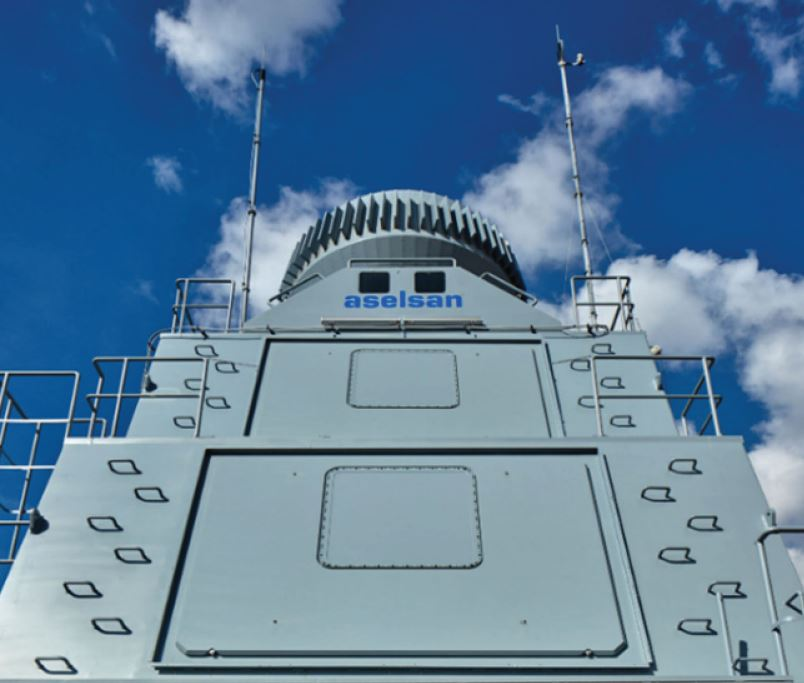
ASELSAN offers the Cenk 3D radar family in the S and X bands with AESA technology, in rotating and non-rotating versions, with advanced GaN technology transmitter/receiver units.
Cenk 400-N – The most capable rotating version, installed on Istif-class frigates. Range 400 km, elevation coverage 70° (80° in tracking), >500 targets, 30 RPM, antenna weight 1,800 kg.
Cenk 300-N – For fast patrol boats.
Cenk 200-N (Akrep 200-N) – Fixed antenna, for weapons fire control.
Cenk 100-N – Multi-directional array for short-range UAV detection.
The non-rotating Çafrad system features four fixed antennas, combining the Cenk 500-N (X-band, 150 km, >1,000 targets) and Cenk 600-N (S-band, 450 km, >2,000 targets) as well as the Cenk 700N IFF.
Russia
The Zaslon MF is a state-of-the-art, multifunctional active phased array (AESA) radar developed by JSC Zaslon for the Project 20385 and 20386 class corvettes as well as the upgraded Kirov-class cruisers. The radar is intended to provide surface and air surveillance, target detection, target tracking and fire control, including target designation and shipboard gun control. The Zaslon MF is capable of engaging low-altitude flying targets and land targets with electromagnetic signature. It can operate in the X and S bands in active mode and in the L-, C-, S-, X- and Ku bands in passive mode. In addition, the Zaslon MF can provide jamming in the X and Ku wavelengths. JSC Zaslon stated that the radar development was completed in the summer of 2017 with operational deployment to take place in 2020 or 2021 on the Project 20386 stealth corvette or the Kirov-class nuclear-powered missile cruiser.
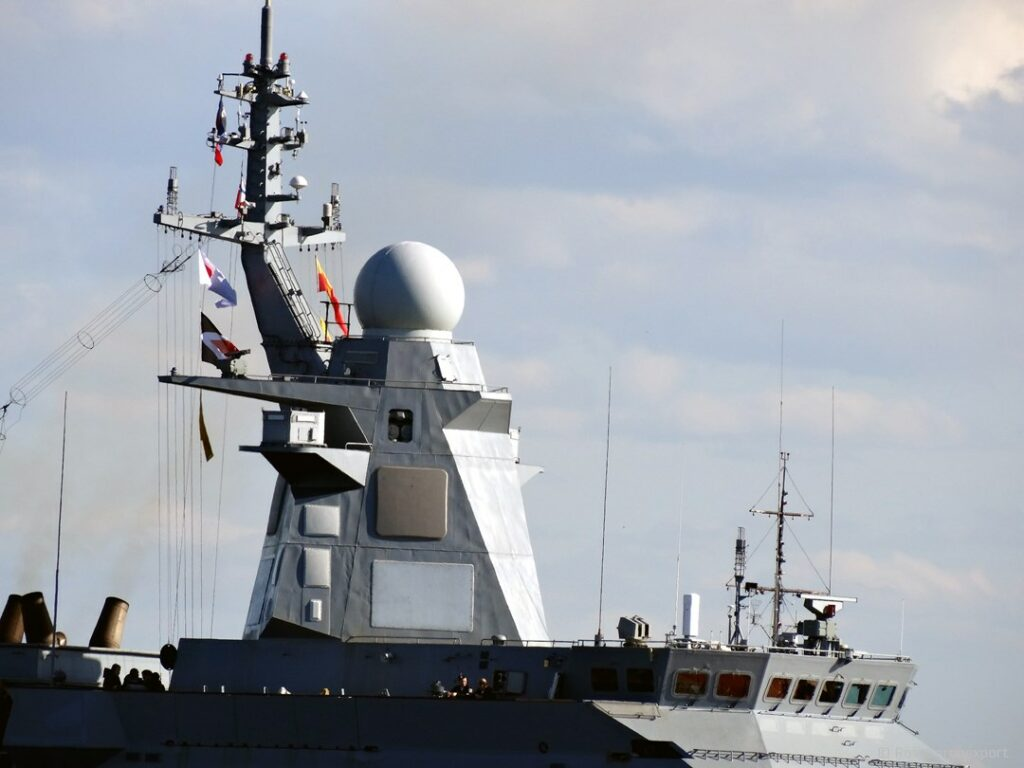
The Zaslon MF can provide automatic identification and classification of tracked targets among many functions provided by its amazing versatility. The new radar system is also able to support other assets, such as rotary-wing aircraft, fighter jets and other aircraft, exchanging critical data with them. Everything in the radar system is designed to be highly automated with minimal operator involvement required via a new specialized workstation.