



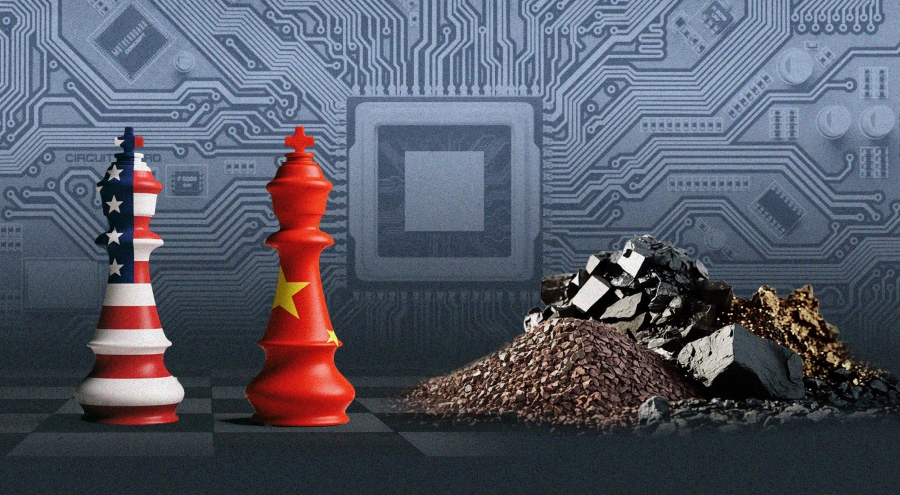
With only one strategic “weapon” — rare earths — Beijing has held the United States and its allies hostage, sending the Pentagon into a tizzy and supply chains into chaos.
Prices have soared, factories have run out of raw materials, and Washington’s strategic advantage is starting to falter. In the quietest but fiercest battle of the 21st century, China didn’t need missiles — just some critical minerals…
Hard restrictions
In June, following trade concessions from Donald Trump, China resumed rare earth exports. However, restrictions on strategically critical materials such as neodymium, dysprosium, terbium, gallium, germanium, antimony, and some magnets remained.
Beijing controls more than 90% of the global market for rare earths, which are used in a myriad of military technologies – from infrared sensors and drone engines to high-precision munitions.
Chinese authorities are now delaying exports of these minerals, tightening controls: they require photos of products or production lines to prove that they are intended for civilian use.
No alternatives
The Pentagon has called for the search for alternative suppliers, but this is not easy. China controls not only mining, but also the technologically complex and environmentally “dirty” stage of processing. In the West, these plants have been closed for years.
According to the International Energy Agency (IEA), China dominates the processing of 19 of the 20 most important minerals, holding an average of 70% of the market.
Complete dependence
To stop imports, the US and its allies would have to build entire industries from scratch — from exploration and mining to processing industries. This requires huge investments, a lot of time, and solutions to serious environmental issues.
American companies cannot simply turn to another equivalent supplier — because there is none yet.
Hopes in Australia and … India
The West hopes in Australia and India, but it is clear that they cannot fully cover the losses.
Australia can cover only 15% to 20%, the remaining 30% to 40%, and this at a cost 5–10 times higher, plus transportation costs. This “restructuring” will cost the US defense sector billions of dollars,” notes economist Thanos Chonthrogiannis of Trust Economics.
A difficult situation
US defense contractors are in a dire straits. Materials are in short supply. In addition, prices have skyrocketed — at least fivefold.
Samarium, a rare metal used in high-temperature magnets for fighter jet engines, has risen 60-fold. And that, experts say, is just the beginning.
Rising prices
Neodymium and dysprosium (essential for electric cars, wind turbines, and advanced electronics) will rise in price, as will key industrial metals such as lithium (for batteries), zinc, tin, manganese, and chromium.
Defense companies also report depletion of germanium, gallium, and antimony. Some have supplies for only a few months, which could cause problems for the entire military industry. Inevitably, there will be a reduction in production. There are already delays in existing contracts, adds the Trust Economics economist.
Critical Dependency
Control of strategic minerals is not just an economic advantage, but a geopolitical tool, and Beijing has used it in the trade war.
The Pentagon has required contractors to stop buying Chinese rare earth magnets by 2027. But the timeline is already unattainable.
The vast majority of components in U.S. Department of Defense weapons systems are made from critical minerals that are subject to Chinese export restrictions.
Moreover, almost every supply chain includes at least one Chinese company. That means any restriction by China affects the entire U.S. defense industry.
Lithium Mines Are Closing – A Significant Shortage Is Coming to the Global Market
At the same time, however, the closure of lithium mines in the Chinese city of Yichun, located in the eastern province of Jiangxi, could significantly affect the global market for this metal.
According to estimates by analysts at the Chinese investment bank CITIC Securities, the cessation of operation of some deposits could cause a global shortage of lithium.
At present, some of the mines in the region face risks of non-compliance with operational requirements. Their total annual production capacity is estimated at 185,000 tons of lithium chloride, which corresponds to approximately 12.5% of global supply.
The possible complete cessation of these production capacities would lead to a significant reduction in the volume of metal available on the market.
Month-long shutdown, significant price increase
The situation worsened after the Chinese company CATL suspended the operation of one of its key mines in Yichun. It is expected that the shutdown will last at least three months, which means a decrease in China’s domestic lithium supply by 8.3 thousand tons per month – about 8% of the total volume.
According to estimates by experts from CITIC Securities, this will create an imbalance between demand and supply and will act as a factor in a significant increase in metal prices.
The reason for the suspension of the operation of the CATL mine was the expiration of the mining license on August 9. The company, which is a world leader in the production of lithium-ion batteries for electric vehicles and energy storage systems, has held this position for eight years in a row. In 2024, its share of the global market was 37.9%, TASS reports.
Strategic resource
Lithium is a strategic resource for the production of batteries used in electric vehicles, consumer electronics and energy storage systems.
Reduced supplies from China – the world’s largest lithium producer and processor – could have a multiplier effect on the global supply chain.
This could lead not only to higher raw material prices, but also to higher costs for end products – from electric vehicles to portable devices.
With global demand for electric vehicles growing rapidly, any instability in lithium supplies intensifies competition between countries and companies for access to raw materials.
The situation in Yichun reveals the vulnerability of the global battery technology market, where dependence on a limited number of key producers remains high. If the mine shutdown is prolonged, battery manufacturers may be forced to urgently seek alternative suppliers or increase secondary lithium processing, which takes time and investment.

