
“Geography means destiny” is a famous quote by the Tunisian-born 14th-century Arab philosopher Ibn Khaldun. Khaldun was, in many ways, in the best position to make this observation. Not only did he travel widely in the known world and meet many sultans and kings, but in 1401 AD, he also had a frank and open conversation with the world conqueror Tamerlane about his place in history.
By the late 14th century, having started from the steppes of Central Asia, Tamerlane had created one of the largest contiguous empires in the world, stretching from Anatolia to Damascus to Jerusalem in West Asia, Iraq, Iran, Afghanistan and Delhi in the East, Central Asia, to the Aral Sea and Crimea in the north.
In sheer size, his vast empire was surpassed only by the 13th-century Mongol Empire, which also encompassed China, Korea, southern Russia, and Eastern Europe.
Khaldun must have observed closely how, within two centuries, two nomadic, pastoralist hordes burst out of the grasslands of southern Europe or the steppes of Central Asia or simply the Eurasian wastelands and became world conquerors, creating two of the largest continuous land empires the world has ever seen. Hence his succinct observation: “Geography means destiny.”
The Timurid Empire in the Early 15th Century
It was no coincidence that Tamerlane and Genghis Khan before him had first united the grasslands of southern Europe with the steppe of Central Asia and then became the invincible power that trampled everything in their path. In other words, whoever unites southern Europe and Central Asia is at least a world ruler.
Despite their nomadic origins and pastoral economies, Central Asian tribes dominated and controlled much of Asia and Eastern Europe for much of the medieval centuries, including the much more civilized and advanced economies of India, Iran, and Egypt, as well as Serbia and Kiev in Europe. Be it the Khiljis and Tughlaqs of the Delhi Sultanate, the later Mughals, the Mamluks of Egypt, the Ghaznavids, the Seljuks and Safavids of Iran, or the Ottomans, all had their origins in the expanse of the Central Asian steppe.
And here lies the crucial lesson from history that one can read Khaldun, given his extraordinary intellect – “Geography means destiny.” This brings us to the Ukraine war.
Although Russia’s invasion of Ukraine began in 2022 or 2014 as some would say, the seeds of this conflict lie much deeper in their history and geography and were theorized in a neat thesis at least 120 years ago by a British geographer Sir Halford J. Mackinder, also known as the founder of modern geopolitics.

The Central Character of History
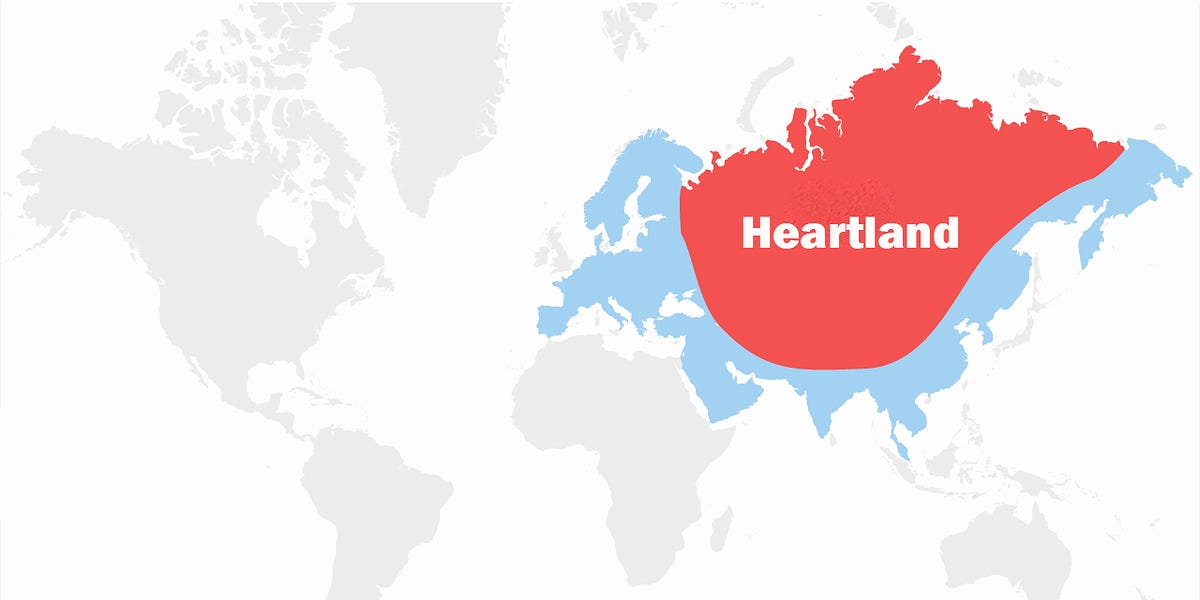
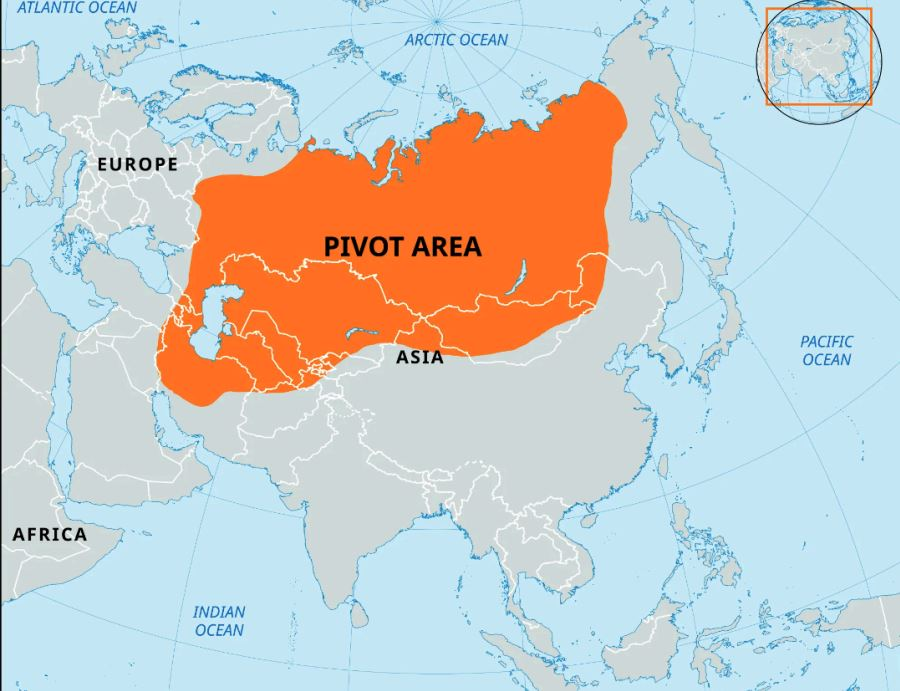
In 1904, Mackinder conceptually divided the world into three parts:
1. The “central region of history” or “the Heartland” comprising Eastern Europe and central Eurasia, extending to the Himalayas in the south and Anatolia in the west.
2. The surrounding area of an inner crescent of remaining Eurasian and North African lands, also including the British Isles, Madagascar, Sri Lanka, the Malay Archipelago, Taiwan and the Japanese Archipelago – which Mackinder called the Offshore Islands – constituted the World Island.
Together, these two areas (1&2) constituted the World Island.
3. The united continents of North and South America, as well as Oceania, were called the Outlying Islands.
Mackinder stated: “He who rules the Heartland, rules the World Island, and he who rules the World Island, rules the world.”

In short, dominating the “heart” is the stepping stone to dominating the world. Despite the simplicity of Mackinder’s thesis, history has confirmed its validity.
The Mongol Empire and Tamerlane first united the “heart” and then dominated the World Island. For much of the 20th century, the Soviet Union ruled the “heart.” Despite its semi-agrarian and backward economy, it dominated a bipolar world and even challenged American supremacy in space and military technology.
Eastern Europe: Key to World Domination?
In Mackinder’s view, Eastern Europe is the critical region that strengthens the Heartland. In his 1904 thesis – “The Geographic Pivot of History”, Mackinder highlighted the geostrategic advantages and enormous economic potential offered by Eastern Europe.
The plains of Eastern Europe provide unlimited opportunities for the development of wheat and other food grains, ores for oil and gas extraction. In other words, there are sufficient resources to support a formidable workforce and large-scale industries. Moreover, Ukraine provides Russia with access to the Black Sea.
Thus, it serves as a crucial link to Central Europe, Western Asia and then to the Mediterranean Sea, Africa and Western Europe. Simply put, with Ukraine, Russia is suddenly able to project its power across the entire Afro-Eurasian supercontinent.
Without Ukraine, Russia feels relegated to the backwaters of Europe and Asia, squeezed into the northeastern corner of Europe and Asia, on the edge of civilization.
In other words, it is Ukraine that completes Mackinder’s Heartland. Mackinder concluded that the Heartland is “the greatest natural fortress on earth,” capable of projecting power in all directions and dominating the Afro-Eurasian World Island.

Eastern Europe and the Two World Wars
People often mistakenly believe that Germany was the instigator of both world wars. However, a closer look will show that both World Wars actually began in the steppes of Eastern Europe. Central to both World Wars was the competition between Germany and Russia for dominance in Eastern Europe.
World War I began in 1914 when Austria-Hungary declared war on Serbia. Similarly, World War II began with Germany and Russia dividing up the countries of Eastern Europe. People often wonder why Hitler made the suicidal mistake of attacking the Soviet Union in 1941.
However, from Mackinder’s perspective, control of the manpower and natural resources of Eastern Europe and the Soviet Union was crucial to Hitler’s dream of world domination. Hitler’s game plan was to clear Eastern Europe and the Soviet Union (Mackinder’s Heartland) of non-Germans to create a “Lebensraum” for the Germans.
In the postwar era, Joseph Stalin attempted to achieve for the Russians what Hitler could not achieve for the Germans. Millions of Ukrainians were either killed or deported, and Russians were installed in their places, thus making Russia a legitimate shareholder in the administration of Ukraine.
In the post-Soviet era, it was these Russian speakers in non-Russian territories that gave Putin an easy excuse to invade these countries.
The Heartland Returns
After the collapse of the Soviet Union, one by one, the countries of Eastern Europe gained independence from Moscow and became sovereign in the true sense. This created a healthy neutral zone between the Heartland and continental Europe.
NATO promised not to expand into the republics of the former Soviet Union. Kiev was naively lured into giving up its nuclear weapons by the promise of Washington, London, and Moscow that they would protect Ukraine from any foreign aggression.
However, as Mackinder would say, Eastern Europe is too strategic a territory to remain a neutral zone. Over the past three decades, NATO has slowly but steadily expanded into these former Soviet republics, while the Heartland was too disorganized to resist. By 2010, Ukraine was the final piece of the puzzle.
The West saw Ukraine as the final frontier to encircle Russia, Mackinder’s heartland. And Russia saw Ukraine as crucial to defending its Heartland and projecting power into the wider world. In this light, the Russo-Ukrainian war was not only inevitable, but had been in the works for many decades.
Putin’s Dream of a New Russia
In this light, Russia’s claim to Ukraine is more than a simple land grab. Russia aims to significantly increase the manpower and resources of the Heartland for further expansion beyond its current borders.
In particular, Belarus is already a Russian satellite state in Eastern Europe. And, with its strategic military alliances with North Korea and Iran, the Russian Heartland Empire is already reaching out to the offshore islands. Vladimir Putin instinctively understands Mackinder’s theory.
Given Ukraine’s strategic location, a westward tilt in Kiev would pose an existential threat to the Heartland.
Consequently, victory in Ukraine is crucial to realizing the dream of a renewed Russia, one that has the ambitions of a world power, despite the small base of the Russian economy. Therefore, Russia’s defeat in Ukraine is crucial to protecting the post-Cold War world order and the balance of power.
What started in Ukraine will not stay in Ukraine?
If history can teach us anything, and if Mackinder’s thesis has any relevance today, it is this:
What started in Ukraine will not stay in Ukraine. The Russia-Ukraine war is about to spread to the wider world. Although the Russian propaganda machine is working overtime to convince everyone that they have no ambitions beyond Ukraine, the countries of Eastern Europe, perhaps because of their historical memory, know better.
This is why Finland abandoned its historic principle of non-alignment and joined NATO. And this is why Poland has more than doubled its defense budget in the past two years. In 2022, Poland spent US$16.5 billion on its defense and will spend up to US$35 billion on its defense in 2025, which corresponds to 4.7% of its GDP, the highest share of defense spending of any NATO country.
Poland understands that victory in Ukraine would provide enormous human, natural resource, food security, and geostrategic advantages to Russia. Moscow’s victory in Ukraine would mean that all the countries between the Black Sea and the Baltic Sea would fall under Russian influence.
For countries like Poland and Finland, Mackinder’s thesis is not some outdated abstract construct but a real memory shaped by a history filled with the horrors of Russian aggression. If only one were paying close attention, Russian leaders would already have begun to hint at their plans.
Russian cities are full of billboards declaring: “Russia’s borders never end.”
Both Putin and the Russian Church have begun to talk about the Russian World (Russkiy Mir in Russian), which extends far beyond Russia’s current borders.
In conclusion, more than 120 years after it was proposed, Mackinder’s theory of a perpetual threat to the world from the Heartland still resonates. As much as we would like to believe that the war is limited to Eastern Ukraine and Western Russia, it will have global consequences and the outcome will reverberate for many decades. It would not be an exaggeration to say that the Russo-Ukrainian war will decide the nature and order of the world that will shape this century.

