


Israel has long sought to drag the US into a wider regional conflict in the Middle East.
In this way, it believes it can get the help it needs to destroy Iran’s nuclear facilities, to strike at Iran’s leadership itself, hoping that this will lead to “regime change” and of course to be able to continue to have Western support for the ongoing military operation in Gaza amidst all the turmoil and destabilization.
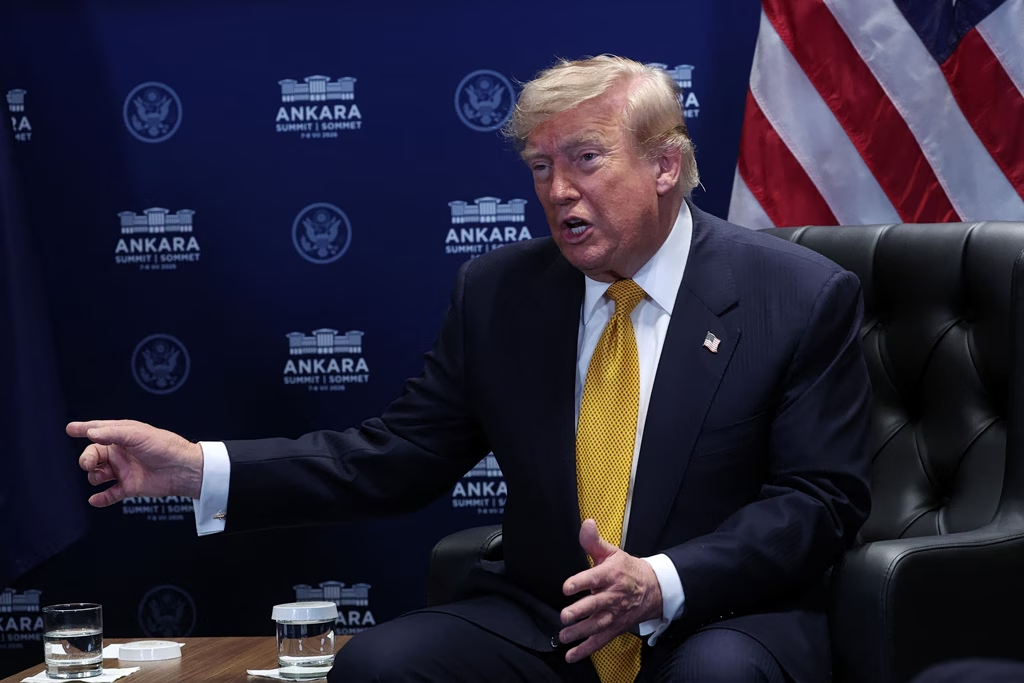
Until now, it was assumed that the US, especially under the leadership of Donald Trump, had chosen to avoid getting involved in another war in the Middle East and was trying to pressure Israel in this direction. After all, Trump argued that the US should not fight these “forever wars.”
However, Trump has an obsession with Iran. Let us not forget that he was the one who decided, during his previous presidential term, the unilateral withdrawal of the US from the agreement on the Iranian nuclear program, while he had tried to create an anti-Iranian axis in the Middle East.
Now, while the US was supposedly negotiating with Iran on the nuclear program agreement, after the start of the Israeli attacks, Trump seems to be changing direction, demanding Iran’s surrender, while there are indications that the US is seriously considering the possibility of helping Israel militarily.
This means that the line that claims that this is an opportunity to deal such major blows to Iran that its leadership will collapse and capitulate has gained the upper hand in the US, especially now that it is weakened in terms of its alliances in the region.
But what those who support such a line overlook is that American involvement in the war, as well as the continuation and escalation of the war in general, will simply bring total conflagration to a wider region. And of course it will mean many more victims for both Iran and Israel.
Iran is still a country that has the ability to respond to a certain extent. It is clear that if it feels that the threat is “existential” its leadership will try to respond by any means possible. And this is very dangerous if we consider that, above all else, Iran can cause great disruption in the Strait of Hormuz, through which a large percentage of the world’s oil passes. This means very real dangers for the wider region.
The escalation of attacks by Israel is not a given that it will automatically lead to the collapse of the state in Iran, even if the US gets involved. But it will certainly escalate the responses and bring the generalised conflict closer. How other movements may react to this development is also not a given. Russia and China may have chosen a stance of appeals for restraint, they have at the same time recognised Iran’s right to legitimate defence, and there is always the open question of what they will do if they see that things are becoming dangerous for the Iranian government. The other countries in the region are not certain that they will look favourably on such an aggressive intervention.
All this means that we are very close to an unprecedented flare-up. We are on the brink of the abyss and a situation that could take an unpredictable turn.
Europe this time chooses to differentiate itself and position itself in favour of avoiding escalation, without following the rhetoric of the American administration. This is certainly a welcome change from the stance it took previously, when it uncritically identified with Israel and did not take timely initiatives to stop the military operations in Gaza. However, it must move even more decisively and not let warmongering logics prevail.
History has shown that bombs do not bring security, but war. After all, Israel may have won several wars, but it has not achieved security and peace. The 2000s, with the “imperial” military interventions of the US and its “willing” allies in Afghanistan and Iraq, showed that there can be no “armed export of democracy”, only destruction and war. Regimes and democracy are not imposed by bombs, but by the sovereign will of the citizens themselves.
All of this means that we cannot and should not accept a logic that says war is a one-way street. Because quite simply, this will only bring more destruction and misery. Because in the end it simply creates the conditions for the next conflict, the next flare-up, the next tragedy.
At a time when problems are more than ever planetary – how else can we describe the ongoing climate catastrophe? – the planet is divided by dividing lines that tend to become war fronts. This is precisely what shows both the criticality of the situation and the urgent need for a different path. Which is not a descent into the abyss, but step by step the conquest of a degree of understanding, negotiation and peaceful resolution of problems.

