

In the world’s most populous democracy, India, the polls in the world’s biggest election remained open for over 44 days. Almost a billion people were eligible to vote. A total of 8,360 candidates contested the 543 seats of the Lower House.
Voter turnout hovered at 66 percent, in a contest that pollsters had seen as a clear winner for Hindu nationalist Prime Minister Narendra Modi. But their predictions fell out. So are the calculations of India’s 10-year-old strongman.
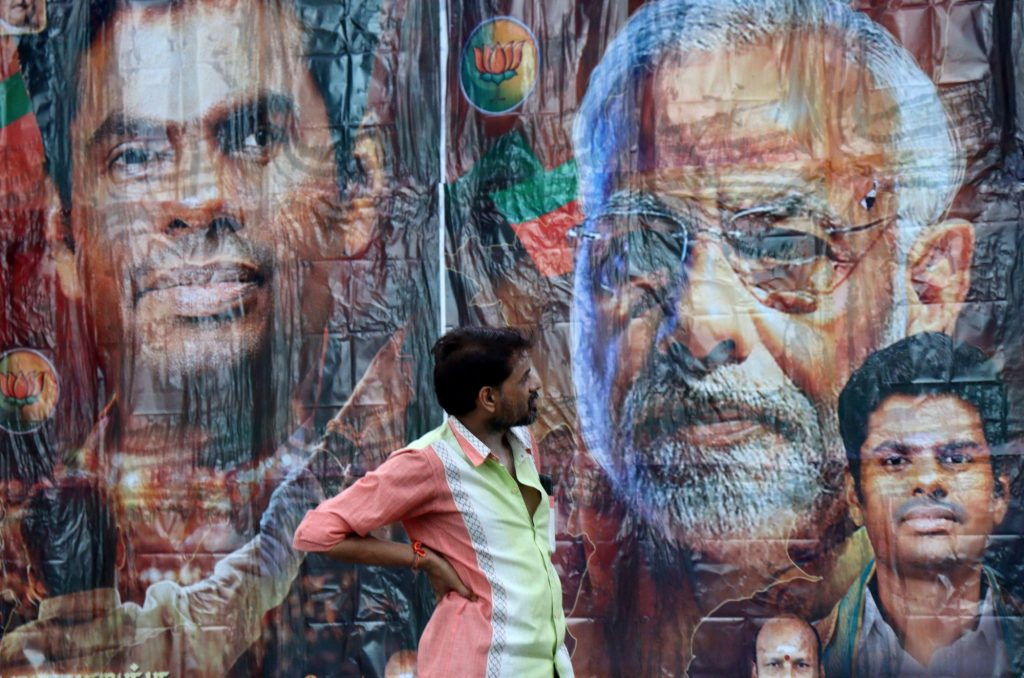
Overconfident, 71-year-old Modi boasted in the run-up to the election that he wanted his ruling Bharatiya Janata Party (BJP) to win a 400-seat supermajority.
In the end, he won 240. Far fewer than the 303 he had secured in the 2019 elections, but also less than the 272 seats required for an absolute majority.
However, it secures this “magic” number and more, with 294 seats, along with the right-wing National Democratic Alliance (NDA) coalition under Modi. Thus, despite his pyrrhic victory, he makes history.
But from these polls, the real winners are the Gandhi political dynasty and the current opposition Indian National Congress, the party founded by Nehru.
Against Modi’s divisive and ultra-nationalist rhetoric, he managed to double his seats to 99. Together with the center-left alliance “INDIA” they collect 232 seats.
“We have succeeded in our efforts to save democracy and the Constitution,” declared Rahul Gandhi, former head of the Indian National Congress, grandson of Indira Gandhi and great-grandson of Jawaharlal Nehru.
They were referring to Modi’s more controversial plans, should he secure a two-thirds majority, for sweeping constitutional change and transforming India from a secular to a Hindu state.

Post-election expectations and challenges
For the nationalist Modi and his Hindu party, their highly aggressive, polarizing election campaign seems to have backfired.
The Indian prime minister has been widely denounced for hate speech against minorities, directly targeting the 210 million Muslims in a Hindu-majority country of 1.4 billion.
Modi’s political opponents, from almost the entire political spectrum, accuse him of pre-election “tooling” of the Judiciary to prosecute Indian opposition figures.
High unemployment rates (8.1% overall and more than double among young people), rising inflation (5% annual, 5% food) and glaring social inequalities also played a role in expressing popular discontent through the ballot box.
The result was essentially Modi’s political “haircut”, despite securing his historic third term as prime minister. In contrast to his ten-year hegemony until now, he will henceforth rely on government partners to rule.
While not fundamentally different on key issues of governance, the smaller National Democratic Alliance (NDA) parties will claim trade-offs. It is a situation that the Modi government has not faced before.
For many, it “tarnishes” his profile as a strong leader and marks the beginning of an uncertain era. And this, because it is still unknown in which direction Modi will move from now on.
There is the realistic option of a more negotiated exercise of power, with its sharing, making India more inclusive. There is also the possibility that Modi’s third term as prime minister could lead to further authoritarianism, as his government still has five years to mold the country into an emerging power.
A superpower in the… “vestibule”
A rising superpower, an international and regional “player” with a nuclear arsenal and broad alliances, India is a “many bride” in these geopolitically tense and volatile times.
Despite its ambivalent foreign policy and the authoritarianism of the Modi administration, the West sees a strategic ally in New Delhi, in one of the “hottest” zones on the planet: that of the Asia-Pacific. Its historical rivalry and competition with China makes India a valuable partner for the US and Europeans.
On top of that, the India-Middle East-Europe Economic Corridor (IMEC) was given the green light at last year’s G20 summit in New Delhi.
A multi-billion dollar plan to connect India to Europe via the Middle East, via energy and telecommunications networks, railways and ports. It is a network of interregional trade, transport and energy routes.
It is expected to compete with China’s global infrastructure development strategy One Belt One Road Initiative: a “web” of investment, trade, infrastructure projects, lending and geopolitical influence.
However, it remains on the “papers”, also because of the raging war between Israel and Hamas in the bloody Gaza Strip.
This comes amid IMF forecasts that India will become the world’s third largest economy by 2027. It will however remain behind China.
On the other hand, it is considered unlikely that New Delhi will sever its ties with Moscow, at least not as long as it imports Russian oil with… scondo.
While nothing suggests a change in his attitude towards the West, with which he maintains close ties, but not in the context of a binding alliance, but of a “give and take” relationship.

