



Today, Greece and all Greeks around the world celebrate the Revolution of the Ancestors, for the liberation of Greece from the conqueror, the Ottoman Empire, for the restoration of the Nation, for the survival of the Traditions and History of the Greek Nation.
Every Greek, with open ears and eyes but most importantly with an open soul, understands that even today, the state may not be Ottoman but it passionately persecutes the Greek identity. This sad condition makes it even more important and timely to pay homage to the Ancestors who decided to deprive themselves of their “peace” and water the Tree of Freedom with their Blood.
A decision they made feeling the price heavy on their shoulders, that they should be responsible for the loss of the Greek Race.
Wanting to assist the determination of today’s Greeks, so that they too may feel the Historical Responsibility and hear the blessing of the Ancestors that echoes unfading through the Centuries, we quote two texts characteristic of the Holy Struggle of 1821. One concerns the Oath of the Friends, and encompasses the essence of the Revolution, and the other the words of the Ethnarch of the Holy Greek Nation, General Theodoros Kolokotronis.
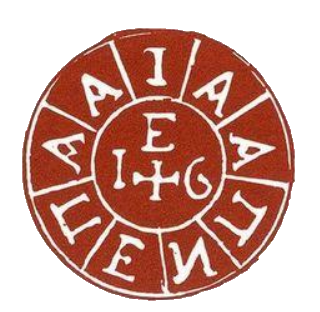
THE SEAL OF THE FRIENDLY SOCIETY
On the periphery are the initials of the baptismal names of the 9 members who led: 1. Ioannis Kapodistrias 2. Anthimos Gazis 3. Athanasios Tsakalof 4. Panagiotis Sekeris 5. Nikolaos Skoufas 6. Emmanouil Xanthos 7. Panagiotis Anagnostopoulos 8. Antonios Komizopoulos 9. Athanasios Sekeris.
In the center are the letter E, the Cross and the numbers 1 and 6. The E refers to Greece. The Cross to Orthodoxy. The numbers 1 and 6 symbolize the Principle (1) of Secrecy – Secrecy (6). Violation of the Principle of Secrecy was punishable by death.
THE OATH OF FRIENDLY SOCIETY MEMBERS
I swear in front the true God, of my own free will, that I will be faithful to the Society in all things during my life. That I will not reveal the least of its signs and words, nor will I stand on any ground that others may ever understand that I know anything about them, neither to my relatives, nor to my spiritual or friend.
I swear that in the future I will not enter into any other society, whatever it may be, nor into any binding bond. And indeed, whatever bond I may have, even the most indifferent one towards the Society, I will consider as nothing.
I swear that I will cherish in my heart an irreconcilable hatred against the tyrants of my country, followers and those who are like-minded with them. I will act in every way to their harm and their complete destruction, when the occasion permits.
I swear that I will never use force to get acquainted with any colleague, taking care on the contrary with the greatest diligence that I do not make a mistake in this way, becoming the cause of a subsequent incident.
I swear to assist, wherever I find a colleague, with all my strength and position. To offer him respect and obedience, if he is greater in rank, and if he happened to be my former enemy, all the more to love him and assist him insofar as my enemy wished him to be greater.
I swear that, as I am admitted to the Society, I will similarly admit another brother, treating him in every way and with all due respect, until I know him to be a true Greek, a fervent defender of the fatherland, a virtuous man and worthy not only to guard the secret, but also to catechize another of right mind.
I swear not to benefit in any way from the Society’s money, considering it as a sacred thing and a pledge belonging to my entire nation. To be similarly careful in the sealed letters received and sent.
I swear never to ask any of the Friends out of curiosity, to learn who will accept him into the Society. However, I will not reveal, or give him reason to understand, who will accept me. I will even feign ignorance, if I know the point in someone’s provision.
I swear to always be careful in my conduct, to be virtuous. To respect my own religion, without despising those of others. To always set a good example. To advise and assist the sick, the unfortunate and the weak. To respect the administration, the customs, the criteria and the governors of the place in which I reside.
THE END OF ALL I SWEAR TO YOU, HOLY BUT THREE-SORROWED FATHERLAND, I SWEAR to Your long-standing sufferings, I swear to the bitter tears that Your afflicted children have shed and are shedding for so many centuries, to my own tears, shed at this moment, and to the future freedom of my fellow countrymen, that I dedicate myself entirely to You. In the future, You will be the cause and the goal of my meditations. Your name the guide of my actions and Your happiness the reward of my labors. May divine justice exhaust all its thunderbolts upon my head, may my name be an abomination, and my subject the object of the curse and anathema of my fellow countrymen, lest I forget for a moment their miseries and fail to fulfill my duty. Finally, may my death be the inevitable punishment of my sin, so that I may not pollute the purity of the Society with my participation.
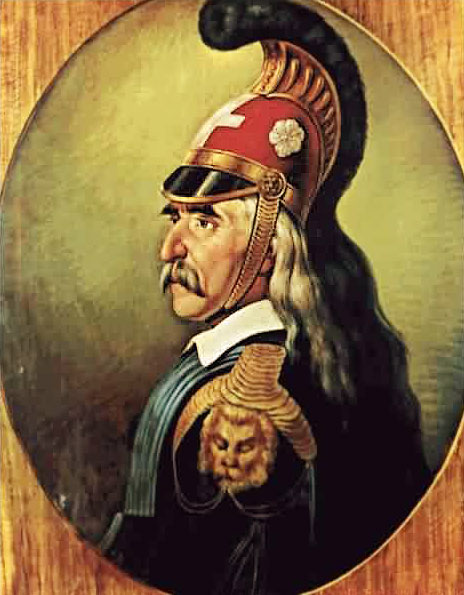
“Give me the pilgrimage papers of Braimis and I will give you the Nation.
Any village that does not return to the nation, I will wipe it off the face of the earth.
The blacks will come out from one side and I will come in from the other, I will burn and kill. Fire and axe to the pilgrims!”
From the General Headquarters in Pheneon,
The General Commander of the Peloponnese
Th. KOLOKOTRONIS
(Spiliadis, III, 354 and Photakou, II, 435).
Theodoros Kolokotronis: Speech to the High School students in Pnyka
delivered by the general on October 8, 1838 and published in the newspaper AION on November 13, 1838.
“The ancient Greeks, our ancestors, fell into discord and ate each other, and so the Romans took time first, then other barbarians and subdued them.
Then the Muslims came and did everything they could to make the people change their faith. They cut out the tongues of many people, but it was impossible to do so. One they cut out, another they crucified. When the sultan saw this, he appointed a viceroy, a patriarch, and gave him the authority of the church. He and the rest of the clergy did as the sultan told them.
Later, the kotzabasis [prefects] became leaders in all the places. The third class, the merchants and the nobles, the best part of the citizens, could not bear the yoke and fled, and the literate took and fled from Greece, their homeland, and thus the people, deprived of the means of advancement, fell into a miserable condition, and this grew worse every day; for if there was anyone among the people with a little learning, the plebs took him, and whoever enjoyed privileges, or was dragged by the merchant of Europe as his assistant, became the prefect’s grammarian.
And some, unable to bear the tyranny of the Turk and seeing the glories and pleasures that they were enjoying, abandoned their faith and became Muslims. And in this way, every day the people became poorer and poorer.
In this unhappy situation, some of the literate fugitives translated and sent books to Greece, and to them we must owe gratitude, because immediately, no man from the people knew the common letters, read these books and saw who our ancestors were, what Themistocles, Aristides and many other of our elders did, and we also saw in what situation we found ourselves at that time. Hence it occurred to us to imitate them and become happier. And so it was done and the Society progressed.
When we decided to make the Revolution, we did not consider how many we were, nor that we did not have chariots, nor that the Turks were holding the castles and cities, nor did any wise person tell us, “Where are you going to fight with a grain barge?”, but like a rain the desire for our freedom fell on all of us, and everyone, including our clergy and the prefects and the captains and the educated and the merchants, small and large, we all agreed on this goal and made the Revolution.