



The American Foundation for Freedom on the Internet (Foundation for Freedom Online), one of the few US Foundations that really fights for freedom of speech, has prepared an extensive investigative journalism report on Microsoft’s participation in the particularly huge and chillingly harsh censorship network that the Democratic party and the Biden administration have formed against any potential opponent.
Reading the report, you will understand that a significant number of government officials, professors, technocrats and businesses have danced a multi-million dollar dance, at the expense of taxpayers and freedom of speech, in order to promote the political agenda they support. At the end of every dance, however, comes the bill and it is extremely unlikely that the new President will forget those who rabidly persecuted him and accused him of being a Russian spy…
Microsoft is hoping for a smooth transition from one presidential administration to the next. And it’s true that the company recently secured a major victory in Washington, receiving the White House’s approval for a $500 billion artificial intelligence investment partnership between SoftBank, Oracle, and Microsoft’s OpenAI.
But as official policy shifts toward online censorship, the tech giant will likely have to confront its own past record of heavy-handedness in suppressing Americans’ free speech online.
New evidence now suggests that Microsoft has served as the private-sector spearhead of a complex system of censorship—a coordinated effort between corporations, government agencies, NGOs, and academics to curtail free speech in America.
Microsoft has not only participated in, but also funded and actively collaborated with, several key initiatives aimed at controlling online content, including the University of Washington’s Center for an Informed Public (CIP) and the Election Integrity Initiative, which was born out of the Department of Homeland Security, of which it is a part.
Records now show that many of the same government officials who led the most damaging censorship initiatives between 2016 and 2020 subsequently moved to senior roles at Microsoft, from where they continue to advance these efforts today, under the company’s umbrella.
The Microsoft files show how the convergence of unchecked corporate power and government influence was used to suppress free speech and raise serious new questions about the commitment of one of America’s most powerful companies to the integrity of public discourse and the preservation of constitutional rights.
“Defense for Democracy”
The “Defense for Democracy” initiative was launched in April 2018 as a collaboration between Microsoft, government agencies, think tanks, and academic institutions aimed at “protecting electoral processes.” One of its main goals was to counter so-called “state-sponsored” disinformation campaigns and limit the spread of “junk news.”
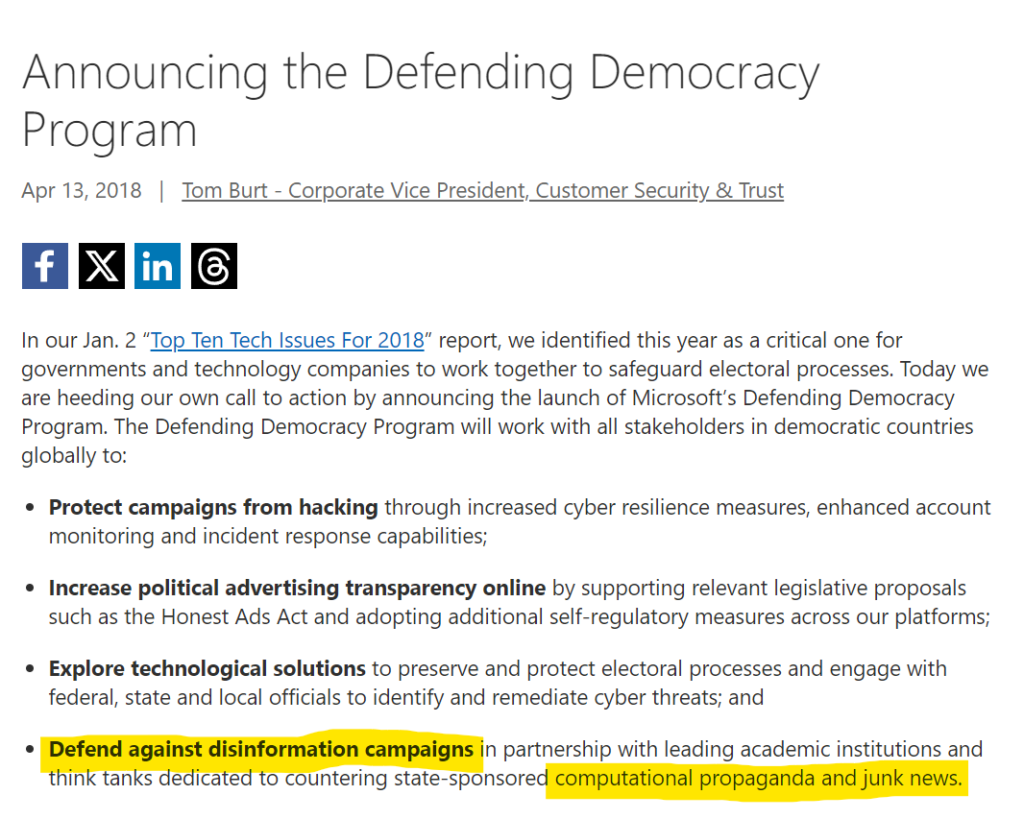
The initiative was announced by Tom Burt, Microsoft’s vice president of customer security and trust. While it ostensibly refers to “customer security,” Burt’s portfolio appears to be focused primarily on managing Microsoft’s direct engagement with top national security officials. White House visitor records reveal that Burt has been a frequent visitor to the Biden White House, meeting with National Security Advisor Anne Neuberger at least four times between 2022 and 2024.
During his tenure, Microsoft worked with Princeton professor Jacob Shapiro, a political scientist and special advisor to the director of national intelligence.
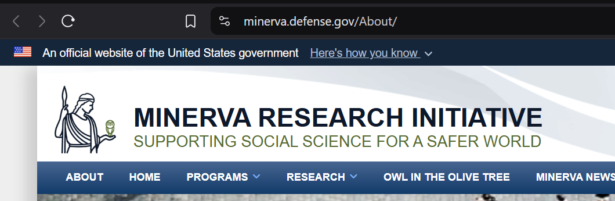
Shapiro’s resume shows that he has received at least $1.76 million in funding from Microsoft for his work on “misinformation” and “disinformation” since 2018. He has also received more than $11.76 million from a controversial Department of Defense program called the Minerva Initiative, a psychological operations research program focused on suppressing unpopular social movements and social contagion. For example, in 2013, Minerva funded a study to analyze the risks of social unrest from climate change.
In 2020, Microsoft researchers worked directly with Shapiro to study and analyze online disinformation related to COVID-19. Microsoft funded another study led by Shapiro that same year, titled “Trends in Online Influence Efforts.” The study claimed to have identified disinformation influence efforts (IEs) by several foreign actors, particularly Russia, on U.S. politics and political movements.
As has been observed elsewhere in the censorship industry, Shapiro’s scope of work quickly expanded to cover not only alleged false information, but also true but unwanted information.
The study acknowledged that such actions often did not involve disinformation at all, acknowledging that they often involved “promotion of true content.” In fact, Shapiro and the study’s authors admitted that for the purposes of the research, they had often broadened the definition of “misinformation” to include “the origin of the content rather than its truth.”
Shapiro’s study also claimed that conservatives and Trump supporters were disproportionately responsible for sharing “junk news,” drawing on previous work by researchers at the Stanford Internet Observatory (SIO) and the Election Integrity Project (EIP). As discussed in more detail below, the EIP was created in 2020 to flag, suppress, and remove online speech.
Shapiro’s study also alleged that Russian influence operations sought to discredit Hillary Clinton, the Democratic Party, and even conservative critics of Donald Trump in 2016 — allegations that are consistent with narratives heavily promoted by the Clinton campaign in the run-up to the 2016 election. Another example Shapiro cited was an alleged Russian influence operation that included over 600 Twitter accounts to support Roy Moore, a Republican candidate in the 2017 Alabama Senate special election.
But this “Russian” influence operation would soon become the subject of a major political scandal after it was revealed that it had been domestically constructed by a group funded by Microsoft board member Reid Hoffman.
Founder of “Hamilton 68” hired by Microsoft
The 600 Twitter accounts cited in Shapiro’s study were identified by “Hamilton 68,” a so-called “disinformation gallery” of the “Coalition to Secure Democracy.”
Created by former FBI counterintelligence officer Clint Watts, Hamilton 68 claimed to be a central tool for identifying alleged Russian influence operations, but its credibility collapsed after the publication of the Twitter Files by journalist Matt Taibbi, which revealed internal Twitter documents that showed Hamilton 68’s methodology was deeply and irreparably flawed.
The documents showed that Twitter executives complained (internally) that most of the accounts flagged by the dashboard were “neither strongly Russian nor strongly bot.” Yoel Roth, then Twitter’s head of trust and safety, blasted Hamilton 68 in internal emails, saying the dashboard was “actively harmful” and promoted “polarization and mistrust through its poor methodology.” “People need to know that they have been unilaterally labeled as Russian agents without evidence or the ability to refute.”
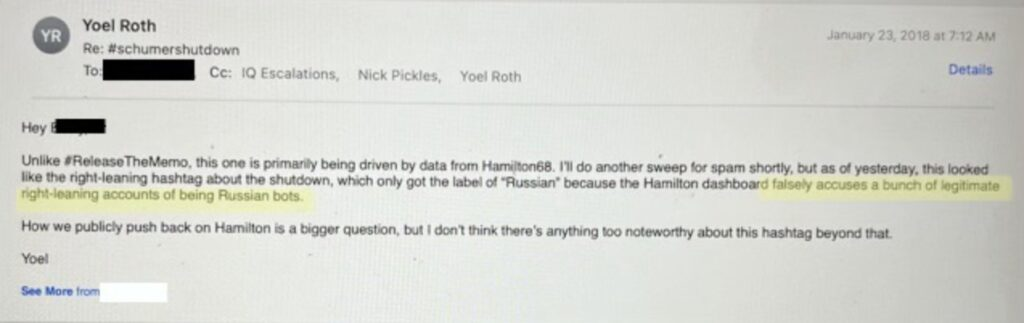

“Simply put, the Hamilton 68 investigation was almost entirely Russian-free. In fact, aside from a few RT accounts, it’s mostly full of ordinary Americans, Canadians, and Brits,” Taibbi said at the time. “It was a scam. Instead of tracking how Russia influenced American perceptions, Hamilton 68 simply gathered a handful of mostly real, American accounts and described their organic conversations as Russian plots.”

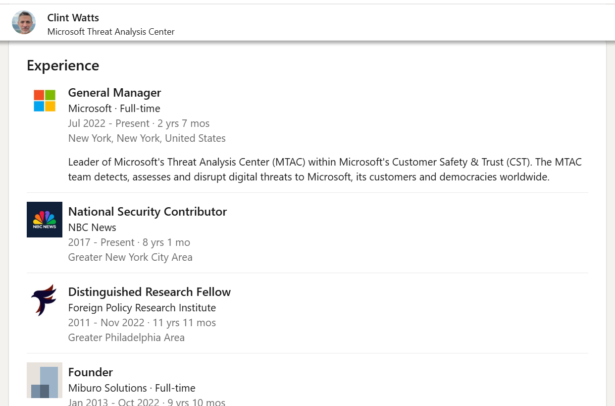
Despite the revelations, the harsh criticism of Hamilton 68, and the humiliating shutdown of the “disinformation board,” Watts was hired by Microsoft in July 2022, following the acquisition of his cyber threat analysis company, Miburo. The acquisition was announced by Burt.
He currently serves as the General Manager of the Microsoft Threat Analysis Center (MTAC), a group whose mission is to “defeat threats to democracies worldwide.”
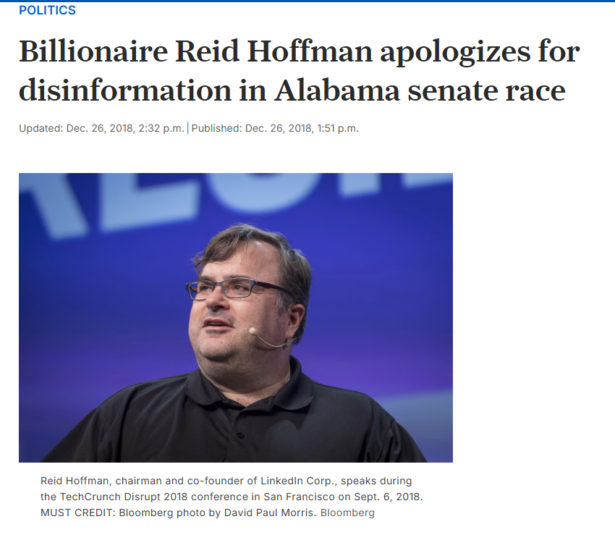
While Hamilton 68’s claims about Roy Moore were completely debunked, another apparent disinformation effort to damage his campaign was uncovered, funded by Microsoft board member Reid Hoffman.
Dubbed “Project Birmingham,” the online disinformation effort involved Hoffman-funded operators posing as conservative Alabama voters online, encouraging Republicans to support other candidates instead of Moore.
A confidential internal report leaked to the New York Times said the group “organized an elaborate ‘false flag’ operation that planted the idea that Moore’s campaign was being boosted on social media by a Russian botnet.”
Democracy Forward
The Democracy Forward initiative, launched alongside Defense for Democracy, focuses on addressing “democratic stability” by promoting a “healthy information ecosystem” and strengthening digital literacy. Ginny Badanes, who leads the initiative, has worked closely with academic institutions and other stakeholders to advance the fight “against disinformation and disinformation.”
The lines and responsibilities between Defense for Democracy and Democracy Forward are often blurred, and evidence suggests that the disinformation and disinformation activities of the two programs often overlap.
For example, Democracy Forward also works closely with Jacob Shapiro of Princeton. In July 2020, Shapiro collaborated with Democracy Forward and Microsoft researchers to “trace the digital footprint of disinformation” on Twitter. Praising the Microsoft team as “good internal thinkers” at the company, Shapiro called the partnership a “productive relationship” to jointly address disinformation.
Badanes has been a frequent speaker at events for the Federal Election Commission, the Aspen Institute, the German Marshall Fund, and dozens of other events on “disinformation” and election integrity. She and other members of Microsoft’s Democracy Forward team have also been frequent visitors to the White House.
The revelations and the frequency of the meetings raise troubling questions about how closely Microsoft coordinated with senior White House national security officials on its censorship activities. Visitor records show that Democracy Forward executive directors have logged at least ten visits to the White House since 2022, often meeting with the Biden administration’s top national security and homeland security officials.
For example, Badanes met at least twice with Caitlin Durkovich, a National Security Council adviser on homeland security. The meetings included members of the “Content Origin and Authenticity Alliance,” a coalition of technology companies founded by Microsoft in 2021 to “fight misleading content” by creating technical standards for certifying the origin of media content. Visitor records show that one of the meetings was attended by Andrew Jenks, a senior Microsoft Azure Security executive who chairs the Alliance.
Microsoft Funding Censorship: The Center for an Informed Public (CIP) at the University of Washington
On December 3, 2019, the University of Washington launched the Center for an Informed Public (CIP), which would become one of four members of the Election Integrity Partnership. Co-founded by political science professor Jevin West and data science professor Kate Starbird, the CIP was described as an effort to “bring together diverse voices from industry, government, nonprofits [and] other institutions” to “translate research on disinformation and disinformation into policy.”
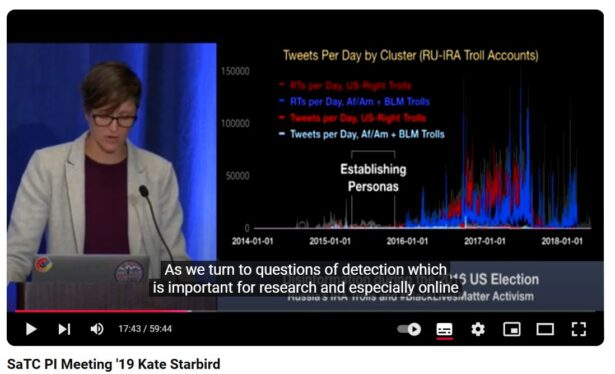
West has received at least $960,000 in funding from Microsoft since 2015. Starbird received $250,000 from Microsoft in 2022 to support “rapid response research into disinformation surrounding the U.S. election.” According to her bio, she has also received at least $4.4 million in taxpayer funding from the National Science Foundation and the Office of Naval Research for research on disinformation.
Notably, the Office of Naval Research runs the grant programs for the Minerva Initiative, the Department of Defense’s psychological operations research program, which suggests that, like Shapiro, Starbird has also been a frequent recipient of Department of Defense psychological operations research funding.
In addition to funding West and Starbird directly, Microsoft has also provided financial support to CIP, although the specific amounts are not disclosed. The relationship between CIP and Microsoft appears to be extremely close, and the company and the academic center have collaborated on several initiatives related to disinformation and misinformation since its founding in 2019.
For example, West and Starbird are frequently invited to give lectures at Microsoft, according to their biographies. In 2019, Starbird was invited to Microsoft to give a talk titled “Muddy Waters: Online Disinformation During Critical Events.” In 2020, CIP and Tom Burt’s Democracy Defense program hosted a series of “workshops” warning of the serious growing threat of “deepfakes” in the 2020 election. Several subsequent analyses since 2020, including an MIT Technology Review analysis in 2024, have concluded that the threat of deepfakes in the election was vastly overstated.
In 2022, West interviewed Microsoft President Brad Smith about Russia’s use of cyberattacks in the Russia-Ukraine war. “I think disinformation in particular is one of the existential threats to democracy,” Smith told the audience.
That same year, West emailed Ginny Badanes, head of Microsoft’s Democracy Forward initiative, to invite her to join the board of a new CIP initiative called Co-Designing for Trust, a digital education project to “help individuals understand and respond to the ways in which misinformation exploits our minds, emotions, and social conditions.” In August, West informed Badanes that the project had received funding from the National Science Foundation.
The Election Integrity Partnership (EIP)
Microsoft’s close relationship with Starbird is particularly problematic, as it sits at the center of the censorship industry complex. In the run-up to the 2020 election, Starbird led a now-defunct Department of Homeland Security (DHS) committee within the Cybersecurity and Infrastructure Security Agency (CISA) called the “Subcommittee on Protecting Critical Infrastructure from Disinformation and Disinformation” (the “MDM Subcommittee”), which directly pressured social media companies about their content moderation policies.
In 2020, Starbird and CIP partnered with the State Department, CISA, FBI, and Stanford Internet Observatory (SIO), among others, to create the Election Integrity Partnership (EIP), a new initiative to flag, suppress, and remove online speech in coordination with major technology companies. EIP’s flagging efforts had a huge impact on the 2020 election.
A November 2023 report released by the House Judiciary Committee concluded that EIP’s censorship efforts were so aggressive that they pressured social media companies to censor factual information, political opinions, and even jokes.
According to the report, the pressure largely benefited Democrats: true information published by conservatives was labeled “disinformation,” while false information published by liberals remained largely tolerated and uncensored.
Starbird, who has argued that “content moderation on social media is free speech, not censorship,” has focused primarily on what she believes to be the threat of disinformation, namely that it comes from the right on social media, supporting Donald Trump in the US, Jair Bolsonaro in Brazil, or Marine Le Pen in France.
Moreover, internal confidential documents released under a Freedom of Information request now reveal that the EIP was established at the request of the federal government to do what the government was expressly prohibited from doing: pressure social media companies to censor thousands of First Amendment-protected posts that CISA deemed objectionable.
” Responsibility for election information security is shared among government agencies: However, no government agency in the United States has an explicit mandate to monitor and correct election disinformation and disinformation. This is especially true for election disinformation originating within the United States, which would likely be barred from law enforcement under the First Amendment and would not be suitable for study by intelligence agencies limited to operating within the United States. As a result, during the 2020 election, local and state election officials, who had a strong partner for election systems and overall cybersecurity efforts under CISA, did not have an intelligence hub to assess disinformation. Student associations approached the SIO leadership in early summer and, in consultation with CISA and other interested parties, a coalition of like-minded collaborating organizations was formed.
In fact, as the House Judiciary Committee staff report noted, there are internal Microsoft documents showing that in early 2020, Chris Krebs, CISA director at the time and Microsoft’s former director of cybersecurity policy until 2017, was considering how to redirect CISA’s censorship efforts from foreign adversaries to domestic actors!
A February 2020 email from Brian Scully, head of CISA’s Countering Foreign Influence Task Force (CFITF), inviting Renee DiResta of SIO to a meeting hosted by Krebs included a list of agenda items, including “How should we think about domestic versus foreign interference?” and “Is there any fruition in being able to work with platforms?”
A month later, in March, Krebs participated in a “broad stakeholder conference call” with Microsoft and other participants about how CISA could take a more active role in monitoring and censorship related to COVID-19 activities. Internal Microsoft notes from the call obtained by the House Judiciary Committee revealed that “monitoring misinformation” and working with “social media organizations, as well as state and local governments to clarify and combat misinformation” were key topics.
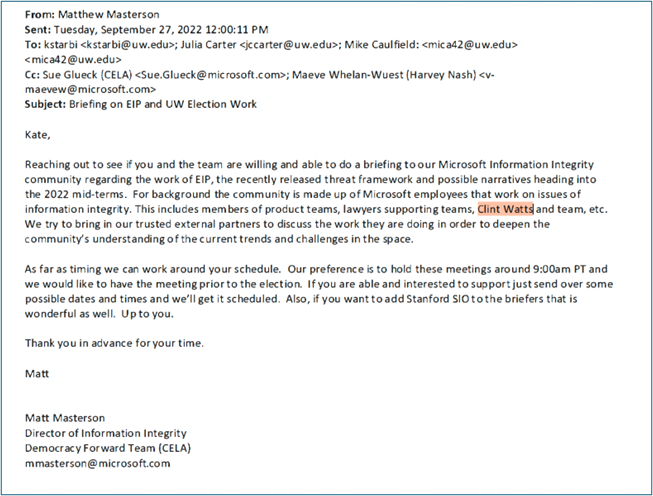
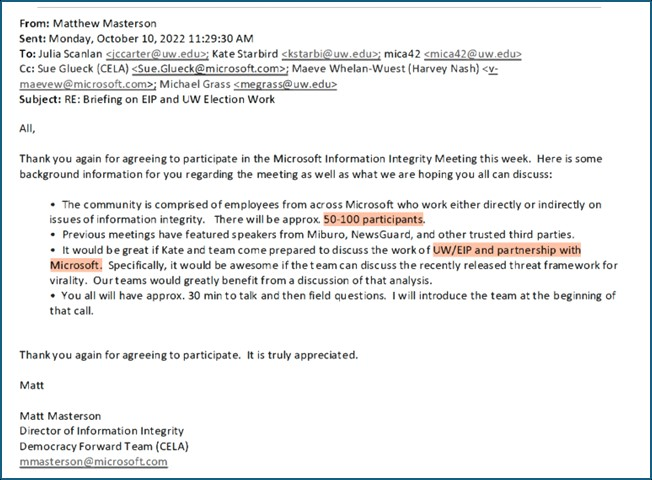
Records show that Microsoft continued to work closely with Starbird until the fall of 2022. Emails made public as part of a public documents request by Racket News reveal that in October 2022, Starbird provided a briefing to up to 100 Microsoft employees working on “information integrity issues.”
An October 10, 2022 email from Microsoft’s Matthew Masterson thanked Starbird for attending the meeting and asked if he could “discuss the work of UW/EIP and its partnership with Microsoft.” Other emails from Masterson to Starbird indicated that Clint Watts, founder of the controversial Hamilton 68 and now a Microsoft executive, would also be at the meeting.
Watts and Starbird had been close partners in “disinformation” activities since early 2021. In April of that year, Watts invited Starbird to an “informal” roundtable hosted by the “new [Biden] administration” to improve “social resilience to misinformation and disinformation.”
Microsoft and CISA
Matthew Masterson, currently “Chief Information Integrity Officer at Microsoft,” is an “alumnus” of the censorship industrial complex, having served in various roles throughout the federal government, including Senior Cybersecurity Advisor at the Department of Homeland Security (with a focus on “election security”), as well as at the Election Assistance Committee.
He was hired by Microsoft in January 2022, having previously worked at the Stanford Internet Observatory, a prominent online censorship hub that participated in the DHS-created Election Integrity Partnership, the most influential group working on censorship of the 2020 election.
In 2021, Masterson was asked by New York Times reporter Shira Ovide what government officials and online platforms were doing to stop disinformation from having a meaningful impact on the 2020 election.
“I’m happy to talk about the work we (the feds) have been doing in coordination with social media companies to anticipate and respond to efforts to undermine the election,” Masterson wrote in an email to Ovide.
Masterson’s response suggests that CISA was in close contact with platforms like Twitter throughout the 2020 election cycle.
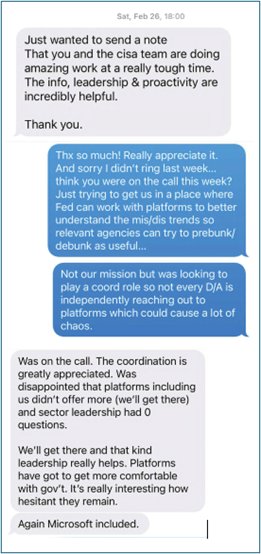
Other communications from Masterson further demonstrate his strong support for government spying on social media. After joining Microsoft in February 2022, Masterson exchanged text messages with DHS Director and former NSA official Jen Easterly, addressing her concern that DHS needed to improve its collaboration with social media platforms to “pre-empt” and “de-empt” misinformation.
“Platforms need to get comfortable with government,” Masterson wrote. “It’s really interesting how hesitant they remain.”
Masterson also went down in history as the architect of one of the most controversial DHS censorship fiascos: the creation of the Disinformation Governance Board (DGB).
In July 2021, Masterson co-authored an article for the Virality Project—a Stanford Internet Observatory (SIO) project focused on combating COVID-19 disinformation—titled “The Case for a Mis- and Disinformation Center of Excellence.”
In the article, Masterson proposed the creation of a government entity with the express mission of “reducing the supply of misinformation and disinformation by making it less prevalent in information spaces.” He advocated for this new task force to fall under CISA, where it would have the authority to exercise broad federal oversight over the dissemination of information, particularly on social media platforms.
Masterson also appears to have been in regular contact with the White House during the formation of the Disinformation Governance Board (DGB). Just a month before his article was published, he met with White House NSC official Puneet Khan and CISA MDM chief Brian Scully. The details of the meeting are not known, but he was joined by SIO founders Alex Stamos and Adriana Stephan.
SIO was eventually shut down in 2024 after congressional investigations found that it had taken over from the federal government the “monitoring and censorship of Americans’ online speech” ahead of the 2020 election.
Masterson continued his censorship crusade when he joined Microsoft. In November 2023, he testified at an artificial intelligence forum sponsored by Senator Chuck Grassley (D-NY) about the “dangers” of misinformation.
Masterson told the senator that Microsoft had implemented new tools as part of Bing’s AI search, including classifiers, meta-models, provenance tools and improved reporting features to “prohibit… the use of these services to create or share information that is fraudulent, false or misleading.” It was not specified who or what would determine the veracity of the information.
Microsoft’s Role on the Disinformation Governance Board
On April 27, 2022, the DGB was announced during a 2023 budget hearing before the House Appropriations Subcommittee on Homeland Security. The board lasted just three weeks before disbanding after a national outcry from policymakers, opinion leaders, the media, and First Amendment advocates.
The controversy centered on President Biden’s decision to appoint Nina Jankowicz to head the DGB. Jankowicz, a far-left author and commentator, had previously promoted the widely debunked claim that Donald Trump colluded with the Russian government to win the 2016 presidential election. She had also publicly stated that the Hunter Biden laptop story was part of a Russian disinformation campaign.
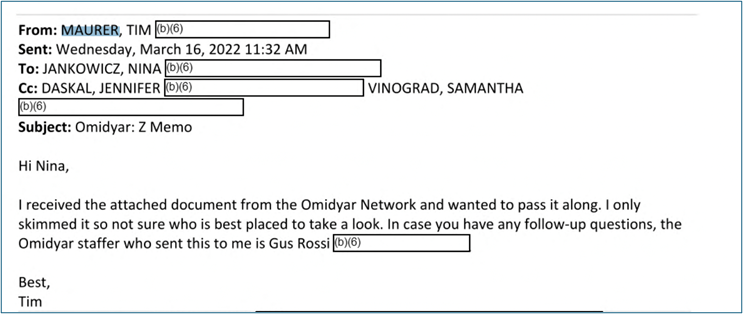
Public records show that Tim Maurer, another current top Microsoft executive, was also heavily involved in the creation of the DGB and interacted frequently with Jankowicz as the DGB was taking shape. Maurer, who was hired by Microsoft in December 2023 as senior director for cybersecurity policy, previously served as a political appointee at DHS and later as a top official on the White House National Security Council (NSC).
Although heavily redacted, FOIA logs released by DHS in 2022 reveal several chat exchanges in which Maurer discussed matters related to the “Disinfo Gov Board Steering Group,” as well as other exchanges with Jankowicz.
Visitor logs reveal that on January 29, 2024, just a month after joining Microsoft, Maurer returned to the White House for a meeting with the Office of Science and Technology Policy. The purpose of the meeting is unclear, but he was joined by Biden administration officials from the Departments of Energy and Education and the National Science Foundation, among others.
FFO has compiled a list of Microsoft’s meetings with the previous administration (The List: Microsoft’s 207 Meetings With The Biden Administration), which you can access here.




I dugg some of you post as I thought they were very beneficial invaluable