In recent remarks about the new US F-47 fighter jet, US President Donald Trump highlighted a fundamental concern of aggressive realism in international relations: the unpredictable nature of alliances. Arguing that US allies will only be able to receive a “somewhat deactivated by about 10%” version of the F-47 because “one day, they may not be our allies anymore,” he highlighted the fluidity of the global balance of power. This observation is consistent with the core tenets of aggressive realism, which emphasize state interest, an anarchic international system, and the transitory nature of alliances. The geopolitical landscape is changing rapidly, and middle powers are responding by prioritizing domestic defense capabilities to avoid vulnerabilities in their tactical quiver as well as their strategic will.
The Path to Strategic Independence
The global arms market is undergoing transformation, driven by a combination of restrictions on US arms exports, technological developments, and shifts in geopolitical alliances. More and more states are rejecting reliance on US military technology, due to concerns about potential bans, export controls, and conditional access to advanced weapons.
Turkey’s Triple Fifth-Generation Fighter Program
A striking example of this trend is Turkey, which is aggressively pursuing independent defense production. Ankara currently has three separate fifth-generation fighter programs underway: Anka-3, Kaan, and Kizilelma. All three have successfully conducted test flights, signaling the country’s commitment to technological autonomy.
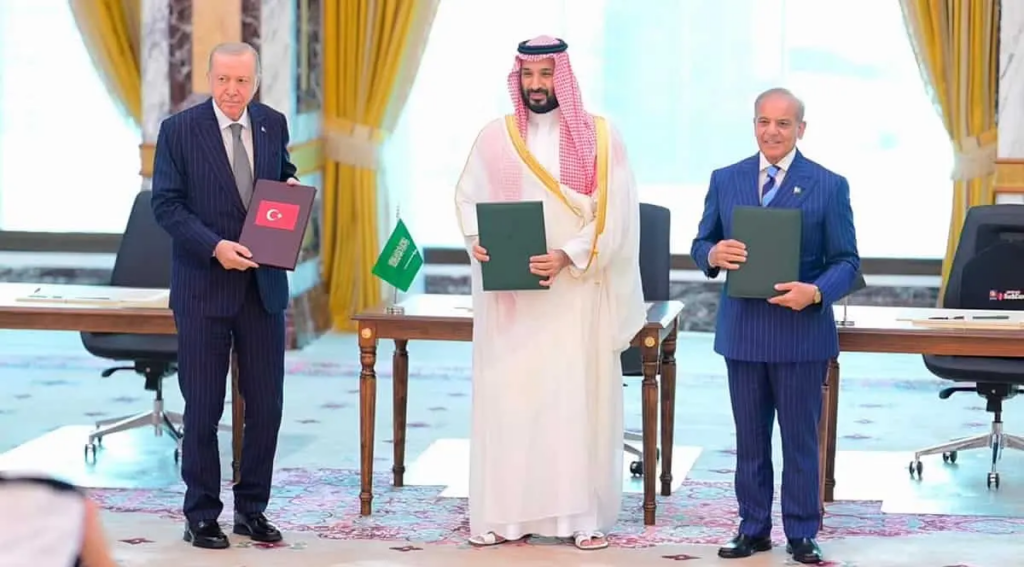
Turkish defense initiatives are not developing in isolation. The country is working closely with Pakistan on a variant of the Kaan, known as the Iqbal, which recently completed a successful test flight of a smaller-scale model. This cooperation is highlighted by the presence of 200+ Pakistani engineers and pilots in Turkey, as well as the establishment of a TAI (Turkish Aerospace Industries) center in Islamabad.
China and Russia as Alternative Suppliers
While the US and its Western allies continue to impose restrictions on arms exports, China and Russia are emerging as alternative suppliers of advanced weapons systems without political constraints. Specifically:
China’s J-35 is developing into a competitive stealth fighter for export, with the Pakistan Air Force (PAF) as a potential first buyer.
Russia’s Su-57 has secured its first export order from Algeria, while negotiations are underway with the UAE, Saudi Arabia and India for the Su-75 Checkmate.
Case Study: Egypt’s Bitter Lesson
Egypt’s experience with Western arms markets is a stark example of the dangers of dependence. Despite buying billions of dollars worth of F-16s and Rafales, Cairo found it could not acquire Beyond-Visual-Range (BVR) missiles, rendering its aircraft strategically ineffective. The refusal of the US and France to provide these critical weapons forced Egypt to turn to the Chinese J-10C, equipped with PL-15E BVR missiles.
The Shaping of a Multipolar Arms Market
The global defense industry is changing at an unprecedented pace. The United States is no longer the sole dominant supplier of advanced military technology. The emergence of credible alternatives from China, Russia, and the emerging defense industries of regional powers means that states have more choices than ever before. Key trends shaping this transition include:
- Increasing Self-Sufficiency in Defense Production – Countries such as Turkey, India, and South Korea are investing aggressively in domestic defense industries.
- Diversification of Weapons Systems – States are seeking to reduce risks by purchasing from multiple suppliers.
- Rejection of External Control – States are increasingly refusing to be subject to end-use restrictions and political pressures from suppliers.
Aggressive realism argues that states act in their own self-interest, seeking to maximize their security and power in an uncertain world. The global shift away from reliance on the United States for defense is a direct manifestation of this theory. With alternatives increasing, the international defense market is no longer unipolar. Instead, a multipolar arms market is emerging, where tactical capability and strategic autonomy are the ultimate goals.