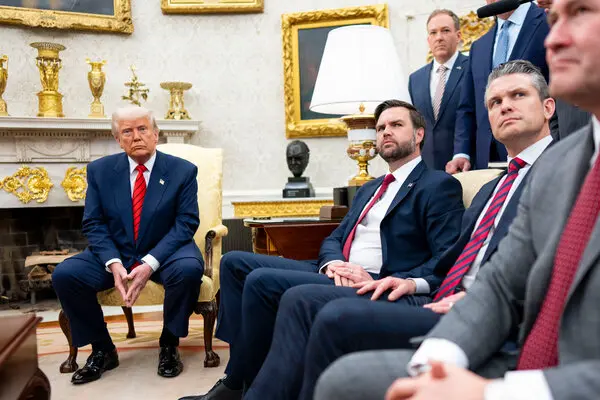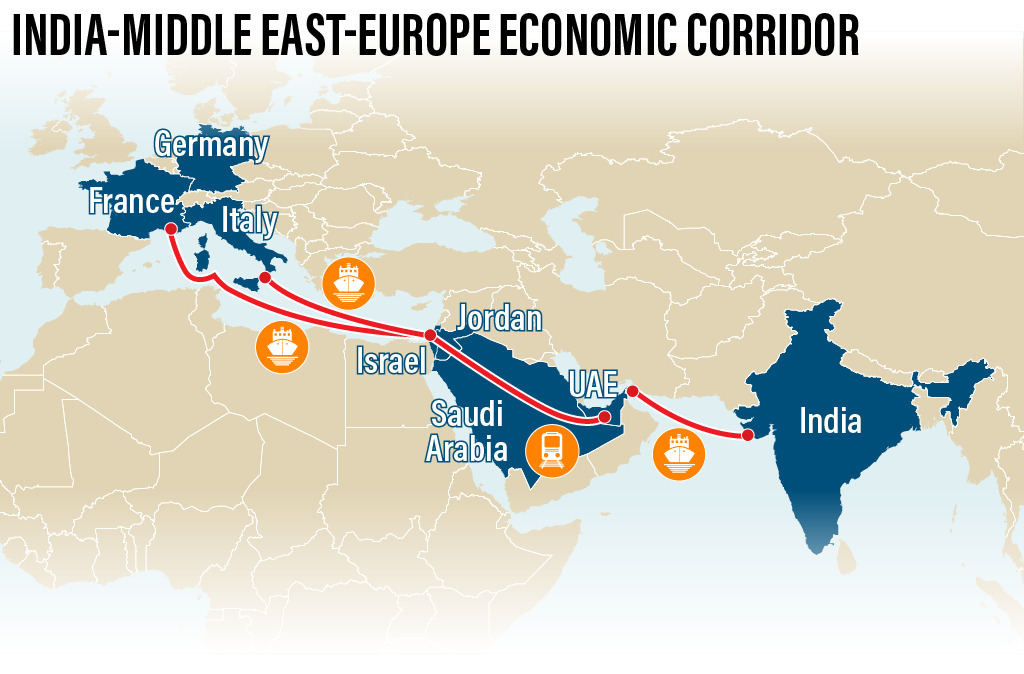
The visit of Indian Prime Minister Narendra Modi to Washington the day before yesterday and his meeting with Donald Trump confirmed the latter’s strong support for the international trade corridor IMEC (India-Middle East-Europe Economic Corridor), which is planned to connect India and its industrial production there with Europe, via Saudi Arabia and Israel.
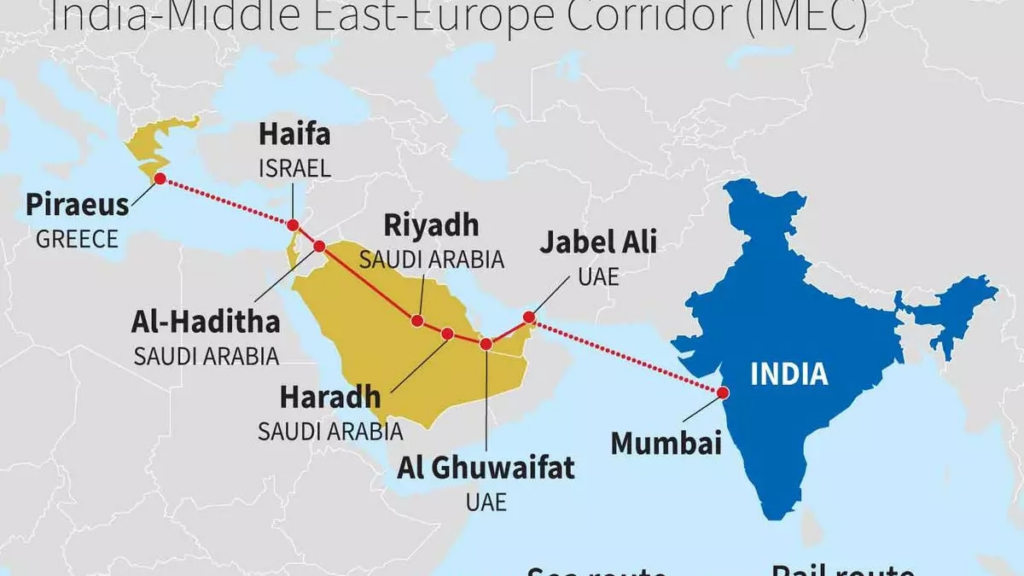
This route will compete with China’s “Silk Road” to Europe, and shows the serious international competition that exists for the fastest and with as few “choke points” as possible commercial communication. Thus, IMEC is planned to start from India, arrive by commercial ships in Saudi Arabia, there to begin a rail connection with Jordan and arrive at the port of Haifa in Israel, bypassing the Red Sea and Suez. In fact, this corridor would also have an energy section, with the transport of electricity and data, as well as hydrogen (and natural gas), alongside the railway section.
The second – now maritime – section will start from Haifa, with commercial ships to Europe, where the main point of arrival and then transit-distribution throughout the continent was very critical. Thus, when in September 2023 at the G20 summit in India, the relevant memorandum of understanding was signed between India, the USA, the European Union, France, Italy, Germany, Saudi Arabia and the Emirates, it became clear that Greece, via Piraeus, could be one of the main points of arrival of the “Road” to Europe. In fact, a relevant reference was made in September 2024, at a meeting between Biden-bin Zayed (Sheikh of the Emirates).
But now this is moving away, as Trump, in his meeting with Modi, stated that the route would end in Italy, which was also one of the major contenders (along with France) for the relevant infrastructure. Greek participation is therefore not guaranteed for many reasons:
- Initially, from infrastructure issues, since the commercial port of Piraeus (largely operated by China), as well as the Greek railway network to Europe, are not ideal to serve such additional transit trade. Therefore, upgrade investments are needed that the Greeks must seek.
- Subsequently, the geopolitical weight of Italy-France, which were also signatories of the IMEC memorandum, is clearly much greater than that of Greece.
- Although Greece is attempting to pursue such a policy of international contacts and cooperation, it must strengthen its arguments for how it can play a significant role in global trade as well as in the energy interconnection of the East-Middle East-Western Europe.
Greece’s position could improve if it participated in global resource production, e.g.
1. by seeking to exploit hydrocarbons in the Libyan Sea and elsewhere (i.e. to have raw materials to “add” to the IMEC route),
2. by accelerating the Israel-Cyprus-Greece electrical interconnection project,
3. by reviving the EastMed project, i.e. the natural gas pipeline through Crete, which would connect the natural gas fields of Egypt, Israel, Cyprus with Europe, and so on.
While constantly projecting on the international stage that “if the routes pass through Greece, the … bogeyman of Turkey is removed-isolated” is starting to become tiresome and shows a disposition for heterodetermination and not for substantive participation.
Thus, while the possibility of Greece’s participation in IMEC and the other major Asia-Europe-America commercial-energy interconnection projects remains open (where there is literally a global rush to see which “roads” will be created first and will yield results), it is under serious investigation as to what percentage/share Greece can practically receive.
To raise the issue of defense: if a country in the Mediterranean wishes to sit at the “table of the greats” and participate seriously in their plans, it must provide, in addition to political will, infrastructure, commercial and legislative facilities, and a solid will to defend all of these. With a defined EEZ, with guaranteed rights to exploit its resources there, with a strong Navy that guarantees the integrity of trade routes and mining infrastructure, and of course with the ability and willingness for long-term planning and relevant development targeting.