



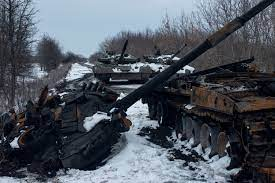
Eight months have passed since the invasion of Ukraine, and it is clear that Russia’s so-called “Special Military Operation” has failed. Moscow’s recent action to annex to the Russian Federation the areas (about 15% of Ukrainian territory) controlled by its troops demonstrates the limits of its objectives and operational capabilities.
The objectives of the Russian “Special Military Operation“
As the President of Russia Vladimir Putin had declared, the main objectives of the Special Military Operation were:
- the prevention of Ukraine’s accession to NATO,
- the protection of the Russian population residing in it and
- the “de-Nazifization” of the regime.

The Results
Against these three goals and after eight months of military operations, the results for Moscow are disappointing:
1. Ukraine has become a de facto NATO country.
On its territory, modern weapon systems have been developed, originating from various NATO states, which today are killing Russians. Its army is trained in the use of weapons and military tactics by NATO experts.
NATO satellites and electronic information systems have been placed at the service of Ukrainian forces. The US alone, since the start of hostilities, has provided Ukraine with military and economic aid of around $65 billion.
The financial aid financially supports the government of Kiev so that it can pay civil servants, pensioners and the military, buy food, fuel and other necessary supplies to continue the war. Essentially it is a conflict between Russia and NATO on Ukrainian soil.
The goal of preventing Ukraine from joining NATO so that it is not within “breathing distance” of Russia’s vital administrative, military and economic centers has failed completely.
In addition, Sweden and Finland, the latter with an extensive border with Russia, are due to join NATO. Finally the Russian invasion brought NATO closer to the Russian borders.
As the situation on the ground has evolved, Ukraine’s integration into NATO structures has accelerated. This is due to the Russian weakness, as it turned out, during operations. Inadequate forces, supply shortages and poor military planning have given and are giving NATO countries plenty of time to turn Ukraine into a “lobster”.

It took eight months of heavy fighting and a Ukrainian counteroffensive in the Kharkiv region for Moscow to realize the necessity of limited mobilization.
The Ukrainian President, after announcing the annexation to Russia of the four provinces of his country, requested the accession, with summary procedures, to NATO. Although the first reactions from the USA and Germany are cautious, this does not fundamentally change things.
Even if Ukraine de jure joins NATO, the situation on the ground will not change substantially. The war will continue with the Ukrainians seeking the liberation of their territories and the Russians defending the now-annexed Russian territories.
2. Russia occupied territories, in the east and south, inhabited by a majority Russian population, although a large part of the Russian population still lives in territories under Kiev’s control.
Today, Russia owns 100% of Lugansk, 60% of Donetsk, 72% of Zaporizhia and 88% of Kherson. But a large part of the Russian population still lives in territories under Kiev’s control.

These are territories west of the confrontation line, in central Ukraine and territories in the South from Nikolaev and Odessa to the border with Moldova. What will happen to these Russians? Will Moscow abandon them to their fate?
Of course, the war continues and we do not know the turn and extent it may take, but it seems that Russia, at the moment when it receives a strong Ukrainian counterattack, is limited to Dobas and the strategic defense of Crimea, securing its hinterland (Kherson ). The goal of protecting the Russian population of Ukraine has been achieved, but only partially.
3. The Russian invasion has hardened and strengthened the Kiev government, not weakened it as Russia had hoped.
“De-Nazification” cannot be achieved as long as President Zelensky, his government and the entire state apparatus remain in place.
On the contrary, the war with the Russians, with its tragic human and material losses, strengthens the patriotism, cohesion and determination of the Ukrainians. The Russian goal of “de-Nazification” has completely failed.
By the time Russia “crosses the Rubicon” on February 24, 2022, it should have known that it will either win or lose. A partial – limited victory will equal defeat. If Russia does not want to be defeated, it must control, not necessarily occupy, all of Ukraine. Even if a western province remains under the control of the Zelensky government, the war will continue, with ample western aid being provided to keep Russia “bleeding”.

What can we expect from the developments?
Moscow’s weakness on the ground so far diminishes its prestige and credibility as a great power. Its armed forces are unable to defeat the smaller Ukrainian army and even receive painful counterattacks forcing them to retreat (eg Liman). Even politicians and parties in Europe who saw Russia as a pole of confrontation against the forces of globalization are now keeping their distance.
Everyone condemns the annexation of the four Ukrainian provinces which seems to have been done hastily to change the impression of the weakness and incompetence shown by the Russians on the ground. Turkey also hypocritically condemned the annexation.
Of course, the war is not over. Everything, even the West’s economic sanctions, depends on future developments on the ground. But Russia has already lost valuable time.
“Everything is recovered except time” Napoleon Bonaparte.
