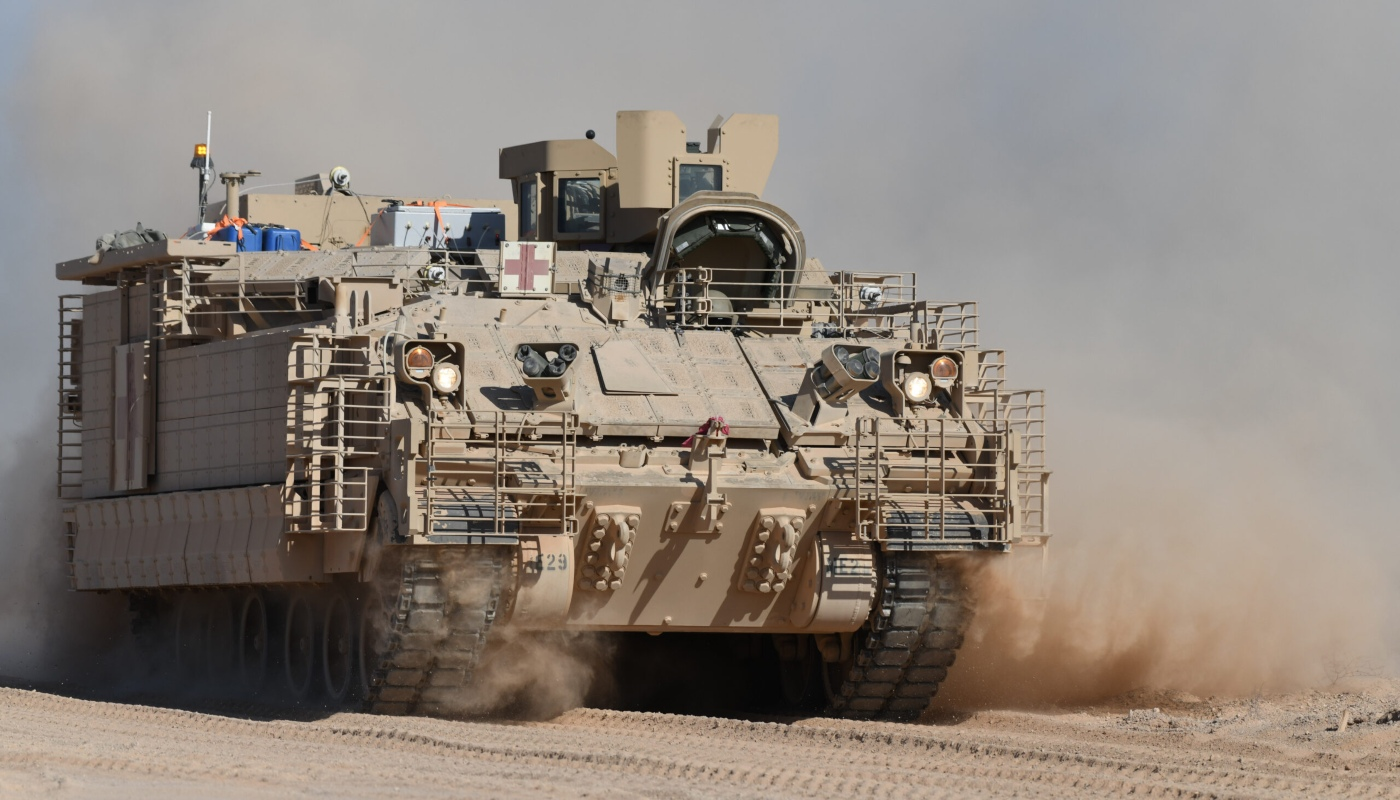
BAE Systems announced that it has begun full-rate production of the AMPV (Armored Multi-Purpose Vehicle), which is intended to replace the US Army’s M-113A3. With the start of full-rate production, it is expected to accelerate the replacement of the US M-113A3. It should be noted that the start of full-rate production was delayed due to certain technical problems that occurred during the vehicle’s tests. One of the problems encountered was the malfunction of the automatic fire extinguishing system. We recall that low-rate production of the vehicles had begun in July 2021, while the first AMPVs were delivered to the US Army in September 2022. In August 2023, the US Department of Defense announced that it was approving the start of full-rate production of the vehicles. The selection of BAE Systems and the AMPV was announced in 2014, and according to the current schedule, the US Army will receive a total of 2,907 AMPVs of various versions. The AMVP is a version of the M2 Bradley armored fighting vehicle, but without the combat turret. In addition to BAE Systems, the program was contested by General Dynamics (with a version of the Stryker, but ultimately did not submit a proposal), and Navistar Defense, with a modified version of the MaxxPro MRAP (Mine-Resistant Armor-Protected) vehicle.
It should be noted that the primary mission of the AMPV is not combat, but rather the support of the M-1 Abrams, the M2 Bradley and the Brigade in general in missions of personnel transport, general resupply, battle and field command and control, providing fire support, transporting the wounded and providing care on the battlefield. The AMPV has a very high degree of common systems with the M2 Bradley and the M-109A7, which facilitates their support. The 2,907 AMPVs that the US Army will receive will be delivered in five versions: General Purpose M-1283 GP (General Purpose), which will replace the M-113A3 (b) Trauma M-1284 MEV (Medical Evacuation Vehicle), which will replace the M-113A4 AMEV (Armored Medical Evacuation Vehicle) (c) Battlefield M-1285 MTV (Medical Treatment Vehicle), which will replace the M-577A3/A4 (d) Combat Command and Control M-1286 MCmd (Mission Command), which will replace the M-1068A3 SICPSC (Standard Integrated Command Post System Carrier) and (e) Mortar Carrier M-1287 MCV (Mortar Carrier Vehicle). which will replace the M-1064A3 MC (Mortar Carrier). The standard armament of the AMVP consists of a 12.7 mm M2 Browning machine gun, in a position protected by armored shields (perimeter) with bulletproof glass (as an interim solution, the US Army has stated that it will incorporate a remotely controlled weapon turret). Alternatively, a 5.56 mm M-249 or 7.62 mm M-240 machine gun or a 40 mm Mk.19 automatic grenade launcher can be selected.
The driver’s position is located in the front part of the vehicle and on the left. It is protected by a window with four day observation periscopes (three with a field of vision forward and one with a field of vision sideways). Next to the driver’s position is the Cummins VTA-903T diesel engine with a maximum power of 600 hp. Behind the driver’s position and the engine is the section where the soldiers are transported. The personnel compartment is elevated, in relation to the front part of the driver and the engine. This creates more interior space. In addition to the rear door, the soldiers also have a roof hatch at their disposal. The hull incorporates factory aluminum armor and additional ERA (Explosive Reactive Armor) type armor, in the front arch and on the sides. Externally, on either side of the rear entry/exit door, the vehicle incorporates armored fuel tanks. The combat weight of the vehicle depends on the version and is between 34 and 36 tons. Their common equipment includes a system of protection against radiological, biological and chemical agents, an air conditioning system, a fire extinguishing system, a night driving system, radios and an intercom system and the FBCB2 (Force XXI Battle Command Brigade and Below) combat management system. The vehicle software is also common, with the ability to manage, process and display data on the vehicle’s status, movement data, location, navigation, diagnostic test results, etc.