



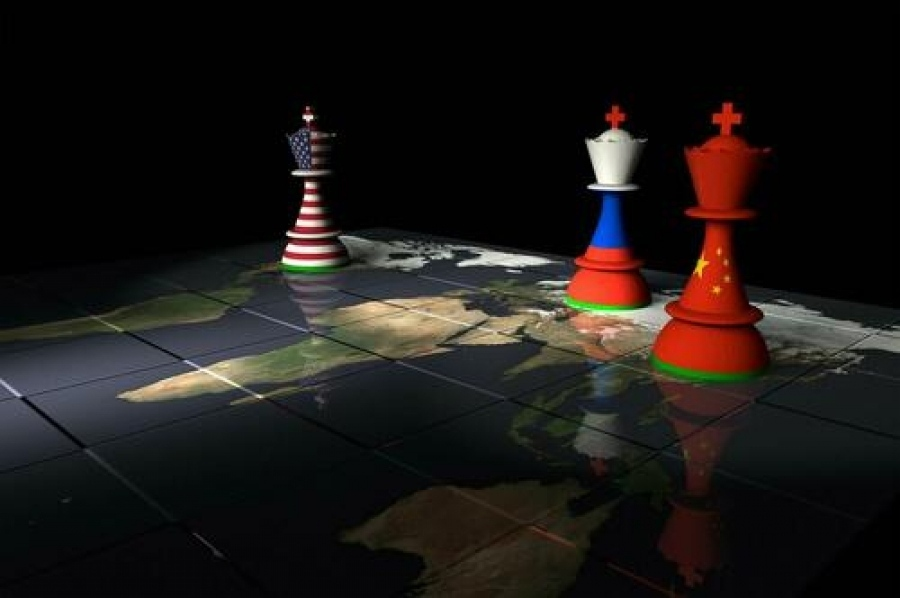
The departure of Syrian President Bassar Al Assad from power marks a defining shift in the geopolitical landscape.
The regime change reveals a well-planned power play by global actors aimed at reshaping not only Syria, but the Middle East and the world at large. The day the Syrian President fled Damascus, the planet was shaken. Syria had descended into chaos, with so many lives and resources lost.
The consequences seemed incomprehensible. However, this kind of disruption doesn’t just happen; there must be a more extensive and well-calculated plan.
The Lost Cause
For Assad and Syria, the game was over when U.S.-backed forces captured the eastern city of Raqqa in 2017. The reason Syria experienced regime change is because the United States and its allies seized the country’s oil and grain-rich wealth.
The oil fields in that region fell into the hands of the U.S.-backed SDF forces, which cut off the flow of revenue the Syrian president needed to keep his country running. Of course, Assad must have known he was almost finished, and Putin certainly did, once Syria was divided. What we are witnessing today is, for all practical purposes, “a debacle in the dark.”
The dark, of course, is a state of the United States. The point is that we are witnessing a negotiation process on a global scale. In any case, as far as Assad was concerned, the US was the guarantor of the jihadists’ security in eastern Syria through the presence of 2,000 special forces and continued air support. And although Turkey was unhappy with the situation because of the YPG Kurds, it was forced to remain neutral because of the Russian presence in the region.
However, while eastern Syria has only oil and gas, its northern part is the most productive agricultural region in the country. Combining these two facts, it is easy to see how Assad and all the other actors knew that this regime change would happen.
For those wondering why Assad’s army failed to resist, soldiers work two jobs to feed their families, which empires do not make. The retreat was inevitable. As has been said, Assad and his backers in Russia, Iran, and the region knew the upheaval was coming.
The American hegemony knew it too. But the only real question for American, Israeli, and EU leaders was how far Putin was prepared to go to support the Syrian president—until the Russian president came up with a plan from which everyone would benefit.
Putin the Smartest of All
We could analyze how the Israelis have benefited and will continue to benefit from the massacre in Syria. Greater Jerusalem is now being formed.
- Remember when ISIS was exporting oil through Turkey, heading to Israel under the supervision of US Central Command?
- Remember when Vladimir Putin showed on TV the Russian Air Force destroying 60,000 tankers and other ISIS infrastructure in the region
We may be wrong, but according to unconfirmed information, his brother Recep Tayyip Erdogan was leading the black market operation that profited from the Syrian oil stolen by ISIS and then the US military presence. What is more important today is what is going to happen, namely the deal that is coming.
Turning back to the Assad ouster, one wonders how many people found it strange that the Syrian president and his family fled to Russia after President-elect Donald Trump met with Ukrainian President Volodymyr Zelensky and French President Emmanuel Macron in Paris.
Almost at the same time that Trump called for a ceasefire in Ukraine, rebel forces led by Hayat Tahrir Al Sham (HTS), along with an umbrella group of Syrian paramilitary groups backed by Turkey, reached the heart of Damascus. Within hours, the Turks and Israelis were seizing territory and strategic positions.
The mainstream media in the West, as usual, was quick to tell us that the Putin administration had been dealt a mortal blow. The ports that the Russians “needed” on the western coast of Syria would surely fall into the American sphere of influence, along with the “new” Syria.
Now, let’s turn the page, starting with the hidden truth behind a sensational headline from The Guardian newspaper: “Elon Musk, the world’s richest man who is now central to Donald Trump’s election campaign, has been in regular contact with Vladimir Putin for the past two years, according to a US report.”
This defamatory report from company officials to the media reiterates a given: Peskov admitted that “the Kremlin had spoken with Musk once — a call in which he and Putin discussed space, as well as current and future technologies.” Let’s sit back and digest that for a moment.
Putin’s right-hand man is not hiding the truth about a call that is likely relevant to what we’re watching today. How so, you might ask? There are several reasons, but the most important one is that eastern Ukraine has one of the largest reserves of lithium and other rare earths in the world.
Okay, let’s just say that the richest man in the world who is also responsible for the efficiency of the American economy will soon secure key raw materials for Tesla and his other businesses. From our perspective, Musk has several other positions/tasks that are in the pipeline, even before Donald Trump is inaugurated.
What about Trump and his friendship with the Israeli Netanyahu?
Well, Israel will consolidate its position in the Middle East by destroying Assad’s Syria and taking as much land as possible. There is also a strategic/economic gain for the Israelis.
We must remember where much of ISIS’s black oil ended up on the market. Add to that the fact that Hezbollah and Iran will be cut off from each other, and Israel is the second biggest winner in this secret detente.
Greater Jerusalem, which has been the real goal of US diplomacy/war in the region, is just one piece missing to complete the puzzle. Tucker Carlson’s recent interview with Jeffrey Sacks is also revealing.
An important observation from this interview is the fact that Netanyahu and his American collaborators engineered the Arab Spring, or the 7 wars in 5 years that General Wesley Clark reported on TV. Sacks says that Syria and other moves on behalf of Israel began 30 years ago, but former President Obama has been the central figure in the military efforts since Afghanistan and Iraq.
And Russia gets what? Israel and Turkey get the biggest share of Syria and all those benefits, while Russia gets about a third of what is now Ukraine and gas valves open to Europe.
You see, what Putin has always wanted was to make his people richer by exporting gas, oil and other resources to an energy-hungry, resource-poor Europe. Russia is bypassing sanctions and blowing up pipelines, putting the EU in a difficult position, but the plan is to open those pipelines and allow Iran to trade oil and gas with China and South Asia.
The Iranian people will prosper, exporting more and spending less on war. You see, Putin sees the world as a flawless machine (possibly), with every part playing an integral role.
I think Musk and a few others see it that way too. Does it make sense to ship something that could be produced next door, 9,000 miles away to a reliable customer? Or does an optimized network of productive people and countries make more sense?
Bankers Get Involved
But what do BlackRock and the European bankers who started this whole mess stand to gain? The Russians will certainly take more territory in Ukraine before the “deal” is done (about 30 square kilometers a day as we write this), but when relations are normalized the world’s biggest banks will have the opportunity to rebuild and seize what’s left of Ukraine.
They will also gain offshore gas fields and innovative energy investments. Maybe Musk discussed this with Putin too? Who knows? What it seems is that someone is looking at this whole “globalization” situation from a broader perspective.
Take a look at the geography. See how far it is from China to Germany or Cairo, for example. The Belt and Road Initiative is a viable regional transportation route, but the world cannot afford it.
What if Russia and other neighboring countries develop sufficiently to replace the US and Europe in trade for this new order of nations?
What if “distance” and “cost” are considered, and globalization is rethought?
Musk is said to have already proposed changes to the US economy to save $1 trillion. How much good could that amount do for America’s faltering infrastructure?
Americans would also gain a lot from the end of these wars and from a new multipolar order, something that is not revealed to the average American because the bankers wanted the status quo.
Now they must think about Plan B
Europe will make cars, cheeses, olive oils, fashion, perfumes, and some motor vehicles, but it also serves as a tourist destination and consumer market. Europeans are better off, thanks to a friendly Russia, cheap gas, and the fact that they are shedding the burden of NATO.
Imagine Russia expanding its industrial base to supply products that might be even cheaper than Chinese ones. Or the Middle East and Africa, which are geographically closer?
Suppose Trump intends to make America more self-sufficient and isolated. How much better off would North and South America be if globalization were more sensibly compartmentalized? Instead of sending gas to Europe, what if Americans used their own gas?
Maybe people like Musk and Putin see this. And if they see it, then surely the old liberal class sees it too. Two questions remain.
- First, are we seeing the formation of the first political supermarket for world peace?
- How will the big pie be organized? Perhaps this is what is meant by a multipolar world.

