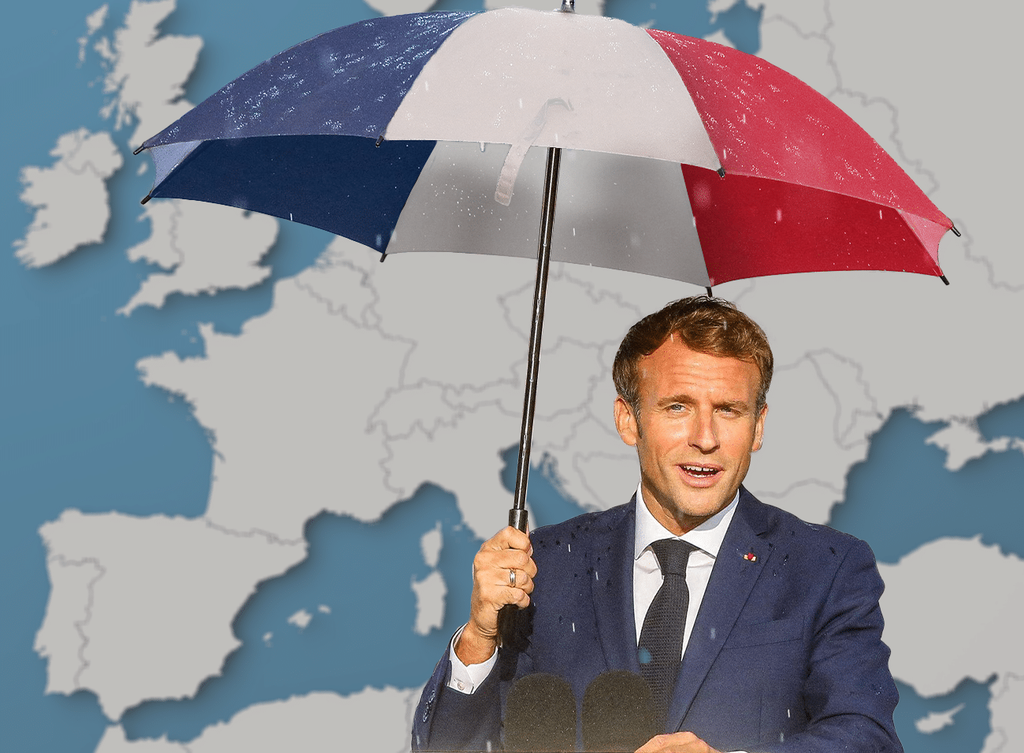
The whole narrative of the “imminent Russian invasion” of Ukraine concerns the reunification of European states in the discipline of the North Atlantic bloc. Emmanuel Macron, in an extremely candid interview with a French newspaper, drew attention to the main structural problems facing the EU: He blamed the fact that the Council of the EU (and other EU countries) had vetoed the previous Franco-German proposal for a Russia-EU summit.
The consequences of this omission, he said clearly, were that “others” were talking to the Russians on behalf of the EU. It is not difficult to assume that it implies US “interests” (either directly or through the NATO bloc). Rather, some Western European leaders have been slow to realize that the whole narrative of the “imminent Russian invasion” of Ukraine concerns the reunification of European states in the discipline of the North Atlantic bloc. French President Emmanuel Macron said in a statement to a Moscow news conference that he understood that silence at this critical juncture could determine Europe for decades to come – leaving it without autonomy.
Emmanuel Macron has explicitly said that new security arrangements are urgently needed in Europe, which clearly signals a “new” agreement outside NATO. He also strongly opposed Washington’s statement, saying he did not believe Russia intended to invade Ukraine, adding that mistakes had been made in NATO expansion.
From his comments, he seems to understand that the crisis in Ukraine – although it poses serious risks of war within Europe – is paradoxically not at the heart of Western Europe’s fears.
Remarkably, China says the same thing explicitly: The authoritative Global Times in a headline warns that the United States is inciting conflict in Ukraine to strengthen the bloc’s discipline – to lure European states back into the US-led bloc. Undoubtedly, China makes the connection that Ukraine provides the perfect axis for leading Europe to the next stage of American hegemony, which requires a united front with the US for the subsequent work of blocking China beyond its borders.
At stake, therefore, are key decisions that will determine Europe in the future. On the one hand, (as Pepe Escobar noted about two years ago), “the goal of Russian and Chinese policy is to recruit Germany into a triple alliance, the largest geopolitical alliance in history that inevitably leads to a change in the world.” force in favor of these three great powers and against Anglo-Saxon naval supremacy “.
On the other hand, NATO was conceived, from the beginning, as a means of Anglo-American control in Europe and more specifically to keep Germany “down” and Russia “outside”. Lord Hastings (Lionel Ismay), the first Secretary General of NATO, famously said that NATO was created to “keep the Soviet Union out, the Americans inside and the Germans down.”
This mentality remains, but the formula has now gained more momentum and a new twist: Keeping Germany “low and prices uncompetitive” over US products, preventing Russia from being a cheap source of energy Europe and keep China “fenced” in EU-US trade. The goal is to firmly limit Europe to America’s narrowly defined economic trajectory and to force it to relinquish the benefits of Chinese and Russian technology, finance and trade – thus helping to achieve the goal of blocking China within its borders.
The geopolitical significance of China, for the first time, intervening directly (taking a very clear and strong stance) on an issue that is central to European affairs is largely overlooked. In the long run, this suggests that China will take a more politically oriented approach to its relations with European states.
In this context, at the press conference of Biden and Olaf Solz in Washington this week, Biden literally intimidates Germany into pledging to abolish Nordstream 2 (in case Russia invades Ukraine), reflecting the fact that Washington aims to keep Germany on the leash of bloc discipline.
Emmanuel Macron’s ambition for some wider Euro-autonomy has been lost, because without the alignment of French and German policy, the “pretended sovereignty” of the EU has been eliminated. In addition, if NordStream does not move forward, the EU’s energy security will disappear. And with little real alternative supply, the EU is permanently pinned on its exact dependence on US LNG (with the possibility of crises in gas prices and at home).
The list of Emmanuel Macron’s challenges does not end here: France holds the rotating EU Presidency, but EU foreign policy requires unanimity among the Member States. Can he secure it?
US President Joe Biden needs a foreign policy achievement to campaign in the by-elections. And 63% of Americans say they would support massive sanctions on Russia if Moscow invaded Ukraine. Biden is known to believe in the saying that ultimately all politics – including foreign policy – succumbs to domestic electoral needs. Strict sanctions on Russia – with Europe acting incessantly – are simply the step that the White House is likely to take as a necessary complement to its assessments.
The most important point to understand from the Putin-Macron incident is that it gave the illusion that Moscow was somehow hoping to open negotiations with the West on minor issues, as a possible gateway to Russia’s existential concerns. Russia is open to negotiations, but only in relation to Putin’s three red lines: No NATO in Ukraine, no missiles on Russia’s border, and the resumption of NATO on the 1997 lines.
Even if the conflict freezes or ceases in the short term, it will not last longer, as the West refuses to acknowledge that Putin means what he says. This will probably only change through the experience of the parties. The West, for the time being, sits optimistic in the belief that it has an escalating advantage in applying pressure levers.
It seems reasonable to expect that this crisis will accompany us – in its various forms – for at least two years. These policy initiatives mark only the beginning of a long, high-stakes phase of a Russian effort to shift the European security architecture to a new form, which the West is currently rejecting. Russia’s goal will be to maintain pressure, even the threat of war, to harass war-hating Western leaders in making this necessary turn.