



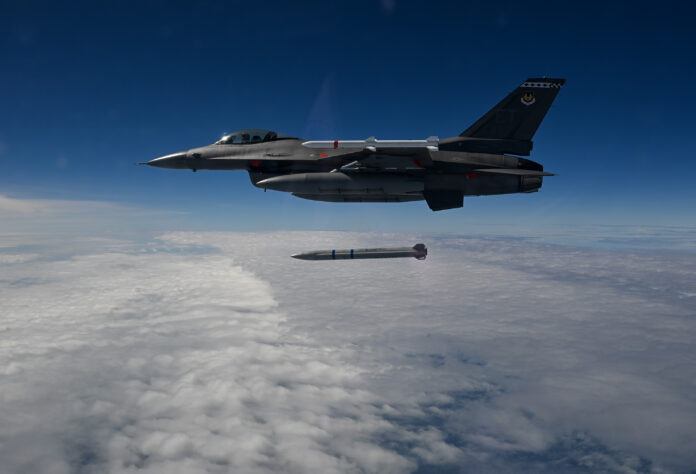
The United States Air Force (USAF) recently achieved a major milestone in the development of its new weapon, the Stand-In Attack Weapon (SiAW), with the successful first launch. The test, which took place on November 7, is a critical step toward enhancing the U.S. Air Force’s precision strike capabilities.
During the test, a SiAW air-to-surface missile was released from an F-16 Fighting Falcon fighter jet of the 40th Test Squadron over the Gulf of Mexico. The test’s objective was to confirm the missile’s safe separation from the aircraft, a key milestone for future tests. The test vehicle that was launched was essentially a “jettison test vehicle,” meaning a missile without an engine or electronics. These vehicles are used to assess whether the missile can be safely separated from the aircraft upon launch command.
SiAW is designed to engage mobile elements, enhancing the USAF’s ability to engage rapidly moving targets such as cruise missile launchers, anti-ship missile platforms, and electronic warfare systems. The test involved several units from the 96th Test Wing. Mission planning and control were conducted from Eglin Air Force Base’s control facility, while engineers monitored the missile’s departure and are currently conducting it.
The SiAW program falls under the responsibility of the U.S. Air Force’s Armaments Directorate, which is responsible for overseeing the weapon’s development and integration. The successful test paves the way for more testing, including evaluations of the missile’s propulsion and targeting systems, as the Air Force moves toward operational deployment.
The SiAW design has an open system architecture, allowing for rapid subsystem upgrades to enhance its battlefield capabilities. This capability is critical in scenarios where adversaries employ access denial/area denial (A2/AD) systems, which attempt to limit U.S. forces’ access to critical combat areas with anti-aircraft or other systems.
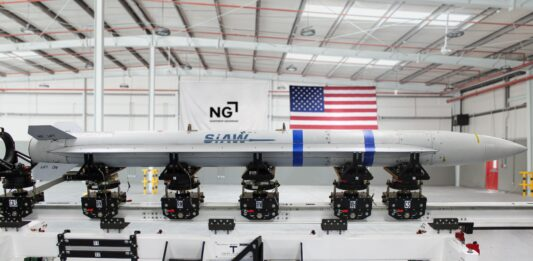
With the completion of this first test, the US Air Force is moving on to the next phase of development, which will include conducting more flight tests to validate the missile’s capabilities. These tests will include firing missiles with full guidance and propulsion systems, testing the accuracy and effectiveness of the SiAW in combat scenarios similar to those it will face in real life.
The same logic as the Israeli Rampage that the Greek Air Force is acquiring
The development of the US Air Force’s Stand-In Attack Weapon (SiAW) comes at a time when weapons such as the Rampage from the Israeli company Elbit Systems have already made their appearance and have been integrated into the air arsenals of several countries.
Rampage, originally called MARS (Multi-purpose, Air-launched Rocket System), is an air-to-surface missile developed by Israel Military Industries (IMI) and Israel Aerospace Industries (IAI). This missile is designed to neutralize high-value targets such as radars, communications centers, weapons depots and airfields, keeping the launching aircraft out of range of unserviceable defense systems. Rampage is known for its ability to fly at supersonic speeds and strike with precision, while also offering a cost-effective solution compared to other expensive systems such as Storm Shadow/SCALP-EG.
The Israeli Air Force was the first to integrate Rampage into its F-16I aircraft, with the Hellenic Air Force following suit, adding the weapon to its F-16V fleet. While SiAW and Rampage share similar goals and capabilities, there are some differences in approach and implementation. SiAW, as a newer development, focuses on a flexible architecture that allows for rapid upgrades and adaptations to future threats. This is achieved through an open systems architecture, which allows for the easy integration of new technologies such as improved guidance systems or new types of munitions.
The Rampage, while similarly versatile, has already undergone a series of tests and operations, demonstrating its reliability in real-world conditions. Its adoption by the Israeli and Greek air forces suggests that this weapon has significant value on the modern battlefield. It is likely that Israel even used Rampage during an attack on Iran.
The USAF’s development of the SiAW can be interpreted as an attempt to copy, with some delay, the success of the Rampage, but adapting it to its own strategic needs and technological priorities. The US Air Force’s approach seems to focus more on flexibility and the ability to adapt to future combat scenarios, while the choice of the Rampage by Israel and Greece indicates a preference for an already proven and reliable system.
These comparisons do not necessarily indicate a pure copycat, but rather a continuous process of redefinition and improvement of weapon systems in an effort to stay ahead of developments in warfare technology. SiAW and Rampage represent two different approaches to achieving the same goal, namely the precise and effective destruction of critical targets on modern battlefields at the lowest possible cost.
