New technologies in the Ukrainian war, and in particular the massive use of low-cost, radio-frequency or fiber-optic guided “first person view” (FPV) drones, which made the operational area transparent and exponentially multiplied the firepower of each fighter, led to the linear confrontation of World War I, about 110 years ago.
The prohibitive losses practically abolished maneuver and brought back the focus on defensive organization projects, which, however, are not a panacea and therefore the golden mean is sought. Over time, the significant importance of fortifications for the defender in war has been recognized. The Metaxa Line, the French Maginot Line, the Finnish Mannerheim Line, the Russian Stalin Line, the German West Wall (Siegfried Line) and Atlantic Wall, and the Israeli Bar Lev Line are examples of fortifications of high symbolic value, which in the last century have played a key role, negative or positive, in the outcome of operations.
The great importance of fortifications was reaffirmed on the battlefield and during the war in Ukraine, which is now in its 41st month. The Ukrainian counteroffensive of 2023 failed not only due to a lack of main weapons systems (tanks, armored vehicles and combat artillery) that the West was transferring by the dropper due to a lack of reserves and ammunition (especially 155 mm artillery). But also because it “collided” with the total length of 6,000 kilometers of Russian defense organization projects (in the regions of Crimea, Kherson, Zaporizhia, Donetsk, Lugansk and Kharkiv) and the total of 170,000 square kilometers of mined territory (including Ukrainian minefields developed in Donbas).
Today, mainly due to the defense organization projects, the numerically inferior Ukrainian forces face the continuous, “creeping” Russian advance, almost exclusively with infantry or motorcycle-mounted company-level or motorized vehicles of the Ulam level, and the massive use by the two opponents of radio-frequency or fiber-optic guided FPV MEAs. In practice, both opponents literally dig for cover underground, knowing that once they are detected, they will be attacked by the deadly MEA FPV.
The importance of the defensive organization works is also highlighted by the fact that the maintenance of Ukrainian sovereignty over approximately 30% of the territory of the Donetsk region is achieved through the 50 km long “fortress zone” (see attached map) which includes four large cities, several smaller ones and many villages and camps where defensive organization works have been carried out.
The “fortress zone” has a general direction from south to north, parallel to the H-20 Kostyantynivka – Slavyansk highway. Its construction began in April 2014, when Ukrainian forces recaptured the cities of Slavyansk, Kramatorsk, Druzhkivka and Kostyantynivka from the Russian-speaking separatists of Donetsk. For the next 11 years, Ukraine spent significant financial and human resources on the defense organization of the “fortress zone”, within which very important industrial and defense infrastructures are located that allow the support of the Ukrainian forces operating in the Donetsk region.
Currently, Russian forces are attempting to overtake the “fortress zone” from the southwest and occupy it, an objective that, according to the estimates of the Institute for the Study of War (ISW), will probably require several years to achieve.
European “epidemic” of defense organization
Based on the above, it is not surprising that in the last month several countries have made announcements, more or less ambitious, for the execution of defense organization projects. The dance of announcements was “led” by the Minister of National Defense of Greece, Nikos Dendias, who on July 24, 2025, during the presentation of the second phase of Agenda 2030, announced the reinforcement of organized positions in Thrace and the Aegean islands.
Specifically. the modernization of existing fortification structures (see attached slide) and the construction of 207 new projects in mainland Greece and 315 new projects in island Greece, with a budget of 65 million euros and a horizon of completion of 100% of the projects within three years.
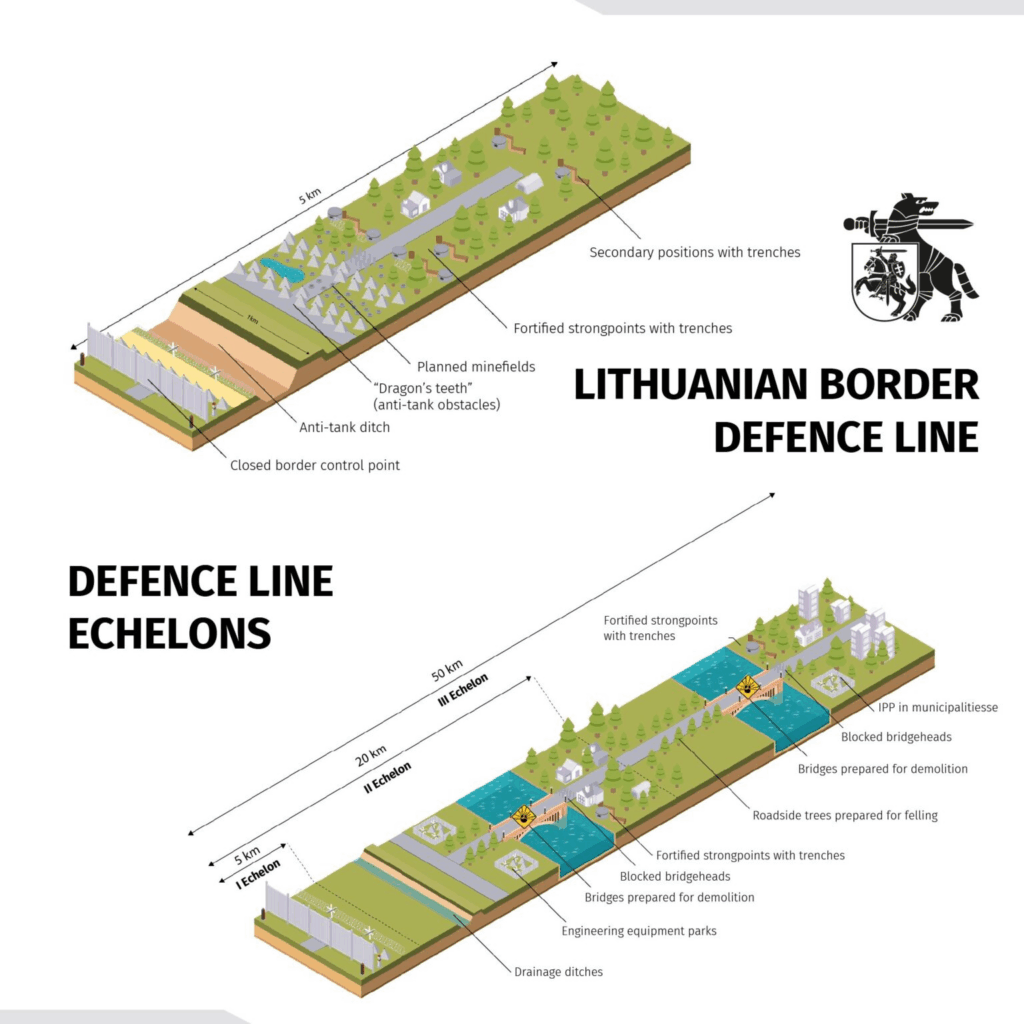
The Lithuanian Ministry of Defense followed suit, announcing on August 14 its intention to create a multilayered zone (see attached diagram) of organized defensive positions 50 km deep to defend the small Baltic country’s border.
On the same date, the Finnish Ministry of Defense posted the first video presentation of the T3RKV fortification project online. According to the Finnish colonel presenting the video, the country has a network of defense organization projects that began construction in 2016 in collaboration with industry, but after the lessons of the Ukraine war, they require an increase in the level of protection and functionality.

Points of concern
Based on the indications so far, countries, like ours, with an unfavorable power correlation in relation to the adversary, appear to consider defense organization projects as an extremely attractive and economically feasible solution to the problems of the current battlefield. However, as has been demonstrated in almost all the “lines” mentioned at the beginning of the analysis, it is possible to overwhelm or disrupt them.
It should also not be overlooked that the operational space is transparent even in peacetime and consequently the defense organization projects being carried out during this period are identified, recorded and targeted by the adversary. For this very reason, prefabricated defense organization projects that can be placed in excavations wherever and whenever required are an option that must be evaluated.
Also, the planning must take into account that the design evolution of defensive organization projects is dynamic. Due to the change in Russian tactics, the Ukrainian model of defensive organization projects at the battalion level with company-level support points and connecting trenches for communication between them, 2 to 5 km long, now includes smaller support points with connecting communication trenches 60 to 70 meters long, under the cover of anti-drone (C-UAS) systems.
Finally, as in the case of obstacles, the effectiveness of defensive organization projects requires their coverage by fire in combination with the existence of sufficient forces, while like obstacles they create burdens for the defender.