

The evolution of technology and in particular computers and robotics is expected to be the next revolution in military affairs (Revolution in Military Affairs). The continuous evolution of the computing power of computers, the development of neural networks and the continuous improvement of AI (Artificial Intelligence) contribute to this. A development that has accelerated since all the above systems have moved to the civil sector in most applications and there are companies that develop various types of software and hardware. Systems that have the ability to collect information in real time (Real time data acquisition) and through AI and Machine Learning to offer the operator that information or alerts that will help make the right choice, as another information center battle.
The first robotic systems with remote control slowly made their appearance in the 1990s with the well-known UAVs and UCAVs in the air force while at the same time various systems were under development for the ground army. The naval sector could not be missing from this development, where as we will see below, the development of weapons, technology and artificial intelligence seems to bring several changes to the equipment and the way the navy fights in the future.
Last June, RINA’s annual marine technology conference, “Warship 2024” took place in Australia, where a multitude of organizations, universities, design offices and officers presented their thoughts and technological developments on the design of future warships. One of the main modules was the evolution of robotic systems and how this affects future ship designs.
MOSHIPS (Mother SHIPS)
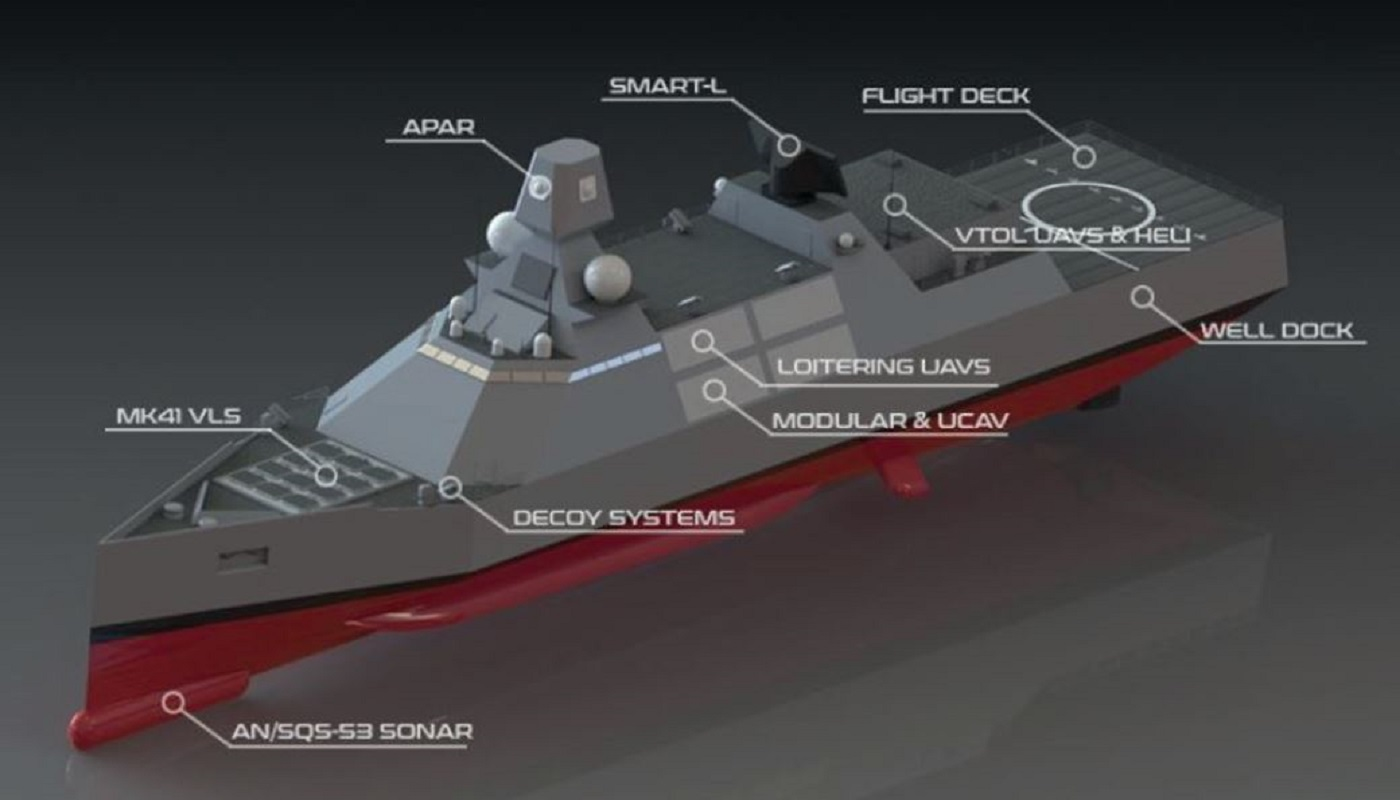
The Lisbon polytechnic has developed a design concept for the design and development of drone carrier and launch vessels in response to the increasing use of USVs by various navies. The goal of the entire study was to develop innovative warship concepts and design tools for the design of new generation surface ships. A conceptual design process was developed for a dedicated drone carrier, with multiple roles and requirements comparable to modern NATO navies.
This conceptual design process included a review of surface warship preliminary design methodologies and the development of a concept of operations for drone carriers, along with the definition of operational requirements, the development of a ship composition model and the development of two ship concepts for different NATO users . The overall objective was to design a naval asset capable of deploying large numbers of unmanned sea, underwater and air units – while operating outside of a conventional group of ships.
The final vessels designed, when detailed and analyzed, were found to merge various features from modern surface ships such as frigates, destroyers, cruisers and conventional aircraft carriers. The operational potential of these ships will be particularly high and at the same time extremely flexible.
A hybrid ship was designed which had all the electronic systems and weapons for self-defense and at the same time the transport and launch areas, UAV, UCAV, USV, UUV and loitering munitions. Although the design is currently nothing more than a concept, a ship with these capabilities could dominate coastal waters where drones would give it multiple operational capabilities in air, land and sea.
Going a step further, such a ship could also exist from a conversion of an older frigate or a civilian ship which would operate in conjunction with and protect friendly warships while providing multiple reconnaissance, targeting and target engagement services.
Let us recall that similar programs with an exclusive mine hunting role are underway for the navies of Great Britain, the Netherlands and Belgium, where motherships will launch USVs with the main mission of finding and neutralizing mines.

The Mate Ship like Loyal Wingman
It has been observed that many navies due to lack of personnel and also financial difficulties cannot have available the units they need to meet the operational needs. This practically means that they cannot have all the weapons they need available at all times.
The solution according to the study is the adoption of a Mate Ship which will have the ability to follow the main unit and carry a sufficient load of weapons at high speed and over long distances. This study was done in Australia and is in contrast to the current LOSV (Large Optionally-crewed Surface Vessel) program with which the Australian navy is trying to counter the problem of crew shortages and the increase of future threats.
The proposal is for a larger capacity LUSV (Large Uncrewed Surface Vessel) based on the Spearhead class, a high-speed trimaran to mount a 64-seat Mk41 VLS launcher. A ship with air, land, sea and submarine attack capability with weapons such as ESSM, SM-2, SM-6, ASROC and Tomahawk. Such a selection, for example, as a ‘Mate Ship’ would more than double the carrying capacity of an Australian Navy HMAS HOBART-class Anti-Aircraft Warfare Destroyer.
Robotic systems are here and here to stay. The rapid development of computer processing speed and AI will help to develop systems capable of carrying out complex and more difficult missions. At the same time, these systems will be the first to be sent on high-risk missions where the loss of human life will involve greater costs. Finally, they will come to cover the gap created by the lack of resources and human resources, but also to replace the high cost manned systems. This development leads, of course, with mathematical precision to a shrinking of the armed forces on a global scale where a smaller number of highly trained military auxiliaries with robotic systems will conduct the wars of the future.