



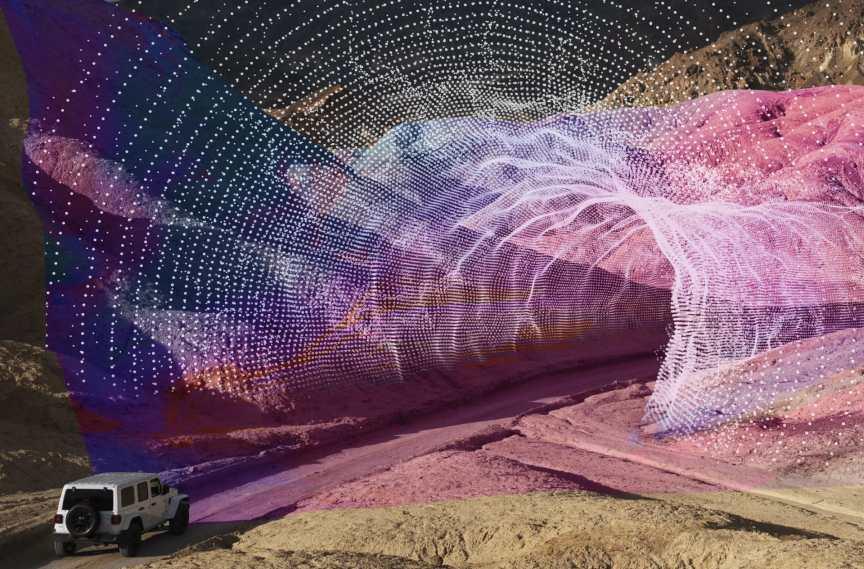
Distance Technologies, a Finnish startup aiming to bring mixed reality technology to every car windshield or airplane cockpit, has raised 10 million euros from GV, the venture capital arm of Google parent Alphabet.
The funds are critical to the development of technology that it says can turn any transparent surface into an augmented reality display, allowing the user to see 3D digital objects superimposed on top of the viewing surface.
This avoids the use of other products such as a mixed reality headset or augmented reality glasses, which require the user to see 3D digital objects overlaid on top of the viewing surface.
How does it work?
Distance’s system uses tracking technology that determines where the user is looking and then calculates the correct light field to match the objects it projects onto the surface to the user’s exact eye positions.
It’s a set of optical layers on top of most liquid crystal displays (LCDs), which allow its technology to project an image to the points your eyes focus on.
It’s a set of optical layers on top of most liquid crystal displays (LCDs) that allow Distance’s technology to beam an image to where your eyes focus.
Using this technique, the Finnish startup can separate the light fields while creating an additional optical layer capable of creating high brightness.
Distance says its system is capable of “infinite” depth meaning it can create a life-size field of view in any environment whether behind the wheel of a car or in the cockpit of an F-18 fighter jet.
The extra feature
Augmented reality displays, or HUDs, are not new to the automotive industry. Companies have been working to add AR features to cars for several years, with tech giant Huawei being one of the first to pioneer the technology in China.
Several other display technology companies are developing their own AR HUDs for cars, including First International Computer, Spectralics, Envisics, Futurus, CY Vision, Raythink, Denso, Bosch, Continental and Panasonic.
According to Distance Technologies’ head of marketing, the company’s system can cover the entire surface of any transparent surface, not just a specific corner or the bottom half of the screen – a limitation faced by most automotive AR HUDs today.

