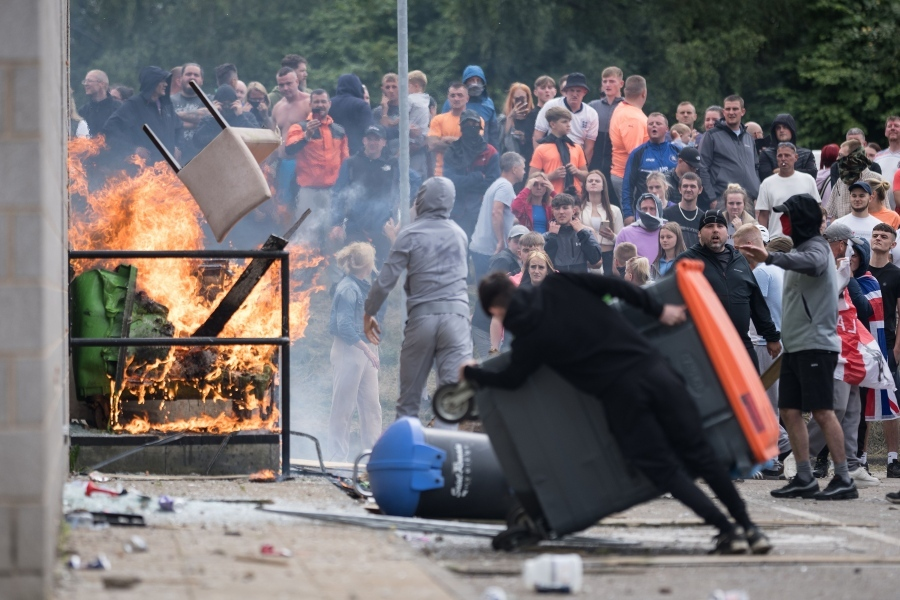
For the disturbances of the last six days shaking the western “prosperity” of the United Kingdom, the media and especially the systemic ones, “show” the extreme right, an easy target for all insurgencies.
While incitement through various social media accounts has certainly played a role, the real problem that fills Britain’s citizens with rage is known by most but few want to highlight it: poverty, immigrant indecency, woke paranoia.
The murder of little girls in Southport was the final straw
The British people have been remarkably patient with successive governments imposing a great wave of mass immigration on the country, without the slightest democratic mandate or any good or properly explained reason. 17.4 million people – the largest democratic mandate in UK electoral history – voted for Brexit, which was a very clear directive to the political elite to take control of the country’s borders and stop the country from uninvitedly turning into foreign place. Unfortunately, the political class ignored this warning and did not accept the people’s verdict, the murders in Southport would either not have happened at all (because the killer and his family would have been sent back to the now completely peaceful and safe Rwanda) or seen as a heinous crime that should only be dealt with by the police and the courts.
They have failed to deliver secure borders and have only increased their contempt for ordinary Britons – especially the white working class. It is this, along with an endless litany of policing and criminal justice, that make Britons feel like second-class citizens in their own country. Frustration and anger over it had turned large parts of the country into a powder keg, just waiting for a spark that was provided with the gruesome murder of the three little girls.
The intolerance of citizens and the poverty of children
So-called “absolute poverty” in Great Britain has now reached its highest level in 30 years, with 14.3 million people living in poverty.
At the same time, the number of children living in poverty in the UK has reached an unprecedented level for the first time in at least 20 years.
According to official figures released by the Ministry of Labor, 4.3 million children live in low-income households. The previous record was set in 2020, when 4.28 million children lived in households with an income below 60% of the median -£545 a week. More generally, 21% of the population was in poverty, i.e. 14.3 million people.
The UK also emerged as the second most miserable place in the world for citizens, according to a ‘Mental State of the Year report’ on mental health by NGO Sapien Labs.
In fact, only Uzbekistan ranks lower than the UK on this global index of mental well-being.
The non-profit organization looked at the results from 500,000 respondents, from 71 countries, on how people’s internal state “affects their ability to function in the context of their lives”. The think tank then compared the countries by giving them a score. Scores below 0 represent distress or distress, scores between 0 and 50 mean resilience, 50-100 mean management, and 100 to 200 mean success or well-being. Britain scored a dismal 49 overall, while the average across all countries was 65.
It was also a close tie between the UK and South Africa as to who had the highest proportion of respondents struggling or struggling (35%).
Despite being a developed country with one of the world’s largest economies, Britons are still more miserable than those living through intense humanitarian disasters (such as those in Yemen). In some ways, the results are not surprising. Besides, the country’s National Statistics Office found that overall personal well-being across the country fell last year.
The country, in addition to the always cloudy weather, is in the midst of high inflation, overpriced housing, post-pandemic, and is now also the informal capital of political correctness and woke culture.